5.1 Rates Equilibrium And pH
No description yet. This curated deck is ready for daily study.
Card preview (24)
What is rate of reaction?
-is the change in concentration of a reactant or product per unit time
The ____________ with respect to a reactant is the power to which the concentration of the reactant is raised in a rate equation
ORDER
What is the rate constant?
-the rate constant (k) -is the constant that links the rate of reaction with the concentration of the reactants raised to the powers of their orders in the rate equation
What is the rate equation?
-the rate equation for a reaction A+B—> C is given by : Rate=k[A]^m [B]^n -where m is the order of reaction with respect to A and n is the order of reaction with respect to B
What is the overall order of a reaction?
-the sum of the individual orders -m+n
What is the equation for rate of reaction?
Rate of reaction(moldm^-3s^-1). = change in concentration of reactant or product ————————————————————————— Time
What is zero order?
-if the order is 0 with respect to reactant A ,then: rate ∝[A]^0 -the rate is unaffected by changing the concentration of A -remember any number to the power of 0 is equal to 1
What does the symbol ∝ mean?
-proportional
What is first order?
-if the order is 1 with respect to a reactant A, then: rate ∝ [A]^1 -the rate is DIRECTLY PROPORTIONAL to the concentration ->if [A] increases by 2 times the rate also increases by 2 times -> if [A] increases by 3 times the rate also increases by 3 times
What is second order?
-if the order is 2 with respect to a reactant A then : rate ∝[A]^2 -the change in rate will be equal to the change in concentration squared ->if [A] increases by 2 times the rate increases by 2^2=4 times ->if [A] increases by 3 times the rate increases by 3^2=9 times
What is the rate equation?
Rate=k[A]^x[B]^y[C]^z -k=rate constant -A-concentration of reactant A -B-concentration of reactant B -C-concentration of reactant C -x,y,z-orders of reaction for each reactant
What is half-life?
-the half-life of a reactant is the time taken for the concentration of the reactant to reduce by half
What order does this rate-concentration graph show?
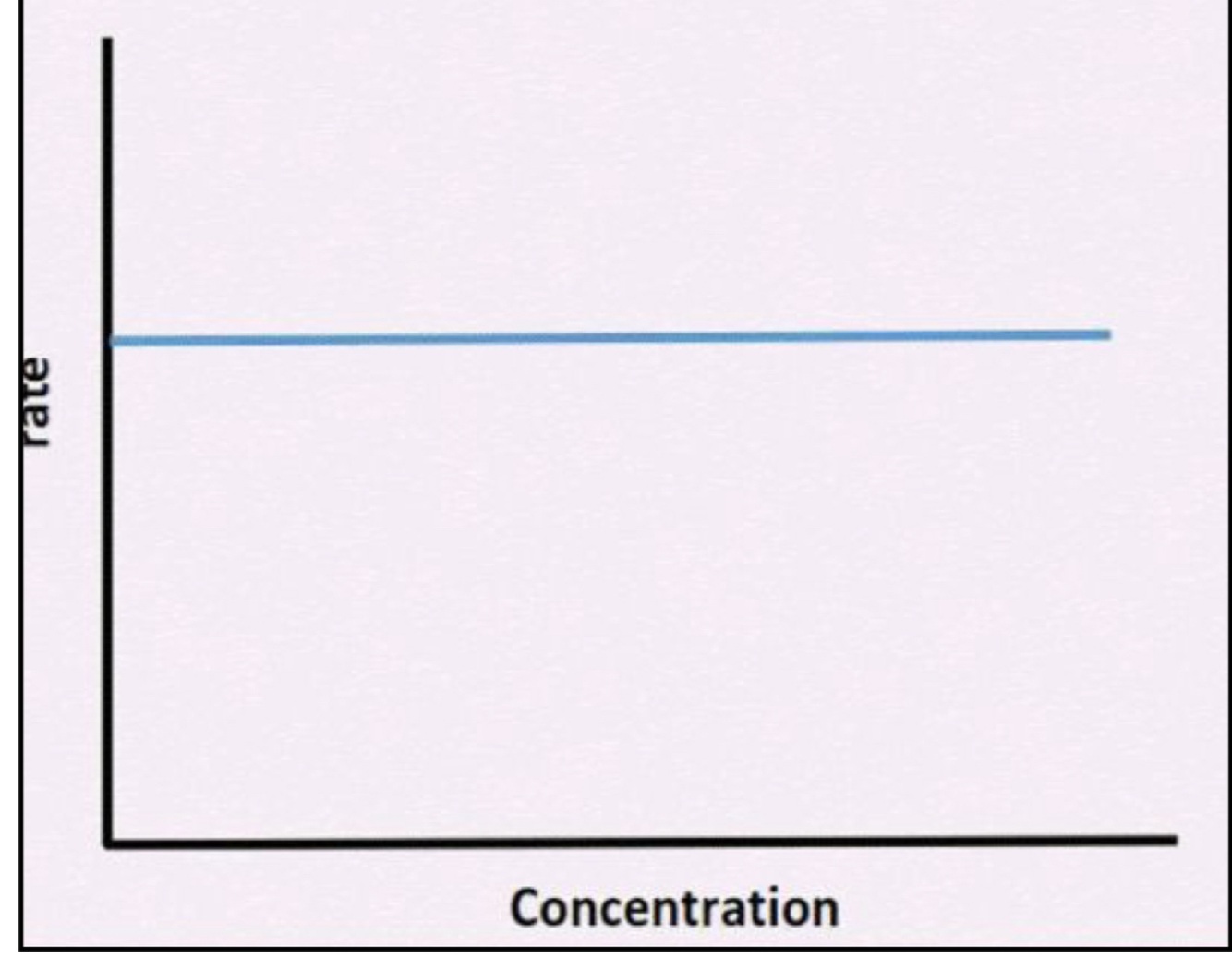
-zero order -changes in concentration of this reactant have no effect on the rate -this is shown on a rate-concentration graph as a horizontal line - rate ∝ [A]^0
What order does this rate-concentration graph show?
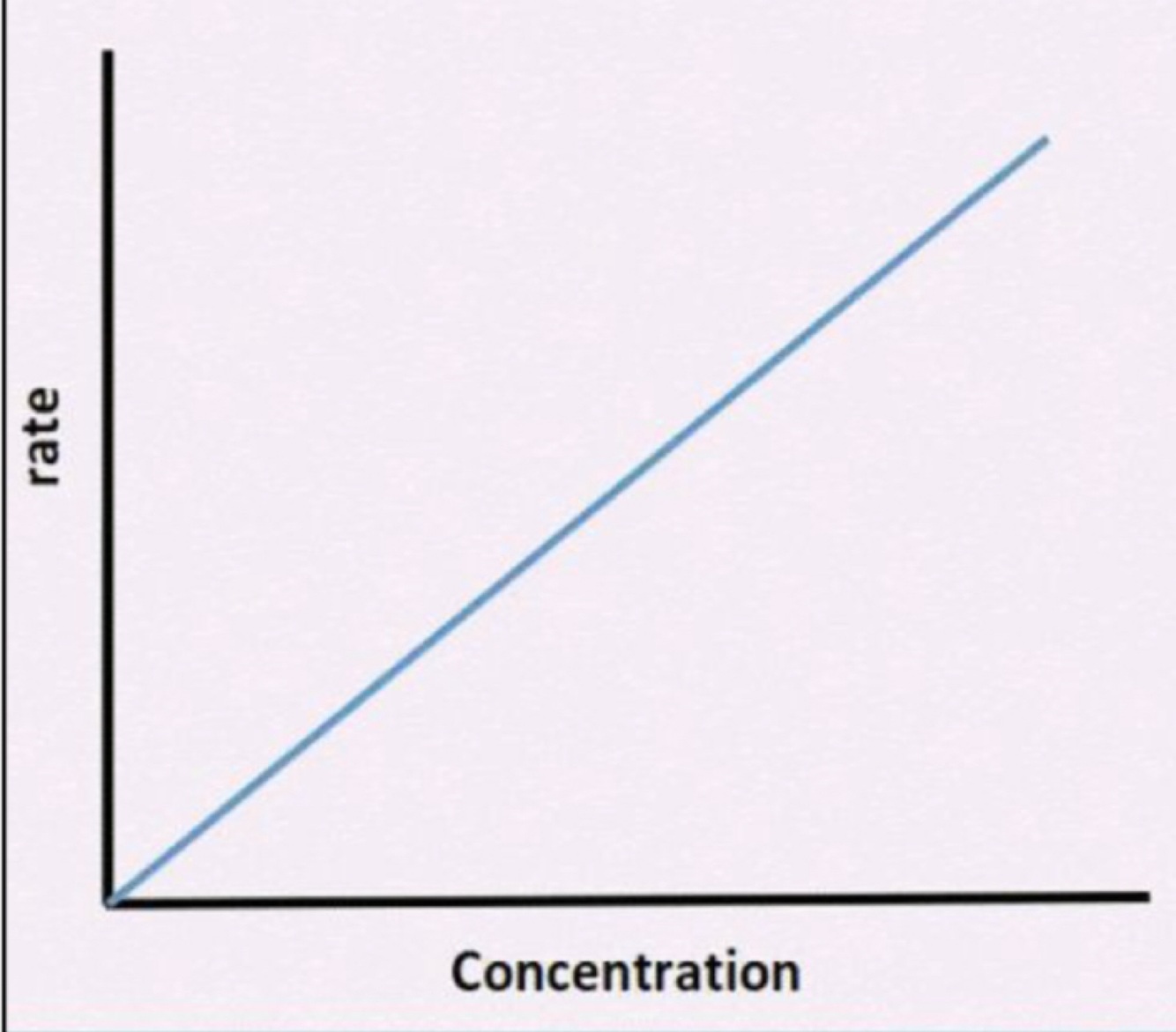
-first order -the concentration of the reactant and rate are directly proportional -doubling the concentration doubles the rate -this graph shows that rate ∝ [B]^1
What order does this rate-concentration graph show?
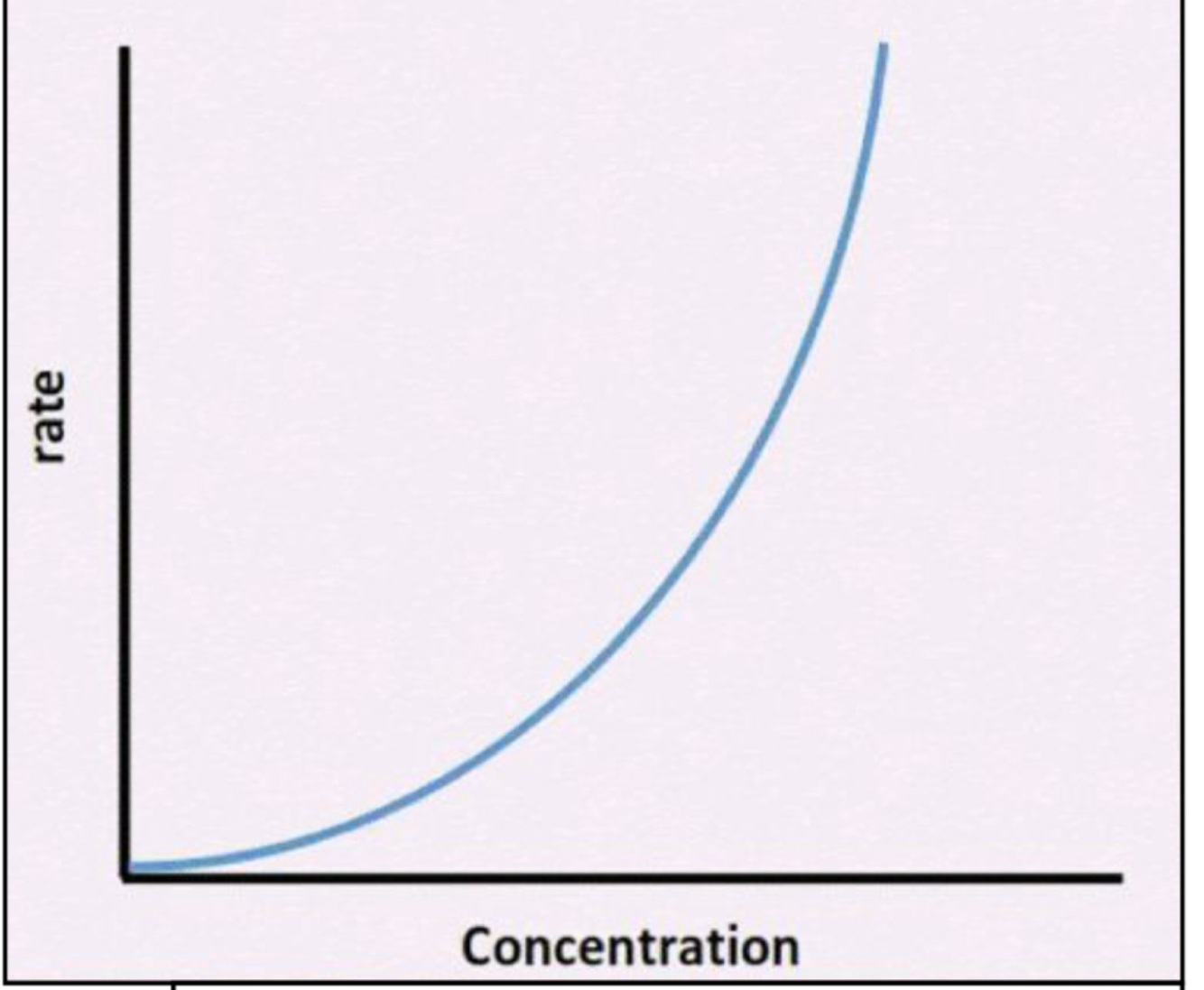
-second order -the rate is proportional to the concentration of the reactant squared -if the concentration of the reactant is tripled the rate will be increased by 3^2 -the graph shows that the rate ∝ [C]^2
How can you determine the rate constant for a first order reaction rate-concentration graph?
-calculate the gradient -gradient= change in y / change in x
It is a mathematical convention that ____________ ___________ are written first. When there is more than one unit with the same sign they are written __________
-positive indices -alphabetically
What are some experimental techniques to obtain rate data for a reaction to be plotted on a concentration - time graph?
-for reactions involving acids or bases, you can measure- .pH changes by carrying out titrations .pH changes by using a pH meter -for reactions that produce gases, you can measure- .the change in volume or pressure .the loss in mass of reactants -for reactions that produce visual changes (usually monitored by using a colorimeter) you can observe- .the formation of a precipitate .a colour change
What is colorimetry?
-Colorimetry can be used to determine the rate of reaction for a reaction that involves the formation or depletion of a coloured species. -A colorimeter is a device that measures the amount of light that is absorbed by a solution. -The amount of light absorbed by the solution is proportional to the concentration of the coloured species. -In a colorimetry experiment, a calibration curve is often generated. -This involves using a colorimeter to measure the absorbance of solutions of known concentrations, from which a calibration curve is plotted. -Then, throughout the experiment, the absorbance of samples from the reaction mixture can be measured and the calibration curve used to convert the absorbance readings into concentration values. A concentration-time graph can then be plotted.
Concentration-time graphs can be plotted from ______________ measurements taken during the course of a reaction (_______________ monitoring)
-continuous -continuous
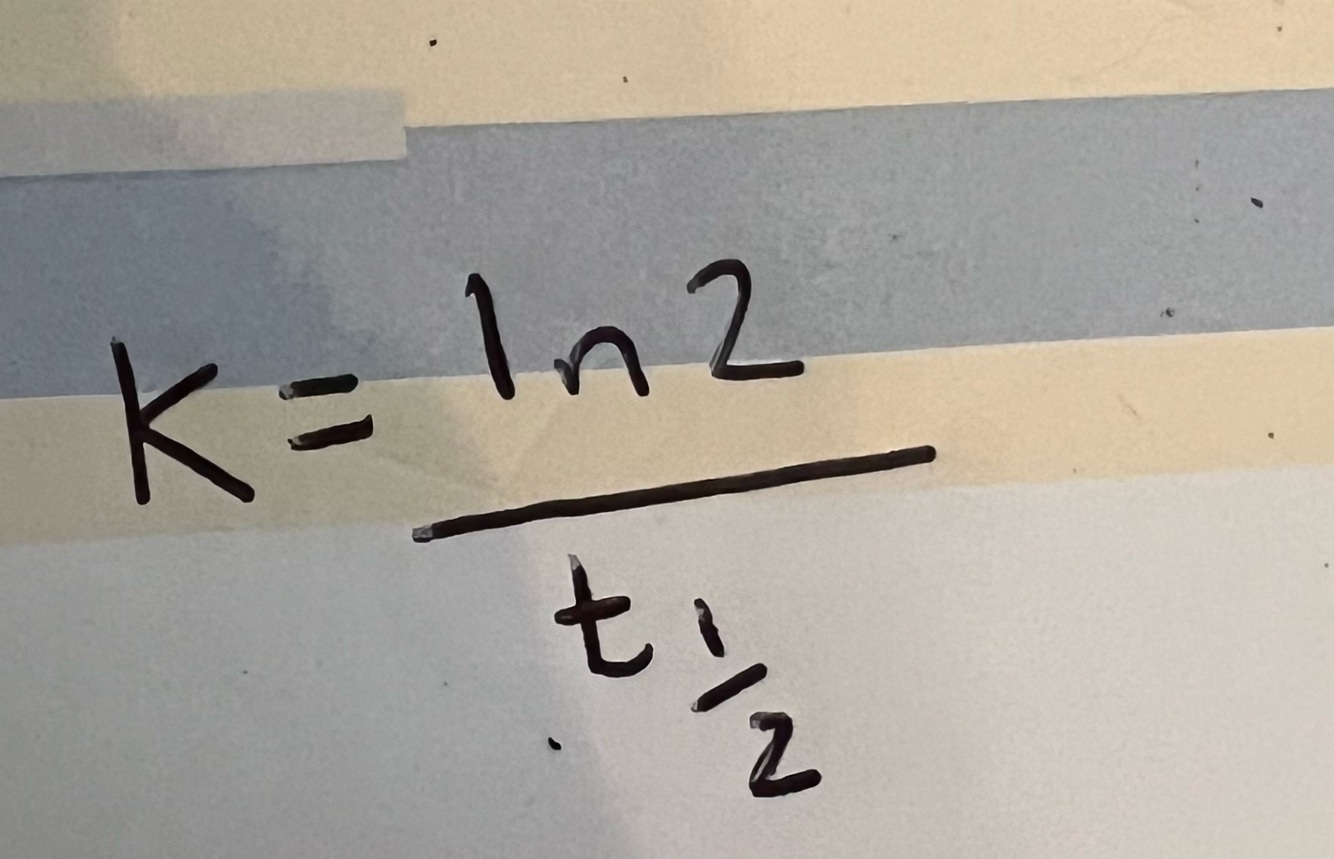
What is the equation used to determine the rate constant (k) from a first order concentration -time graph?
-because first order reactions have constant half-lives , the value of the half-life can be used to calculate the rate constant
What is the rate-determining step?
-the slowest step in the reaction mechanism of a multi-step reaction
What are some things to consider when determining possible steps in a reaction mechanism from the rate equation ?
The reaction mechanism must be worked out by looking at the rate equation and ensuring that : -a rate-determining step is given that involves the number of molecules shown by the order for that reactant (e.g if it is a second order there will be 2 molecules of that reactant) -subsequent steps are shown that eventually generate the products shown in the balanced equation -any intermediate generated is used up in the subsequent steps -the species involved in the reaction mechanism cancel out to leave the overall equation
What is the effect of temperature change on the rate of reaction and hence the rate constant?
-increase of temperature gives more energy to the molecules -means more frequent collisions that exceed the activation energy (more successful collisions) -raising the temperature speeds up the rate of most reactions by increasing the rate constant