Lecture 18: DNA, structure, topology & recognition
暂无描述。系统推荐的高质量记忆内容,适合每天坚持背诵学习。
卡片预览 (24 张)
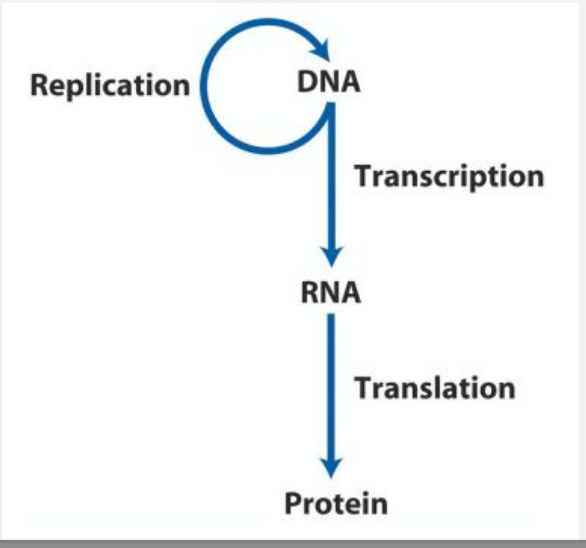
Central Dogma What is the central Dogma of Molecular Biology?
DNA -> RNA -> Protein
The Basics of DNA What is DNA? What type of molecule is DNA? What does DNA contain?
• DNA is an informational molecule • DNA is a polymer • Sequence of bases that specify genetic information
The Basics of DNA How is DNA synthesized?
DNA is synthesized from dNTPs - linked by phosphodiester bonds - Bases available for hydrogen bonding and stacking
The Basics of DNA What linkages are in DNA?
• Phosphodiester bonds • 5’ to 3’ polarity
The Basics of DNA What information is within the genes?
Nucleotides specify the amino acid sequences of proteins
The Basics of DNA What information is outside of genes?
Regulatory sequences for DNA replication and mRNA synthesis
The Basics of DNA What determines if a hydrogen bond is weak or strong?
Angled hydrogen bonds are weaker due to constrains in protein structures
DNA Structure What are the two strands of DNA held together by? What do hydrogen bonds mediate?
• base- pairing interactions • base-pairing interactions in DNA
DNA Structure What angle are the DNA strands?
Antiparalell
DNA Structure What allows information in DNA to be copied?
Complementarity
DNA Structure What is on the outside of the DNA structure? What is on the inside?
Outside - Sugar-phosphate backbone Inside - The bases are stacked
DNA Structure What are the bases in DNA?
Adenine (A) Cytosine (C) Guanine (G) Thymine (T)
DNA Structure What is Chargaff’s Rule? - Base pairs - # of Hydrogen bonds
Base pairs are purine-pyrimidine - A pairs with T - G pairs with C All Tigers Go Crazy Hydrogen Bonds A=T (2) C≡G (3)
DNA Structure What structure does DNA form?
A double helix (right-handed helix)
DNA Structure Describe the double helix What is it stabilized by? What types of grooves does it have? Where do most DNA binding proteins bind?
By hydrogen bonding & stacking interactions A major and minor groove Most proteins bind in the major groove
DNA Structure What are the 3 types of DNA structures? Describe them
A form (right-handed) - DNA-RNA or RNA-RNA helix - Found in solution - I I bp/turn B form (right-handed) - Most stable - Found in solution - 10.5 bp/turn Z form (left-handed) - Maybe in cells, but certain viral proteins specifically recognize the Z form DNA
DNA Denaturation What is denaturation? How can it be done?
Separation of the two strands of DNA Can be done by exposing DNA to a higher temperature or a higher pH
DNA Denaturation What is the tm (melting temperature)? What doe the two curves represent?
Temperature at which 50% of DNA is denatured Curves - Red curve = more G-C pairs - Blue curve = less G-C pairs - red has a higher tm
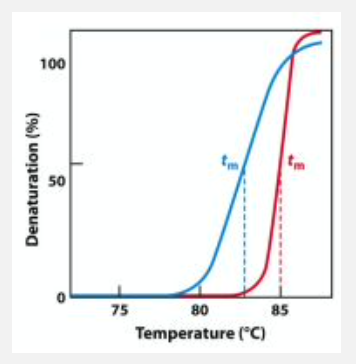
DNA Denaturation What does a higher tm mean? Why might this happen?
• It takes a higher temperature to denature 50% of DNA.. • the only way this can happen is if we have more G-C pairs (more hydrogen bonding)
RNA What is RNA? How stable is it in comparison to DNA?
Single strand helix Much less stable than DNA
RNA What are the bases in RNA?
• Adenine (A) • Cytosine (C) • Guanine (G) • Uracil (U)
RNA What are the base pairs in RNA?
• A pairs with U • G pairs with C • G also pairs with U
RNA What is RNase P?
Catalytic RNA that cleaves the precurser to tRNA
RNA What are the types of RNA?
• mRNA • tRNA • rRNA