4. Crude Oil
No description yet. This curated deck is ready for daily study.
Card preview (24)
What is crude oil?
A mixture of hydrocarbons
What is a fuel?
A substance that releases heat energy when burned.
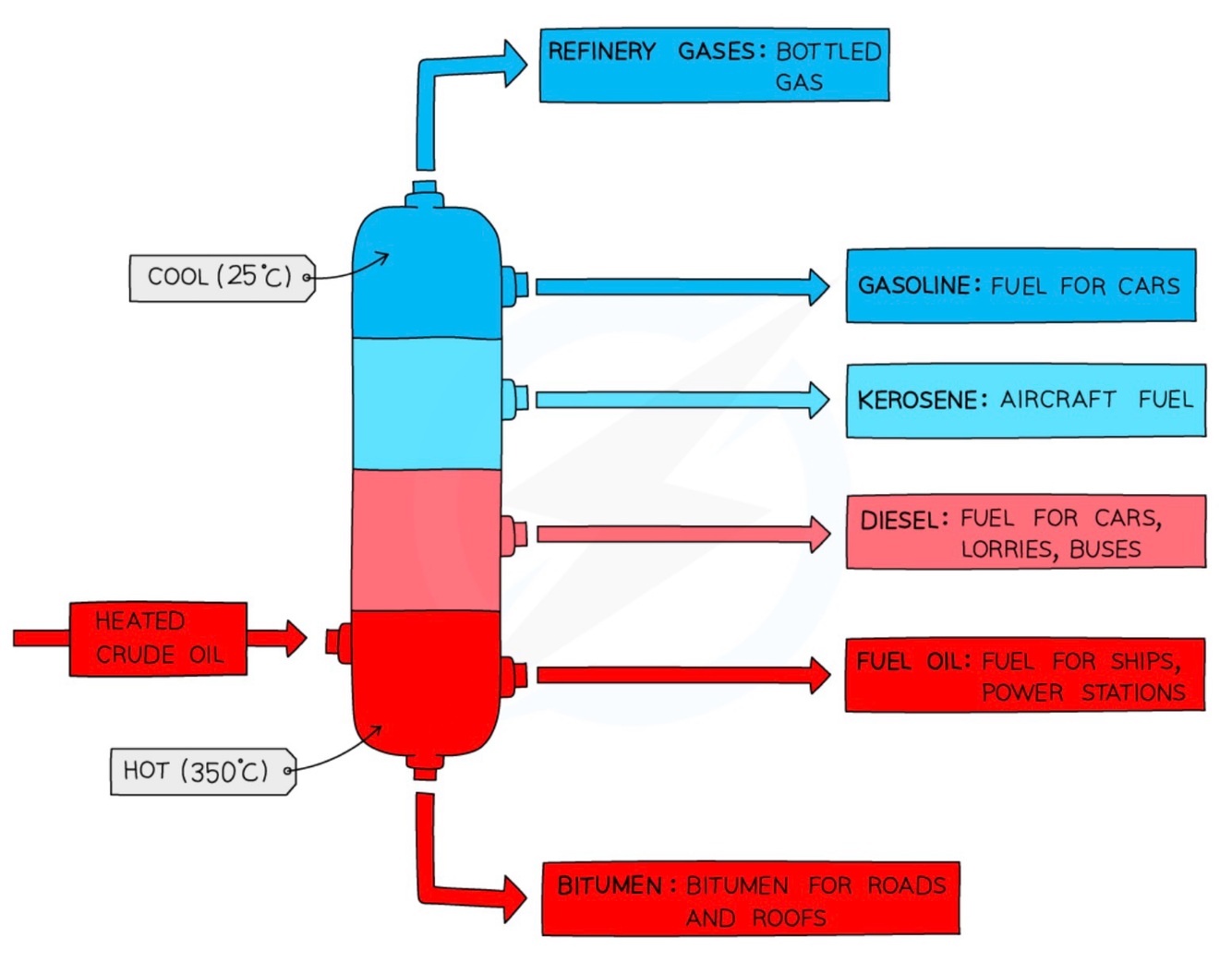
State the use of refinery gasses
Domestic cooking & heating
State the use of gasoline / petrol
Fule for cars
State the use of kerosene
Aeroplane fuel
State the use of diesel
Fuel for diesel engines in some cars and larger vehicles like trains
State the use of bitumen
Surfacing roads and roofs
State the use of fuel oil
Fuel for ships and power stations
Describe how crude oil is separated into fractions in the fractionating column through the process of fractional distillation.
• The crude oil is heated • The vapour enters the lower part of the column • Hydrocarbons rise up the column • The column is hotter at the bottom than the top (temperature gradient) • Hydrocarbons condense at their boiling points • At a height where the boiling point of the vapour is lower than the temperature in the colomn
Describe what is meant by volatility and its trend across fractions.
• Volatility = tendency of a substance to vaporise. • As molecular size increases, intermolecular forces strengthen. • Therefore, hydrocarbons become less volatile with increasing molecular size. • Hydrocarbons are less volatile lower in the fractionating column
Describe the trend of colour across fractions.
• As carbon chain length increases the colour of the liquid gets darker as it gets thicker and more viscous • Darker colours lower in the fractionating column
Describe the trend of boiling point across fractions.
• As the molecules get larger, the intermolecular attraction becomes greater • So more heat is needed to separate the molecules • With increasing molecular size there is an increase in boiling point • Higher boiling point lower in the fractionating column
Describe what is meant by viscosity and its trend across fractions. Extra
• Viscosity = ease of flow of a liquid. • High viscosity → liquid is thicker and flows less easily. • As the number of carbon atoms (and molecular mass) increases, intermolecular forces strengthen, making the liquid more viscous and flow less easily. • Greater viscosity lower in the fractionating column
Describe what is required for the complete combustion of hydrocarbons and give the products
• Excess oxygen • Carbon dioxide and water
Describe what is insufficient in the incomplete combustion of hydrocarbons and give the products
• Insufficient oxygen • Water, Carbon Monoxide (CO) and Soot (C)
Why is carbon monoxide dangerous?
• Poisonous • Reduces the capacity of the blood to transport oxygen
Why can oxides of nitrogen form in car engines?
In car engines, the temperature reached is high enough to allow nitrogen and oxygen from air to react, forming oxides of nitrogen
How does combustion of fossil fuels produce sulfur dioxide?
• Fossil fuels often contain small amounts of sulfur impurities. • When these fuels are burned, the sulfur is oxidised to form sulfur dioxide (SO₂).
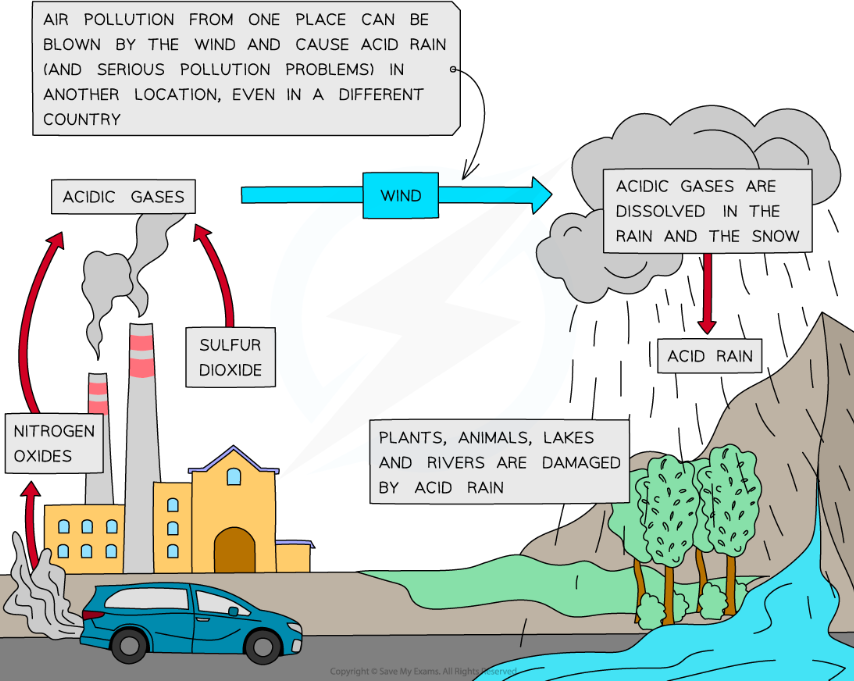
How does sulfur dioxide contribute to acid rain?
• The sulfur dioxide produced from the combustion of fossil fuels dissolves in rainwater droplets to form sulfuric acid
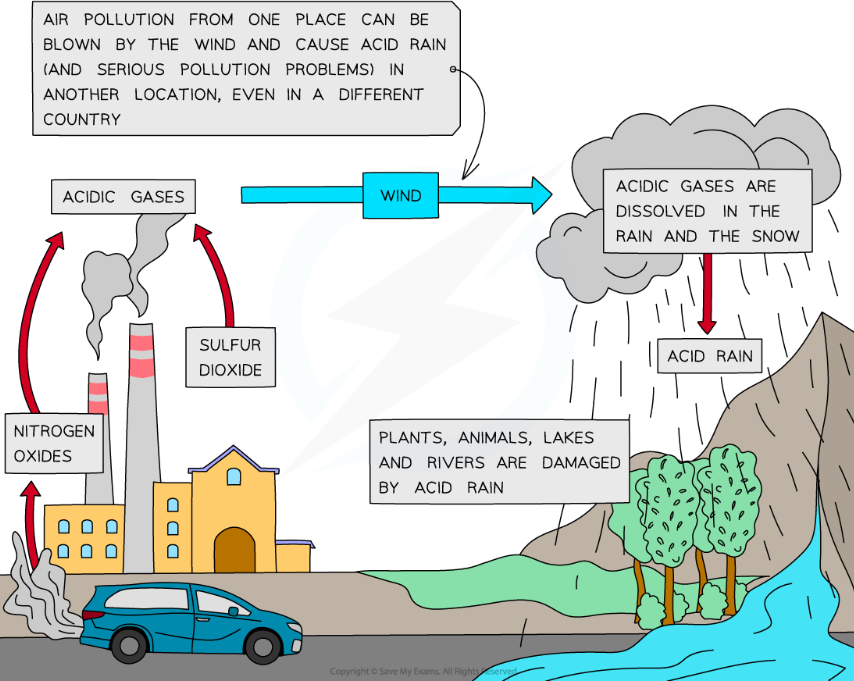
How do oxides of nitrogen contribute to acid rain
• Nitrogen dioxide produced from car engines at high temperatures reacts with rain water to form a mixture of nitrous and nitric acids, which contribute to acid rain:
What is meant by cracking?
Breaking down long-chain alkanes to form shorter-chain alkanes and alkenes.
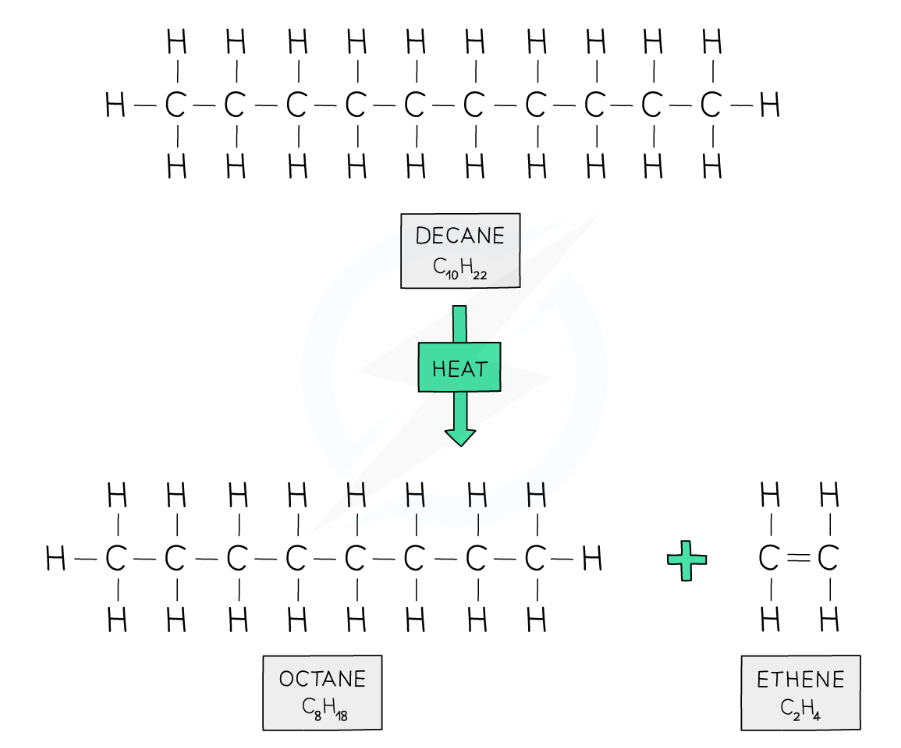
State the two conditions required for catalytic cracking
• Silica or alumina as the catalyst • A temperature in the range of 600–700 ºC
Explain why it is necessary to convert long‑chain alkanes into shorter‑chain alkanes.
• Greater demand for short chain alkanes (than long chain alkanes) • More long-chain alkanes than are needed • Not enough short chain alkanes to meet demands
Fractionating Column Diagram