ASBHDS Session 2 - Quality of Life, Long Term Conditions and Mental Health
No description yet. This curated deck is ready for daily study.
Card preview (24)
What are the reasons for measuring health?
• To have an indication of the need for healthcare. • To target resources where they are most needed. • To assess the effectiveness of health interventions. • To evaluate the quality of health services. • To use evaluations of effectiveness to get better value for money. • To monitor patients’ progress
What are commonly used measurements of health?
• Mortality • Morbidity • Patient-based outcomes
Outline patient-based outcomes.
• An attempt to assess well-being from the patient’s point of view. • Examples are: health-related quality of life (HRQoL), health status, functional abilities. • Patient-reported outcome measures (PROMs) are measures of health that come directly from patients. They work by comparing scores before and after treatment or over longer-periods
What is the use of patient based outcomes?
• Patient base outcomes are used in conditions where the aim is managing rather than curing. Biomedical tests just one part of picture. There is a need to focus on patient’s concerns (patient-centred care). One needs to pay attention to iatrogenic effects of care. • Patient-based outcomes can: I. Be used clinically II. Be used to assess benefits in relation to cost III. Be used in clinical audit IV. Be used to measure health status of populations V. Be used to compare interventions in a clinical trial VI. Be used as a measure of service quality
Outline Patient-reported outcome measures (PROMs).
• Improve clinical management of patients – informed, shared decision-making • Domain 2: Enhancing quality of life for people with long-term conditions. Overarching indicator 2: Health-related quality of life for people with long-term conditions. - Domain 3: Helping people to recover from episodes of ill health or following injury. Improvement area 3.1 Total health gain as assessed by patients for elective procedures (measured using a PROM) • Challenges: I. Minimising the time and cost of collection, analysis, and presentation of data II. Achieving high rates of patient participation III. Providing appropriate output to different audiences IV. Avoiding misuse of PROMs
What is Health related quality of life (HRQoL) and what does it depend on?
• ‘Quality of life in clinical medicine represents the functional effect of an illness and its consequent therapy upon a patient, as perceived by the patient.’ • Depends on: I. Physical function II. Symptoms III. Global judgements of health IV. Psychological well-being V, Social well-being VI. Cognitive functioning VII. Personal constructs VIII. Satisfaction with care
How does one measure HRQoL using PROM?
• Use of questionnaires known as ‘instruments’ or ‘scales’ • Should fulfil certain criteria: I. Reliability- is the instrument accurate over time and internally consistent? (if the patient has no change in health, she should get the same score each time on the measure) II. Validity – does the instrument actually measure what it is intended to measure? (a measure might be accessing only pain, and neglecting social aspects of illness)
What are the two basic groupings for measuring HRQoL using PROM?
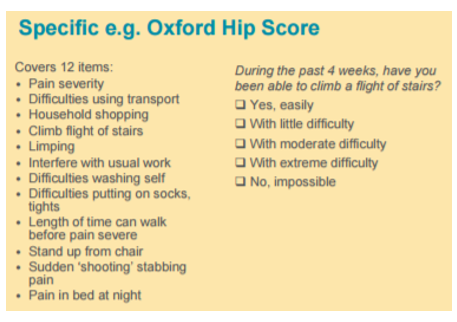
- Generic instruments I. Can be used with any population (incl. healthy people) II. Generally cover perceptions of overall health III. Also questions on social, emotional and physical functioning, pain and self-care - Specific instruments I. Evaluates a series of health dimensions specific to a disease, site or dimension II. Types of specific instruments: A. Disease specific – Asthma Quality of Life Questionnaire, Arthritis Impact Measurement Scale (AIMS) B. Site specific – Oxford Hip Score, Shoulder Disability Questionnaire C. Dimension specific – Beck Depression Inventory, McGill Pain Questionnaire
What are some pros and cons of generic instruments?
• Generic instruments – advantages: I. Can be used for broad range of health problems II. Can be used if no disease-specific instrument III. Enable comparisons across treatment groups IV. Can be used to detect unexpected positive/negative effects of an intervention V. Can be used to assess health of populations • Generic instruments – disadvantages: I. Generic nature means inherently less detailed II. Loss of relevance – too general? III. Can be less sensitive to changes that occur as a result of an intervention V. May be less acceptable to patients
What are some examples of generic measures?
• The Short-Form 36-item questionnaire (SF-36) • The EuroQol EQ-5D
Outline the SF-36.
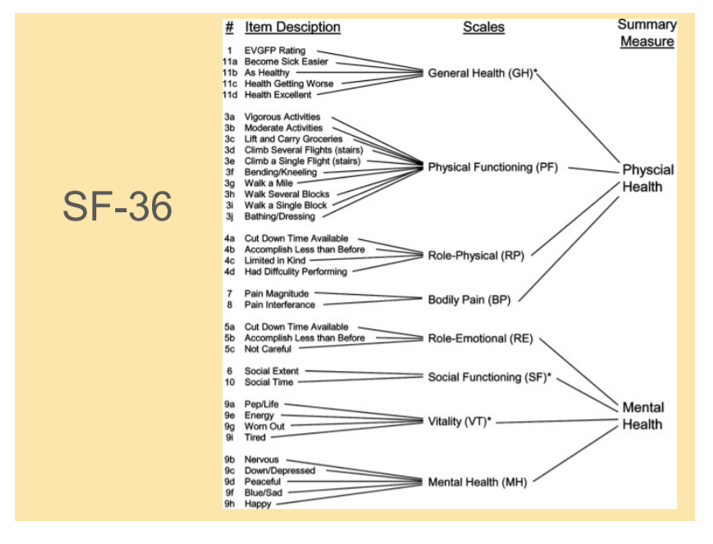
• Contains 36 items which can also be grouped into 8 dimensions: I. Physical functioning II. Social functioning III. Role functioning (physical) IV. Role functioning (emotiona) V. Bodily pain VI. Vitality VII. General health VIII. Mental health • Responses are scored. Scores for items within each dimension are added together. This score is transformed to give each respondent’s score for each dimension (0-100).
Outline EuroQol EQ-5D.
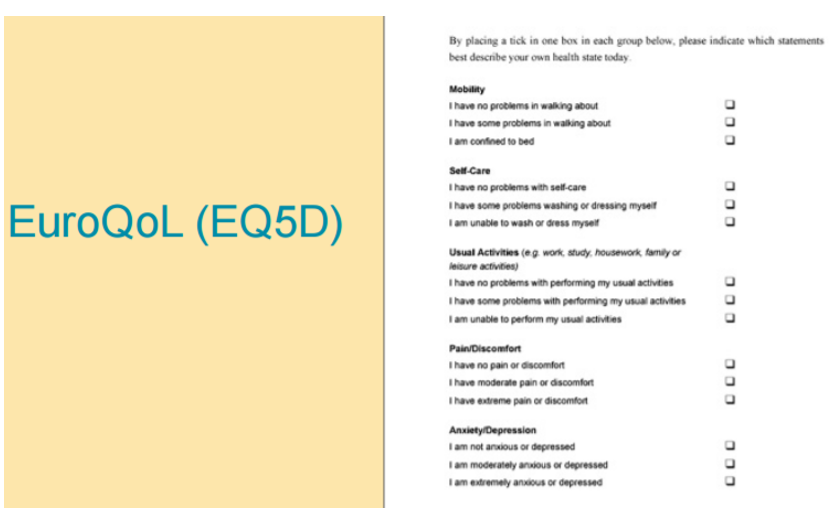
• Generates a single index value for health status on which full health is assigned a value of 1 and death a value of 0. • It is particularly suitable for use in economic evaluations. • It has 5 deimensions I. Mobility II. Self-care III. Usual activities IV. Pain/Discomfort V. Anxiety/Depression • It has 3 levels for each dimension I. No problems II. Some/moderate problems III. Extreme problems
Outline the pros and cons of Specific instrumens.
• Specific instruments – Advantages: I. Very relevant content II. Sensitive to change III. Acceptable to patient • Specific instruments – Disadvantages: I. Can’t use them with people who don’t have the disease II. Comparison is limited III. May not detect unexpected effects
Discuss anxiety due to another medical condition.
• In general, anxiety disorders are normal reactions to stress that has become excessive. The anxiety is shown as significant and possibly intense dread or uneasiness. Anxiety may take the form of panic attacks, obsessive-compulsive behavior or generalised anxiety. • It is a response to a threat I. Threats to identity/well-being II. Threatening events (sugery, treatment, test results, uncertainty) • Likely to occur at various stages in illness – e.g. diagnosis, awaiting test results, discharge from hospital, illness progression, making lifestyle changes
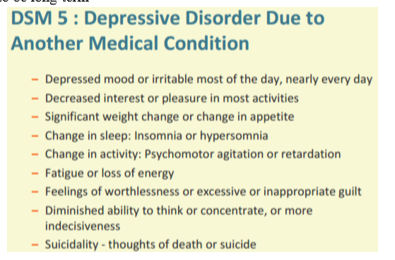
Discuss Depressive disorder due to another medical condition
• Response to loss, failure or helplessness I. Loss of health/physical capacity II. Loss of identity/social status III. Reaction to symptoms, negative experiences of illness IV. Physiological changes (e.g. MS) V. Medication side effects • Tends to be long term • Co-morbid depression can: I. Exacerbate the distress associated with physical health problems; adversely affect illness outcomes (including via reduced adherence to treatment) (NICE 2010) II. Increase risk of mortality E.g. 1 in 10 with post-stroke depression have suicidal thoughts
What are some barriers to recognising psychological problems in patients?
• Symptoms may be inadvertently missed I. Attributed to illness or treatment II. Experienced out with the consultation • Patients may not disclose symptoms I. Perception of inevitability II. Desire to avoid stigma, feeling judged or a burden, or seen as failing to cope • HCPs may avoid asking: I. Perception that it is out with their role/expertise II. Capacity/time constraints III. Reluctance to label people
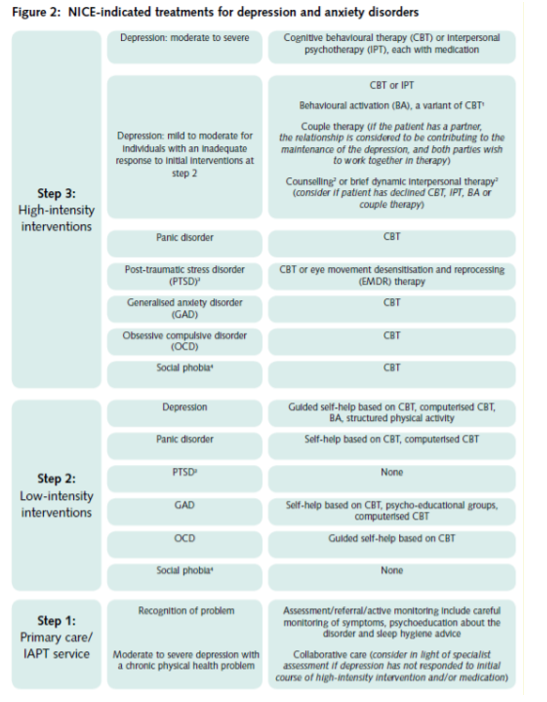
What are long term conditions?
• Encompasses wide range of conditions I. long term II. often profound influence on lives of sufferers III. often co-morbid conditions • Manifestations may vary greatly day-to-day • Controlled but not cured • LTCs will increase with ageing population but not only older people who live with LTCs
Outline the work of LTC’s from a sociological approach.
• Illness work (symptom management, treatment) • Everyday life work (managing daily living) • Emotional work (managing one’s own emotions and those of others) • Biographical and narrative work (reconstruction of biography) • Identity work (work to maintain an acceptable identity)
Outline illness work.
• Getting the diagnosis I. May be prolonged period of uncertainty II. Ambivalent status of some diagnoses III. Diagnosis can be profoundly shocking, very threatening or a relief • Managing the symptoms I. Central to the coping task is dealing with the physical manifestations of the illness II. Interaction between body and identity III. Bodily changes –> self-conception changes • Self-management I.Optimum self-management is difficult to achieve A. Poor rates of adherence to treatment B. Reduced quality of life C. Poor psychological wellbeing
Outline everyday work.
• Coping and strategic management I. Coping – the cognitive processes involved in dealing with illness II. Strategy – actions and processes involved in managing the condition and its impact • E.g. decisions about mobilisation of resources and how to balance demands on others and remain independent* • Normalisation I. You can try to keep your pre-illness lifestyle and identity intact (e.g. by disguising or minimising symptoms) II. Or re-designate your new life as “normal life” – This may involve people signalling changes in identity rather than preserving old ones.
Outline emotional work.
• Work that people do to protect the emotional well-being of others • Maintaining normal activities becomes deliberately conscious • People find friendships disrupted and may strategically withdraw or restrict their social terrain • May involve downplaying pain or other symptoms • Presenting “cheery self” • Impact on role I. Impact on role (breadwinner, wife, mother etc.) may be devastating II. Dependency – feeling of uselessness to self and others III. May be especially devastating for young people
Outline biographical work.
• Loss of self • Former self-image crumbles away without simultaneous development of equally valued new ones I. Constant struggle to lead valued lives and maintain positive definitions of self II. Argued that focus on physical discomfort minimised broader significance of suffering for people with chronic illness • Biographical disruption: I. Chronic illness as a major disruptive experience II. Threatens sense of taken-for-granted world III. New consciousness of the body and fragility of life, grief for a former life IV. Biographical shift from a perceived normal trajectory to an abnormal
Outline identity work.
• Different conditions carry different connotations • Affects how people see themselves and how others see them • Consequence of actual and imagined reaction of others • Illness can become the defining aspect of identity • “…you don’t get treated the same, you get treated as though you’re a bit senile and you’re not the same person anymore. The cancer takes over the family, it’s the condition, it’s not mum or Katie”*
Discuss stigma.
• Stigma is a negatively defined condition, attribute, trait or behaviour conferring “deviant” status • Discreditable and discredited I. Discreditable – nothing seen, but if found out… – e.g. mental illness / HIV positive II. Discredited – physically visible characteristic or well known stigma which sets them apart – e.g. physical disability, known suicide attempt III. Some conditions both, e.g. epilepsy • Felt vs. enacted I. Enacted stigma – the real experience of prejudice, discrimination and disadvantage (as the consequence of a condition) II. Felt stigma – fear of enacted stigma, also encompasses a feeling of shame (associated with having a condition), selective concealment.