Topic 17.2 Carbonyl compounds
No description yet. This curated deck is ready for daily study.
Card preview (24)
Carbonyl group
• A carbon atom joined by a double bond to an oxygen atom. • -C=O • Carbonyl compounds can be classed as either aldehydes or ketones.
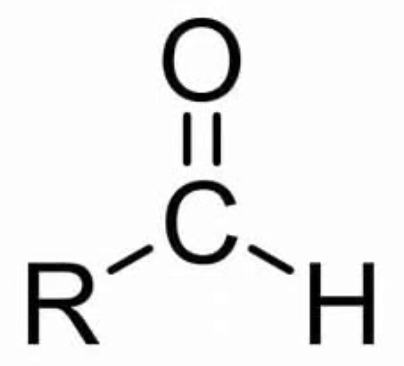
Aldehydes
• A hydrogen atom is bonded to the carbonyl group. • General formula: RCHO • =O at the end of carbon chain • Aledehydes are oxidised further to produce carboxylic acids.
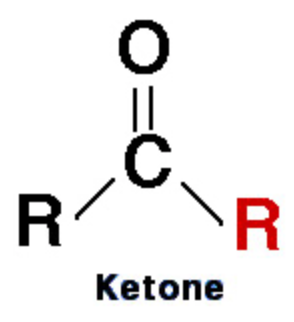
Ketone
• There is only hydrocarbon groups joined to the carbonyl group. • Cannot be further oxidised as they do not have hydrogen atom attached to their carbonyl.
Bonding in carbonyl compounds
• Contain -C=O group. • Polar bond. • Electron density is greater near the δ- O atom.
Physical properties in carbonyl compounds
• Distinctive smells. • Boiling temperature are between those of alkanes (low) and alcohol (high). • Boiling points increase with chain length. • No hydrogen bonding but permanent dipole dipole attraction.
Physical properties in ketones and aldehydes
• Smaller aldehydes and ketones are soluble in water - they can form hydrogen bonds with water. • Solubility decreases as chain length increases- hydrocarbon part of the molecules become more significant.
Primary alcohol
Oxidised: Primary alcohol —> aldehyde —> carboxylic acid
Secondary alcohol
Oxidised: Secondary alcohol —> ketone —> X
Tertiary alcohol
Tertiary alcohol —> X
Reagent observations: Felling’s reagent
Aldehyde: brick red, precipitate solid Ketone: stays blue, no visible change
Reagent observations: Tollen’s reagent
Aldehyde: silver mirror, black precipitate Ketone: stays colourless, no visible change
Reagent observations: sodium dichromate
Aldehydes: decolourises Ketones: stays purple, no visible change
Reagent observations: K2Cr2O7
Aldehyde: colour change, orange to green Ketone: stays orange, no visible change
Reaction with proponal/anone: Sodium dicromate
Propanal: green Propanone: orange (no change)
Reaction with proponal/anone: Felling’s solution
Propanal: light blue Propanone: dark blue
Reaction with proponal/anone: Tolling’s reagent
Propanal: white precipitate Propanone: colourless
Reduction reactions (eg. 2° alcohol –> 1° alcohol)
Aldehydes and ketones can be reduced to alcohols using lithium tetrahydridoaluminate (LiAlH4) dissolved in dry ether. -Reducing agent represented by [H]
Oxidation reactions
-Aldehydes can be oxidised to form carboxylic acids -Ketones are not easily oxidised (assume they aren’t) -Oxidising agents shown as [O]
Reactions with iodine
• Triidomethane reaction. • Carbonyl compound added to an alkaline solution of iodine. • Mixture warmed then cooled. • Yellow precipitate forms - this is a positive result. • Test for CH3CO group (found in ethanal and all methyl ketones).
Reaction with HCN
-Aldehydes and ketones react with HCN in an alkaline solution of KCN -These are addition reactions where a hydrogen atom joins to the oxygen in the carbonyl group and the cyanide group attaches to the carbon of the carbonyl group
Naming products
OH group- hydroxy CN group- nitrile The products are known as hydroxynitriles
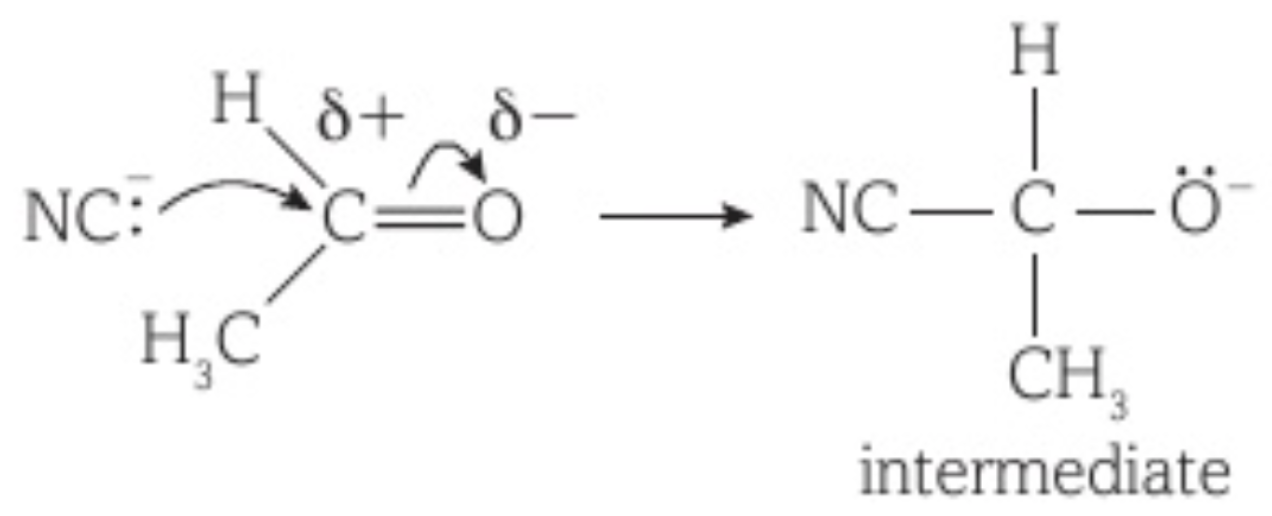
Nucleophilic addition mechanism (Step 1)
Step 1: nucleophilic attack by a cyanide ion on the δ+ carbon atom of the carbonyl group.
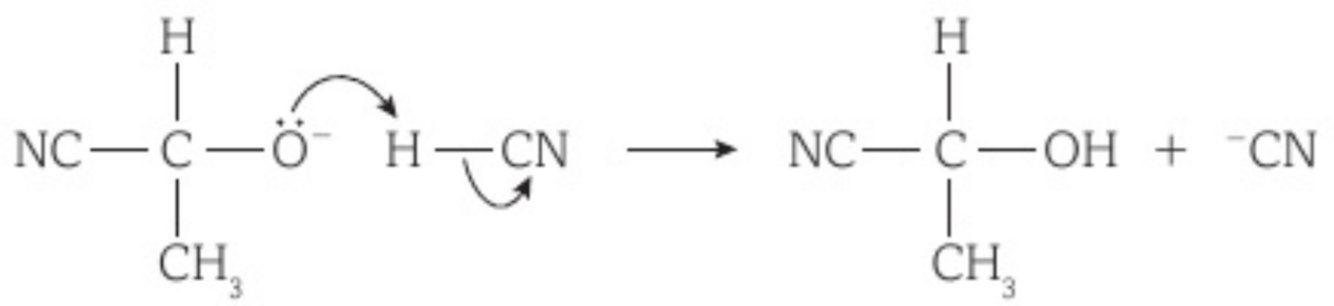
Nucleophilic addition mechanism (Step 2)
Step 2: the intermediate reacts with a hydrogen cyanide molecule.
Optical activity
• As C=O is planar there is an equal chance of the CN- ion attacking from each side of the plane. • Even though the product contains a chiral centre, the product is not optically active as there are equal amounts of each enantiomer - a racemic mixture.