2 States of matter and diffusion
暂无描述。系统推荐的高质量记忆内容,适合每天坚持背诵学习。
卡片预览 (24 张)
Describe the attractive forces in a gas
very low or negligible
What would you observe while a substance such as potassium permanganate (crystal) diffuses through water in a beaker
The darker more intense purple colour is found near the crystal at first. After some time the colour is more pale and uniform throughout the water.
Describe the attractive forces in a liquid
medium
Describe the relative energy of particles in a liquid
moderate
What state is water at 120°C?
gas boiling point of water is 100°C
What is the name of the process shown in the image below? What would you observe at the end of this process?
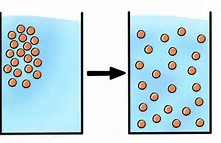
Diffusion Colour is now uniform throughout and more pale
Sarah sprayed some perfume in the corner of the room and Tony could smell it on the other side of the room about 3 minutes later. What is the name of this process?
Diffusion
Name the change of state- gas to liquid
condensation
Describe the particle movement in a liquid
slipping past each other
What is the valency of a hydrogen ion?
H 1+
Explain why this happens?
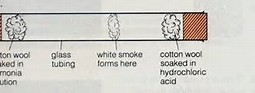
Both the ammonia and hydrogen chloride particles diffuse across the tube The ammonia particles are less massive and diffuse faster The hydrogen chloride particles are more massive and diffuse more slowly They meet closer to the hydrogen chloride side and form ammonium chloride- a white cloud forms.
Name the change of state- liquid to gas
evaporation
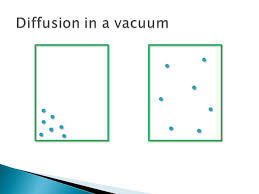
During diffusion of a substance through air, many tiny invisible air particles collide with the larger particles in the substance. These larger particles move through the air in a random motion from areas of high concentration to areas of low concentration. How would diffusion of a gas differ in a vacuum?
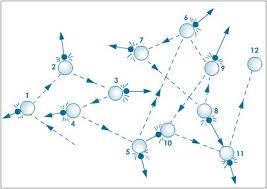
Diffusion through air is a slow process. Gaseous particles move very rapidly but the collision with air particles slow their movement. In a vacuum gases diffuse very quickly (no air particles in the way!)
What state is water at -60 degrees Celsius
solid
Describe the particle arrangement of a liquid
irregular arrangement, close together
Describe the relative energy of particles in a solid
low
Name the change of state- solid to gas
sublimation
Describe the particle movement in a solid
vibrating in fixed positions
Describe the shape and volume of a solid
both definite shape and volume
What are the two possible iron ions?
Fe 2+ and Fe 3+
Name the change of state- gas to solid
deposition
A typical diffusion practical is set up in a long tube. A hydrogen chloride soaked cotton wool is placed in one end and an ammonia soaked cotton wool is placed in the other end. What would you observe is the experiment was carried out at a higher temperature?
The white cloud would form in the same position as before but would form more rapidly. At higher temperature the particles have more energy and travel at higher speeds. This means that the collisions between the air particles and the larger particles occur more frequently and they collide with more force. This makes them move more rapidly through the air or diffuse more quickly.
Propan-1-ol has a melting point of -126°C and a boiling point of 98°C. What state is propan-1-ol at 99°C?
gaseous it is beyond the boiling point.
Name the change of state- solid to liquid
melting