2.2 Bonding, Structure and Properties of Matter
No description yet. This curated deck is ready for daily study.
Card preview (15)
Draw out the structure of a solid, liquid and gas
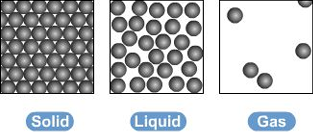
What does melting, boiling, freezing and condensing point depend on?
Amount of energy required to change state depends on the strength of the forces between particles of the substance
How does the strength of bonds between particles correlate to boiling point?
The stronger the forces, the higher the melting point Because more energy is needed to overcome the intermolecular forces of attraction
What are the properties of ionic compounds?
Regular strucutres (giant ionic lattices) In which there are strong electrostatic forces of attraction 3D, so forces of attraction are in all directions between oppositely charged ions
What symbols would you use to display: Solid Liquid Gas Aqueous solutions
(s) (l) (g) (aq)
Why do ionic compounds have high melting and boiling points?
Lots of energy is needed to overcome the strong forces of attraction
Why can ionic compounds conduct electricity when they are melted or dissolved?
Ions are free to move and carry current When they are solid, ions can’t move therefore cannot conduct charge
Why are small molecules normally liquid or gas?
Weak intermolecular forces So intermolecular forces of attraction are easily overcome COVALENT BONDS BETWEEN MOLECULES ARE NOT BROKEN
Why do small molecules not conduct electricity?
Small molecules do not have an overall electric charge
What are the properties of polymers?
• Large molecules • Atoms are linked to other atoms by strong covalent bonds • Intermolecular forces between polymers are strong so they are solid at room temperature
Why do giant covalent structures have very high melting and boiling points, given an example of two?
All of the atoms in these structures are linked to other atoms by strong covalent bonds Therefore lots of energy is required to overcome these strong covalent bonds Diamond Silicon dioxide Graphite
What are the properties of metals?
High melting and boiling points Atoms are in layers so they can slide over each other, making them easy to bend and shape
What is an alloy?
2 or more different types of metal in one substance
Why are alloys harder than pure metals?
Different sized atoms Layers don’t slide over each other nicely causing distortion So alloys are harder than pure metals
Why are metals good conductors?
Sea of free delocalised electrons able to easily carry electrical charge through the metal Thermal energy (heat) can be conducted by delocalised electrons, so they are good conductors of heat too