Glycogen Metabolism
暂无描述。系统推荐的高质量记忆内容,适合每天坚持背诵学习。
卡片预览 (24 张)
What is glycogen?
The storage form of glucose that acts as a rapid source of glucose when blood glucose levels drop A branched homopolymer of glucose
Where are our main stores of glycogen located?
The liver and muscles
What is the main use of glycogen in the liver vs. the muscles?
Muscles = Used to provide glucose for glycolysis and subsequent energy production when a sudden burst of physical activity is required Liver = Used between meals/long fasts; broken down to provide a steady supply of glucose to the bloodstream
Glucose monomers are linked together via…
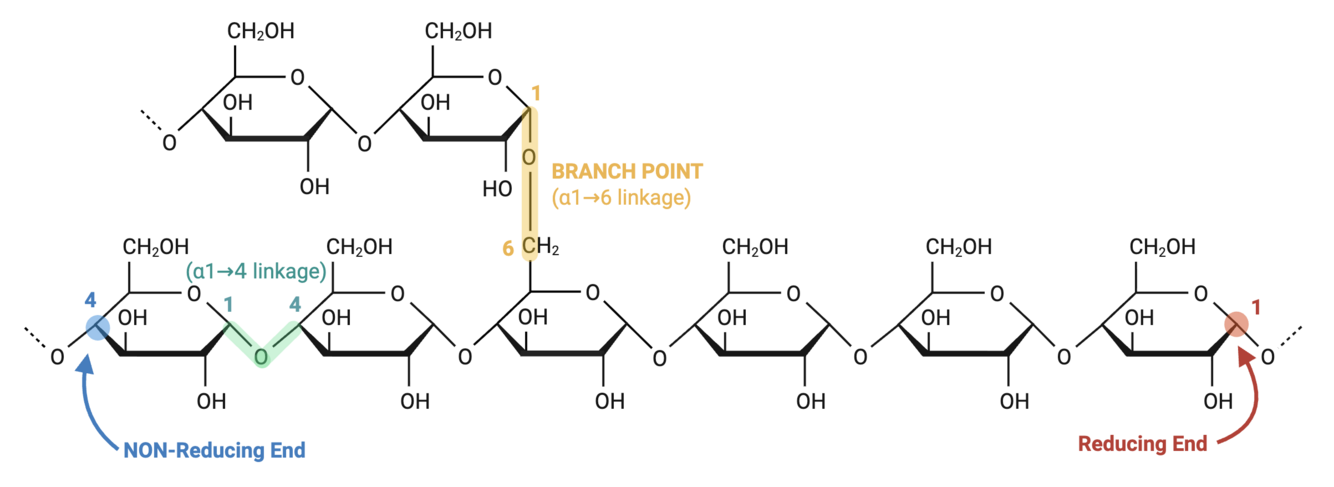
α1→4 linkages!
Which carbons correspond to the reducing vs. non-reducing ends of a glycogen chain?
C1 = REDUCING End C4 = NON-Reducing End
Glucose can polymerize into two kinds, what are these two? Which kind is more prevalent?
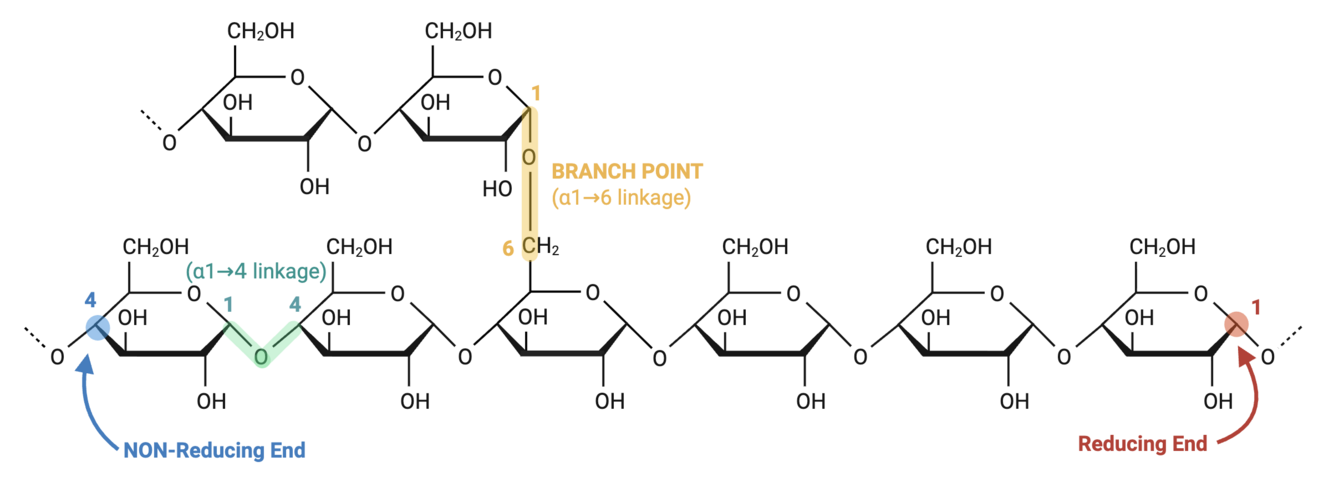
Amylose = Linear Amylopectin = Branched –> Amylopectin is more prevalent; glycogen is highly branched!
At what ends of a glycogen chain do branches form? What kinds of linkages are glycogen branches?
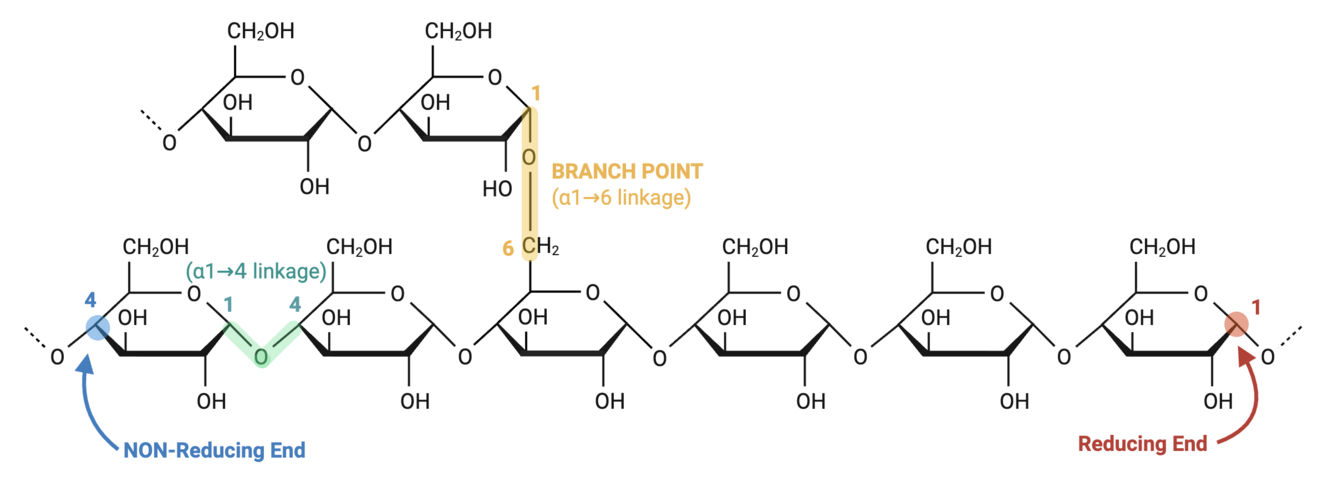
Branches form at the REDUCING END (C1) of a glycogen chain! –> The terminal C1 (reducing end) of one glycogen chain connects to the C6 of a monomer in another glycogen chain == α1→6 linkages
Roughly how long is each glycogen chain?
Each glycogen chain is ~12-14 monomers
How frequently is glycogen branched?
Branch-point roughly very 8-12 monomers
Glycogen forms _______ in the cytoplasm that come in 2 forms: _____ + ______
Glycogen forms GRANULES in the cytoplasm that come in 2 forms: α granules + β granules
What is found at the core of ALL glycogen granules? WHY?
A homodimer of glycogenin –> Because glycogenin homodimer serves a scaffold/primer for glucose polymerization (AKA. the starting point of glycogen chains)
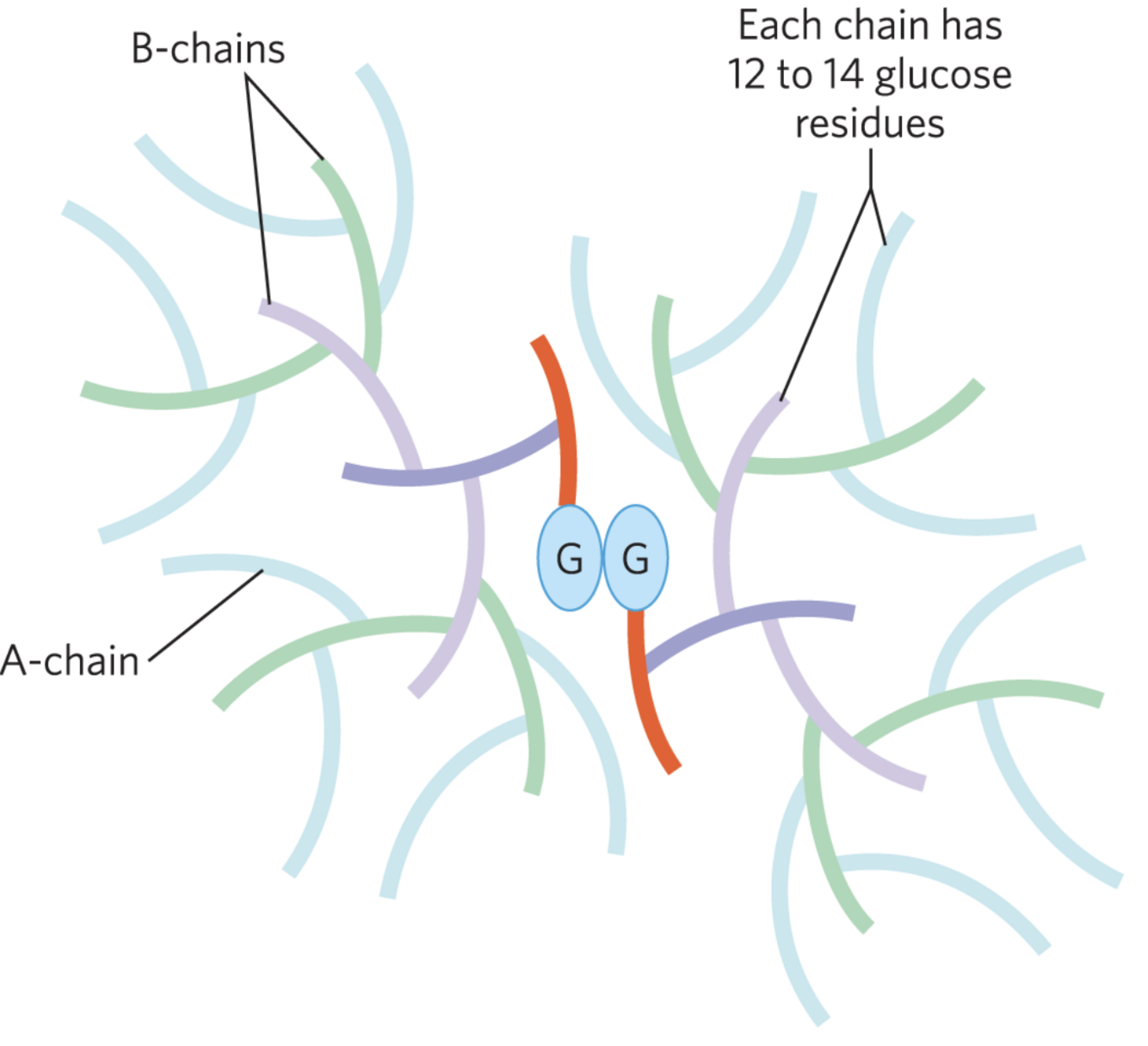
What are the glycogen chains called that are directly connected to the core glycogenin homodimer?
PRIMER strands!
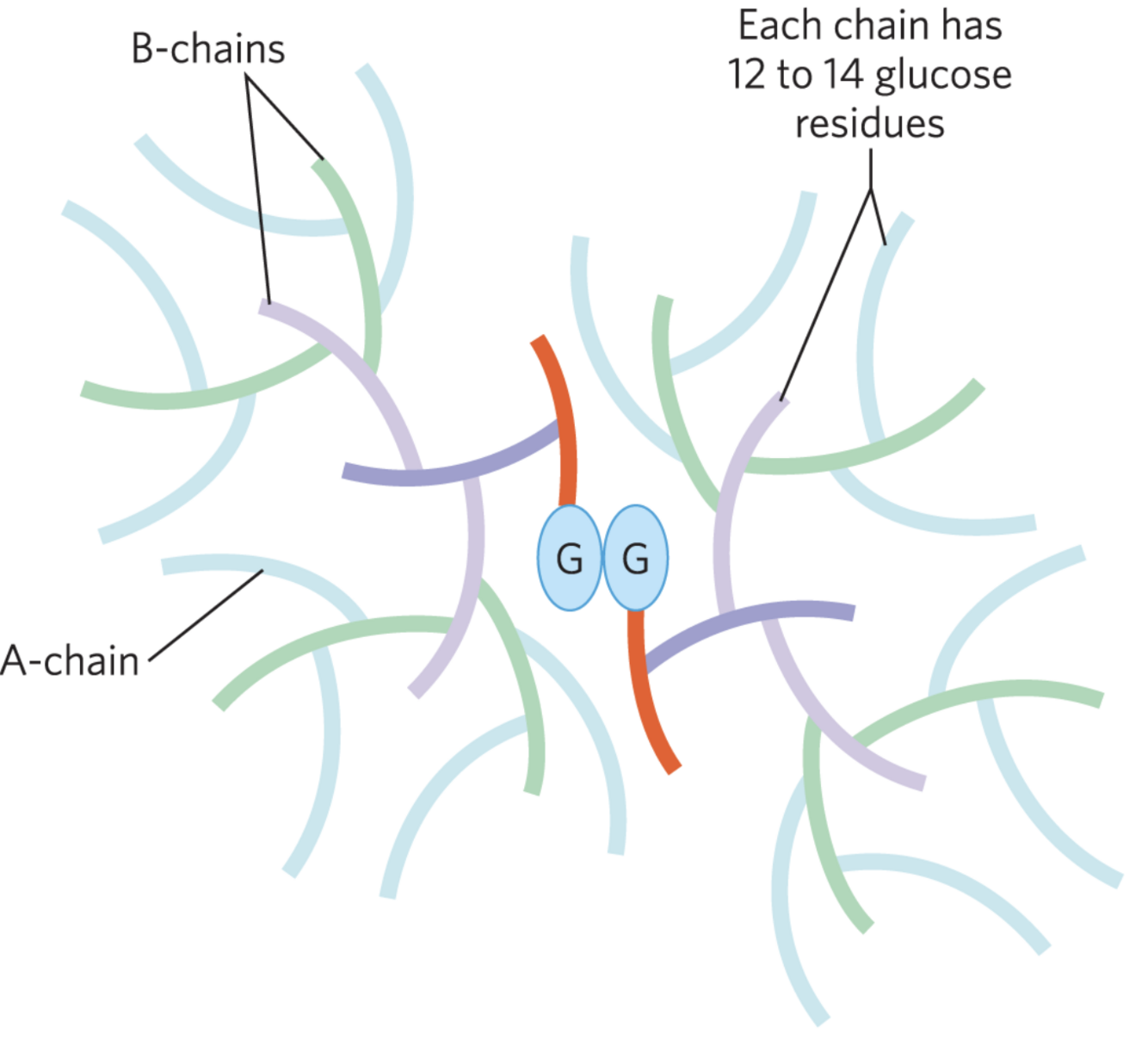
What is the difference between A and B chains in glycogen granules?
B Chains = Internal, branched glycogen chains A Chains = External, UNBRANCHED glycogen chains
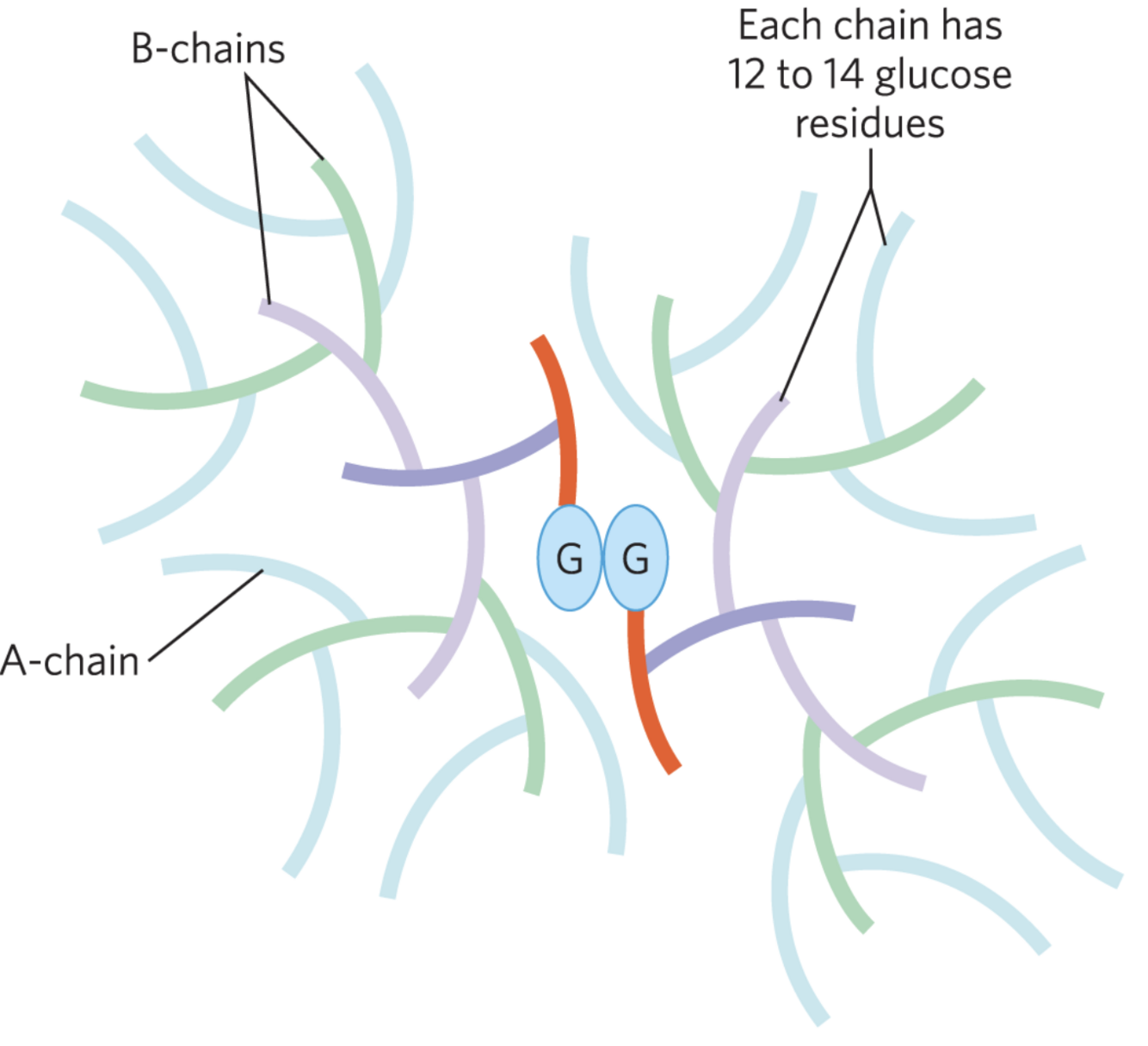
Glycogen strands in glycogen granules form a _______ arrangement which provides MANY __________ ends that is helpful for glycogen _____ + _______
Glycogen strands in glycogen granules form a TIERED arrangement which provides MANY NON-REDUCING ends that are helpful for glycogen synthesis + breakdown –> Because glycogen synthase and phosphorylase both function at the NON-reducing ends of glycogen chains
α granules vs. β granules
α granules = (1) Larger (~300 nm diameter) (2) Found in the LIVER (3) Made up of conglomerated β granules β granules = (1) Smaller (20-30 nm diameter) (2) Found mainly in the MUSCLES (3) Made of ~55,000 monomers
What is glycogenolysis?
The enzymatic breakdown of stored glycogen into glucose-1-phosphate
What are the 3 main enzymes involved in glycogenolysis? (Give brief description of their functions)
1) Glycogen phosphorylase –> Cleaves α1→4 linkages via a PHOSPHOROLYSIS process to release one Glucose-1-phosphate molecule at a time 2) Glycogen DEBRANCHING enzyme (AKA. “glucantransferase”) –> Catalyzes 2 successive rxns. that transfer monomers remaining at the end of a degraded glycogen chain to other existing strands to create longer linear chains = allows for glycogen phosphorylase to continue its action 3) Phosphoglucomutase –> Isomerizes glucose-1-phosphate (the product of glycogen phosphorylase) to glucose-6-phosphate
What is phosphorolysis?
PhosphoroLYSIS = The lysis (cleavage) of bonds using an inorganic phosphate grp (Pi)
Glycogen phosphorylase catalyzes what?
Glycogen phosphorylase catalyzes **the phosphoroLYSIS of α1→4 linkages at the non-reducing end of glycogen chains == Produces free molecules of Glucose-1-phosphate!
What is the product of glycogen phosphorylase?
Glucose-1-phosphate
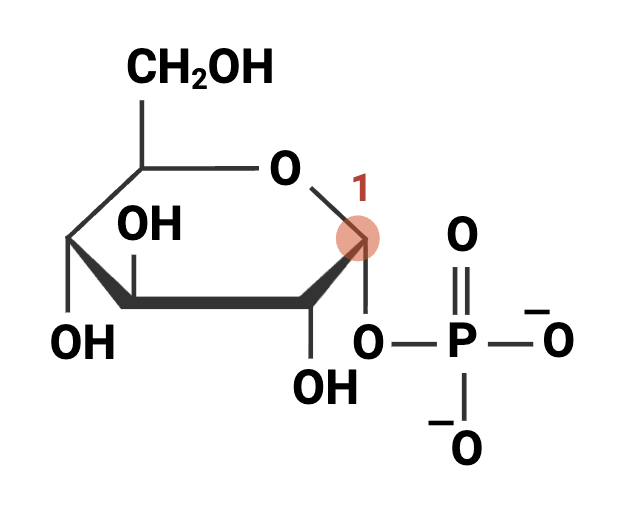
Explain the process of glycogenolysis via glycogen phosphorylase:
1) Inorganic phospate (Pi) attacks C1 of the glucose monomer at the non-reducing end of a glycogen chain == Non-reducing terminal glucose monomer gets phosphorylated at C1 and released from the glycogen chain! 2) A new non-reducing end is formed and glycogen phosphorylase repeats the process 3) Glycogen phosphorylase will conduct repeat cycles of phosphorolysis –> UNTIL it reaches a point in the glycogen chain it is working on that is 4 glucose monomers away from a branch point! == STOPS it function!
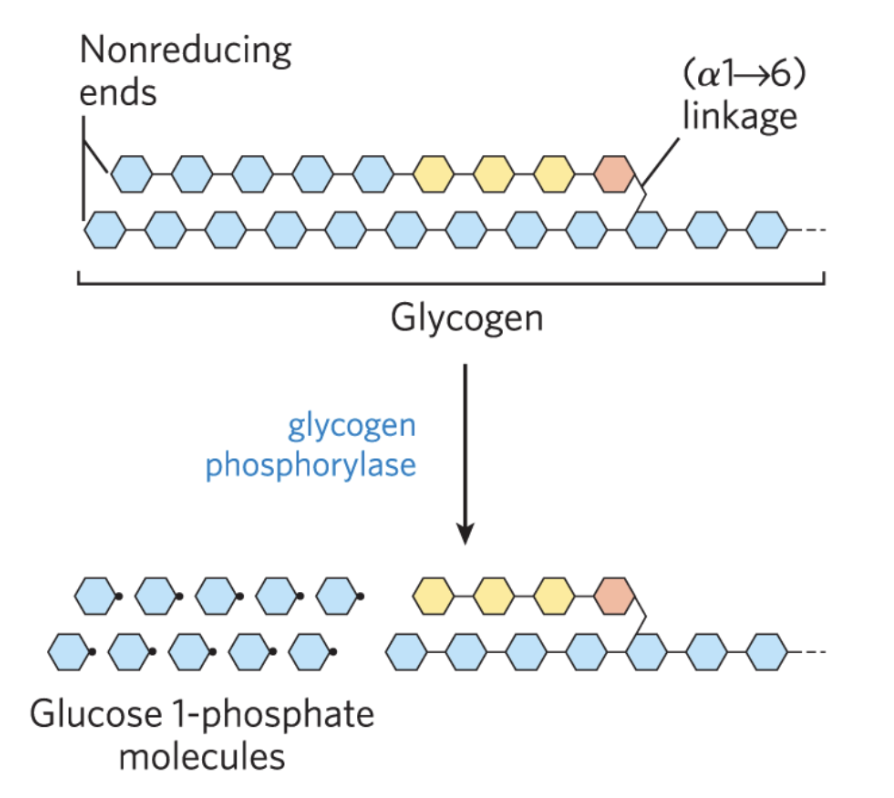
When does glycogen phosphorylase stop its phosphorolysis activity?
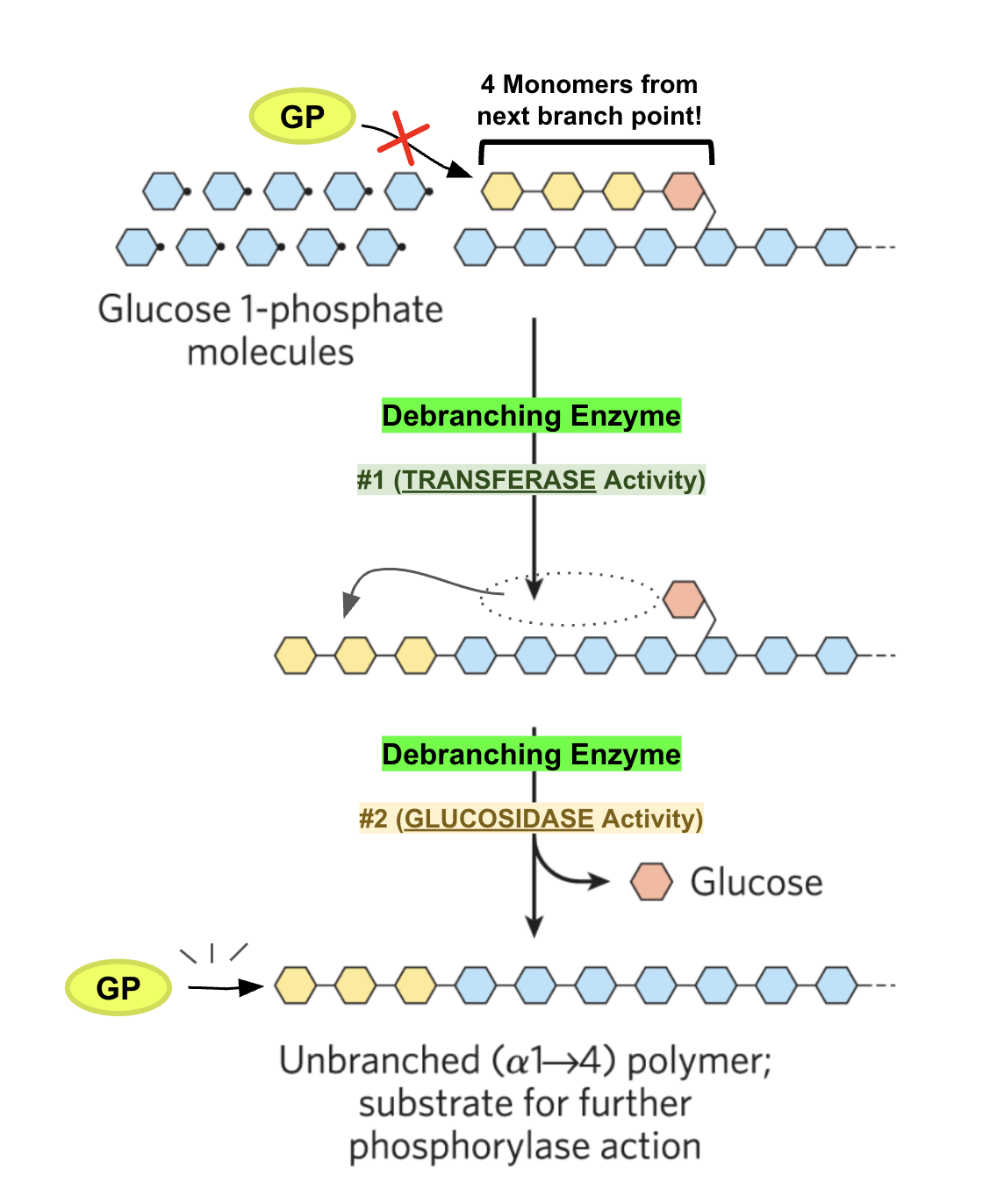
When it reaches a point in the glycogen chain it’s degrading that is 4 monomers away from the next branch point!
What are the two enzymatic activities of glycogen debranching enzyme?
1) Transferase rxn. 2) Glucosidase rxn. –> debranching enzyme is bifunctional!
Explain the process of debranching enzyme action:
Rxn #1) Transferase activity! –> Debranching enzyme transfers a group of THREE glucose molecules from the degraded branch to a nearby non-reducing end! (= Leaves on monomer behind!) Rxn 2) Glucosidase activity! –> Debranching enzyme then releases the single monomer left behind at the branch point == gets released as GLUCOSE (not G1P!) 3) Glycogen phosphorylase activity can now continue on this elongated chain