5.3 Transition Metals
No description yet. This curated deck is ready for daily study.
Card preview (24)
Define a transition metal
-d-block elements that have an ion with an incomplete d-sub shell
Why are scandium and zinc not classed as transition metals?
-because they do not have any ions with partially filled d-orbitals -scandium only forms Sc+3 ion in which d-orbitals are empty -zinc forms only Zn2+ ion in which d-orbitals are full
When writing electron configurations in what order should you write the 3d and 4s sub shell?
The 4s sub shell has a lower energy than the3d sub shell This means that the 4s orbital fills before the orbitals in the 3D sub shell
What are the two transition metals do not follow the rules for filling sub shells?
Chromium-the five 3d-orbitals and the 4s orbital all contain one electron with no orbital being completely filled. Copper-the five 3d-orbitals are full but there is only one electron in the 4s-orbital
Write out the electron configuration for chromium
1s2 2s2 2p6 3s2 3p6 4s1 3d5
Write out the electron configuration for copper
1s2 2s2 2p6 3s2 3p6 4s1 3d10
When forming positive ions from transition metals the ___ electrons are lost before the ____ electrons.
4s orbital 3d orbitals As once the electrons occupy the orbitals the 4s electrons have a higher energy (FIRST IN FIRST OUT)
Transition elements exist in more than one …
-oxidation state -e.g Fe2+ and Fe3+ -> Cr2+ and Cr3+ and Cr6+ ->Mn2+ and Mn7+
In what two ways to transition metals behave as catalysts?
->transition metals provide a surface on which a reaction can take place. Reactants are absorbed onto the surface of the metal and held in place while a reaction occurs. After the reaction, the products are desorbed and the metal remains unchanged ->transition metal ions have the ability to change their oxidation states by gaining or losing electrons. They then bind to reactants, forming intermediates as part of a chemical pathway, often with a lower activation energy which speeds up the reaction
What are the benefits and risks of transition metals catalysts?
-they reduce the amount of energy needed to make a reaction occur -transition metals compounds can be toxic, when substances bind to the active site and stop the transition metal catalysts from working, the catalysts can no longer be used and must be disposed of in a way that causes no pollution
List two examples of the catalytic behaviour of transition metals
->hydrogen peroxide decomposes slowly at room temperature and pressure into water and oxygen (2H2O2(aq) -> 2H2O(l) + O2(g) ) -manganese(IV) oxide, MnO2 is a suitable catalyst, in which manganese has a 4+ oxidation state -this reaction is used as a way to prepare oxygen gas ->zinc granules will react with dilute sulfuric acid to form hydrogen and zinc sulfate, copper sulfate acts as a catalyst, copper has a 2+ oxidation state in copper sulfate -this reaction is used to produce hydrogen gas
Define the term ligand
-a molecule or ion that can donate a pair of electrons to the transition metal ion to form a coordinate bond
Define the term complex ion
-> a transition metal ion bonded to one or more ligands by coordinate bonds (dative covalent bonds)
Define the term coordination number
-> the total number of COORDINATE bonds formed between a central metal ion and its ligands
Ligands are _________ ________ as they are electrons donors
Lewis bases
List 6 common ligands, state their formula and charge
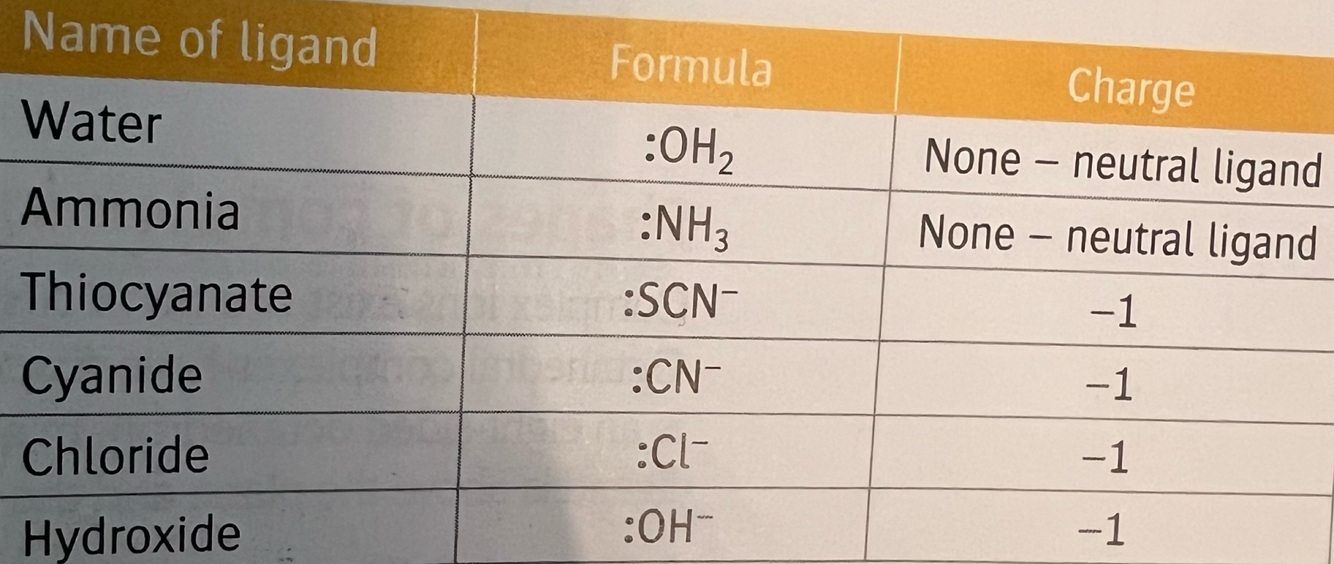
What are bidentate ligands?
-> they each form 2 coordinate bonds
Explain why ethane-1,2-diamine can act as a bidentate ligand
-nitrogen atoms both have a lone pair of electrons which can be donated to a metal ion and form 2 coordinate bonds
What is an example of a bidentate ligand?
-> NH2CH2CH2NH2 (‘en’)
List three examples of monodentate ligands
• H2O -Cl- -NH3
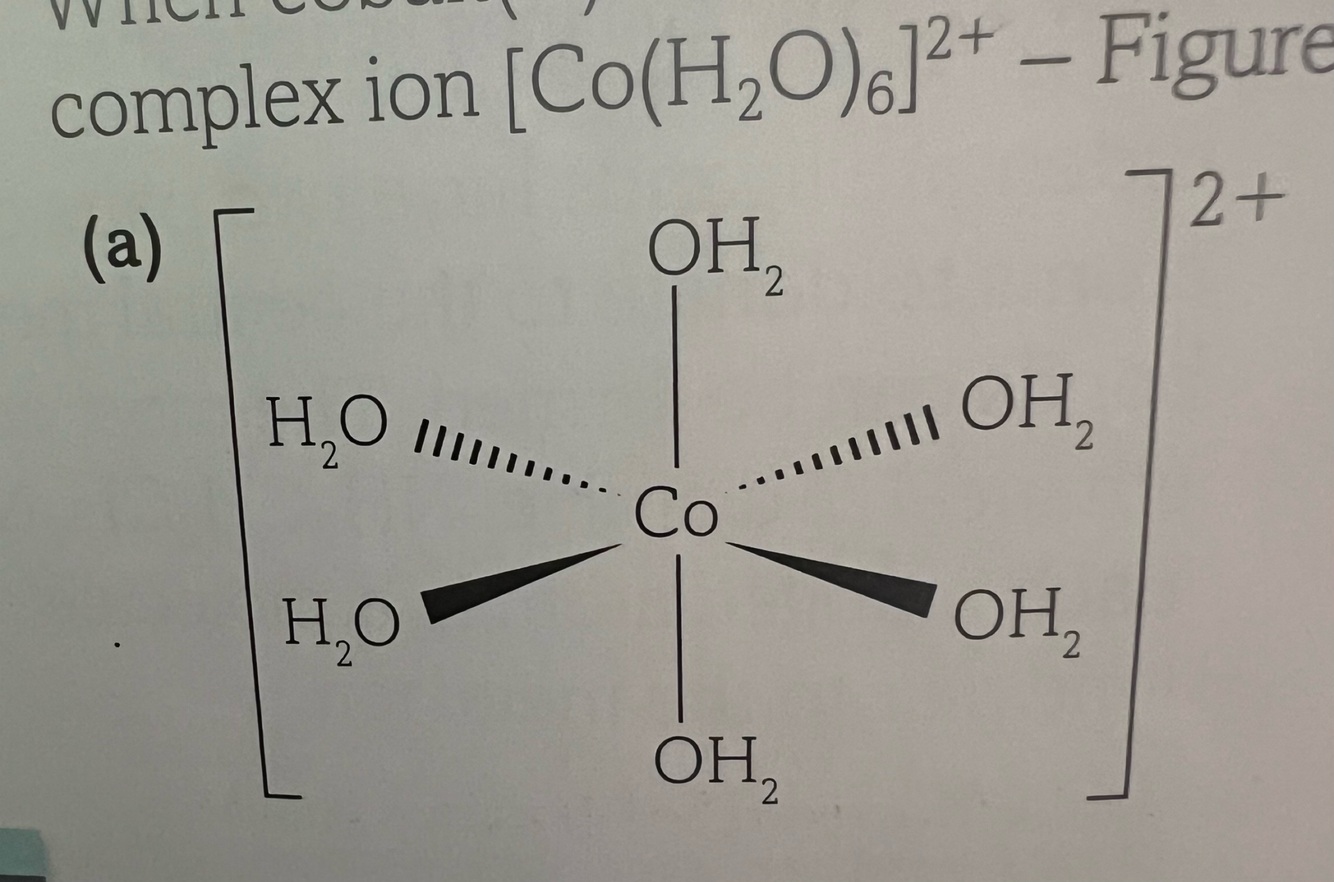
Draw out an example of a complex ion with an octahedral shape What is its coordinate number
-many hexaaqua complexes form octahedral shape -they have a coordinate number of six E.g.
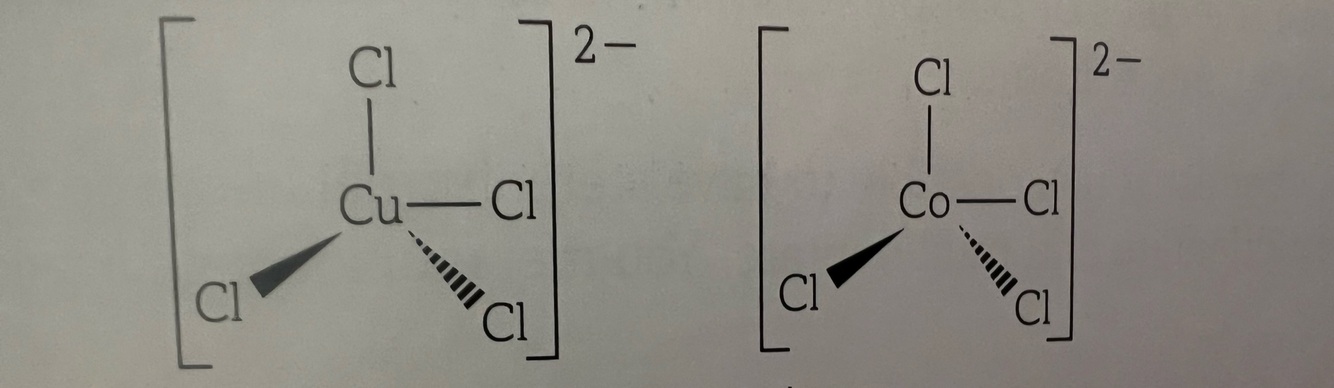
Draw out [CuCl4]2- and [CoCl4]2- What shape are they ?
Tetrahedral ->many tetrachloro complexes form tetrahedral shape as chloride ligands are so large only four can fit around the transition metal ion
Draw out a complex ion with the square planar shape What is an example of a complex ion with this shape?
-complexes of Pt often form this shape 90degrees bond angle E.g. cis-platin, Pt(NH3)2Cl2