Lecture 17 - Alkenes
No description yet. This curated deck is ready for daily study.
Card preview (12)
Compare properties of alkanes and alkenes
Alkanes: - Sp3 hybridised - tetrahedral shaped - 109.5 - saturated Alkenes: - Sp2 hybridised - trigonal planar - 120 - unsaturated
What is a C=C bond made up of?
a sigma bond with two electrons a pi bond with two electrons- electron density above and below the plane of the sigma bond
Give the property of isolated double bonds
isolated double bonds are nucleophilic due to the high region of electron density- so, they attract electrophiles.
what is the bond enthalpy of a C-C bond vs a C=C bond? What does this tell us about the strength of a pi bond?
• C-C = 346 KJmol-1 • C=C = 611KJmol-1 Pi bonds must be weaker than sigma bonds because the bond enthalpy of C=C is less than double of the C-C sigma bond
What is produced when propene reacts with HCl? Which is the major product-regioselectivity?.
2- chloropropane OR 1-chloropropane 1-chloropropane is not observed- regioselectivity.
Draw the reaction between propene with HCl showing the sigma and pi bonds and including the intermediate carbocations.
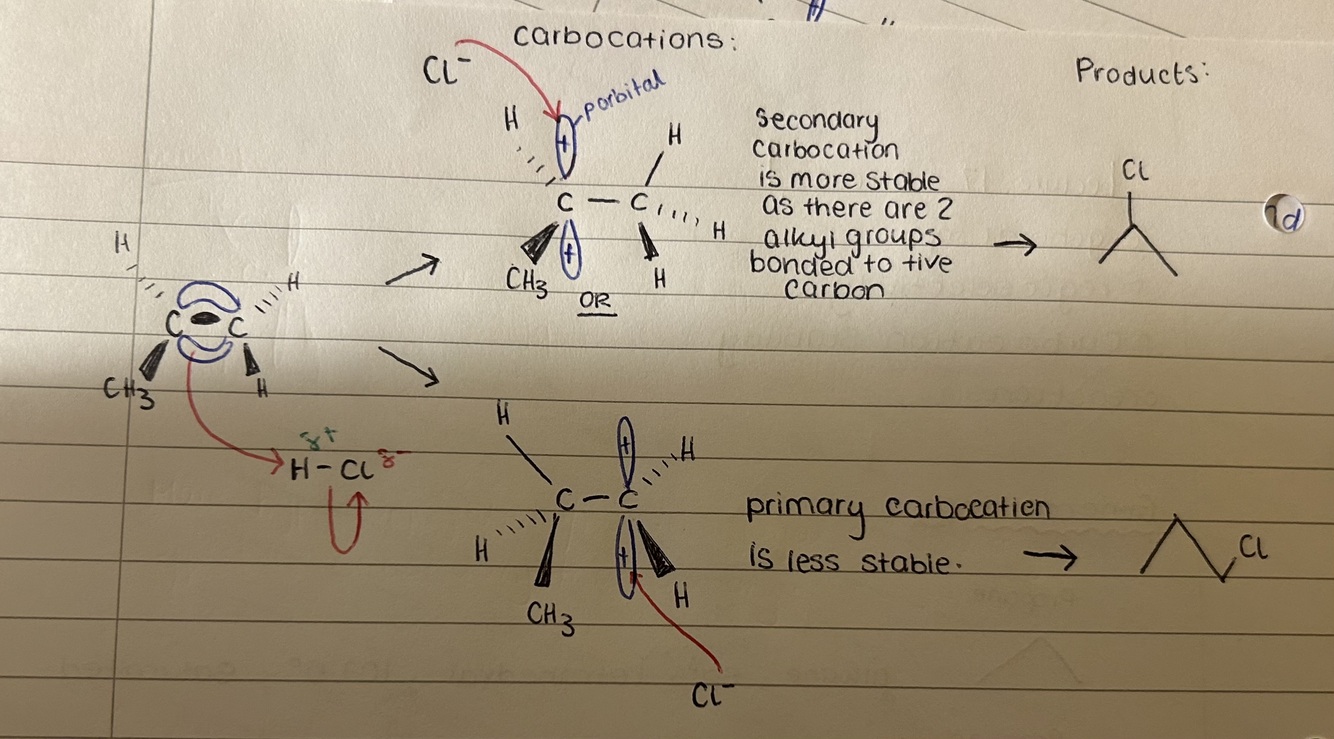
Why is 2-chloropropane the major product and not 1-chloropropane?
• 2-chloropropane is formed from a secondary carbocation and 1-chloropropane from a primary carbocation. • secondary carbocations are more stable than a primary carbocation.
Why is a secondary carbocation more stable than a primary?
• inductive effects: occur via sigma bonds. Alkyl groups push electron density towards the positively charged carbon, making it less positive and stabilising it. Secondary carbonation= more alkyl groups than primary. • hyperconjugation : this is the overlap of a sigma C-H bond with a vacant p orbital in the positively charged carbon atom. It stabilises the carbocation In secondary carbocations more C-H bonds overlap with the vacant p orbital than in primary carbocations
rank tertiary, secondary and primary carbocations in order of stability
most stable tertiary secondary primary least stable
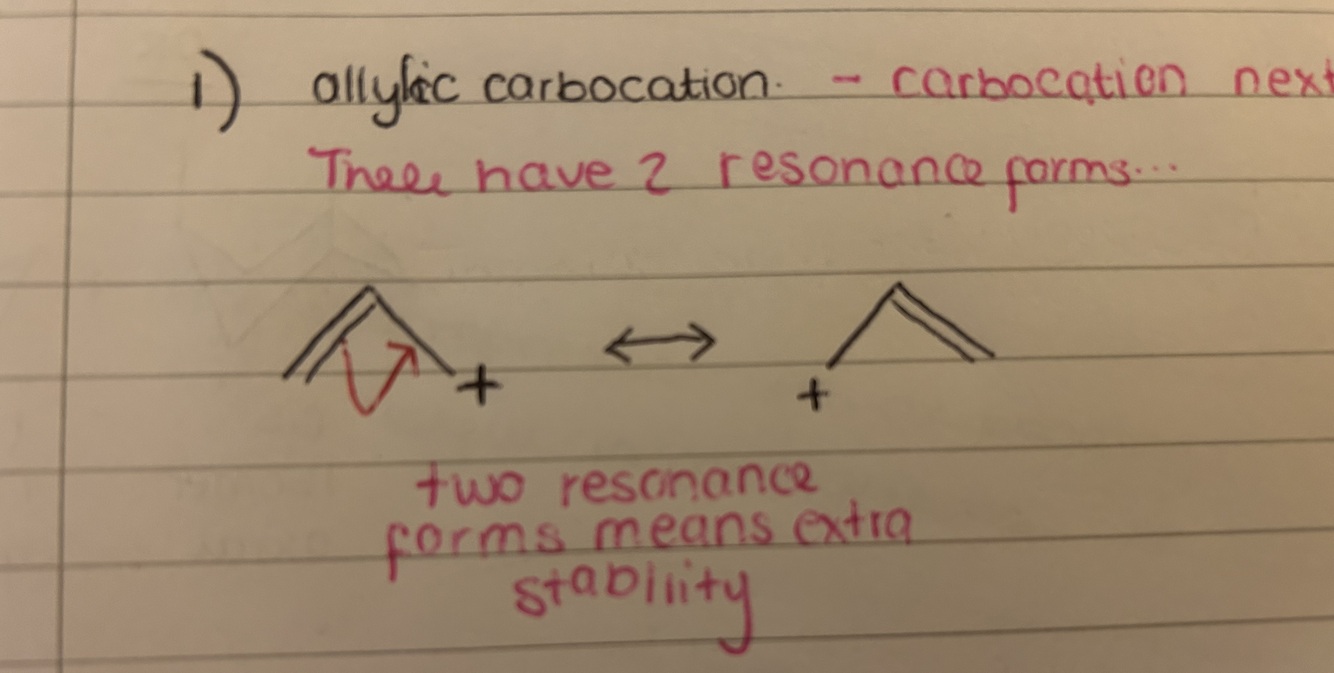
Describe why allylic carbocations are more stable.
the carbocation is next to a double bond. These have two resonance forms which means extra stability.
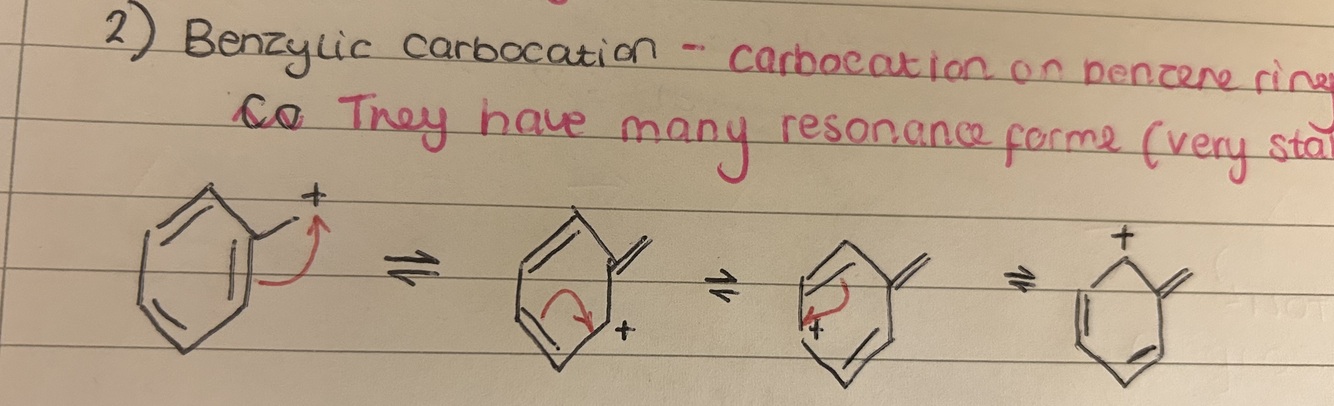
Describe why benzylic carbocations are more stable, Show all resonance forms
carbocation on benzene ring. They have many resonance forms- very stable
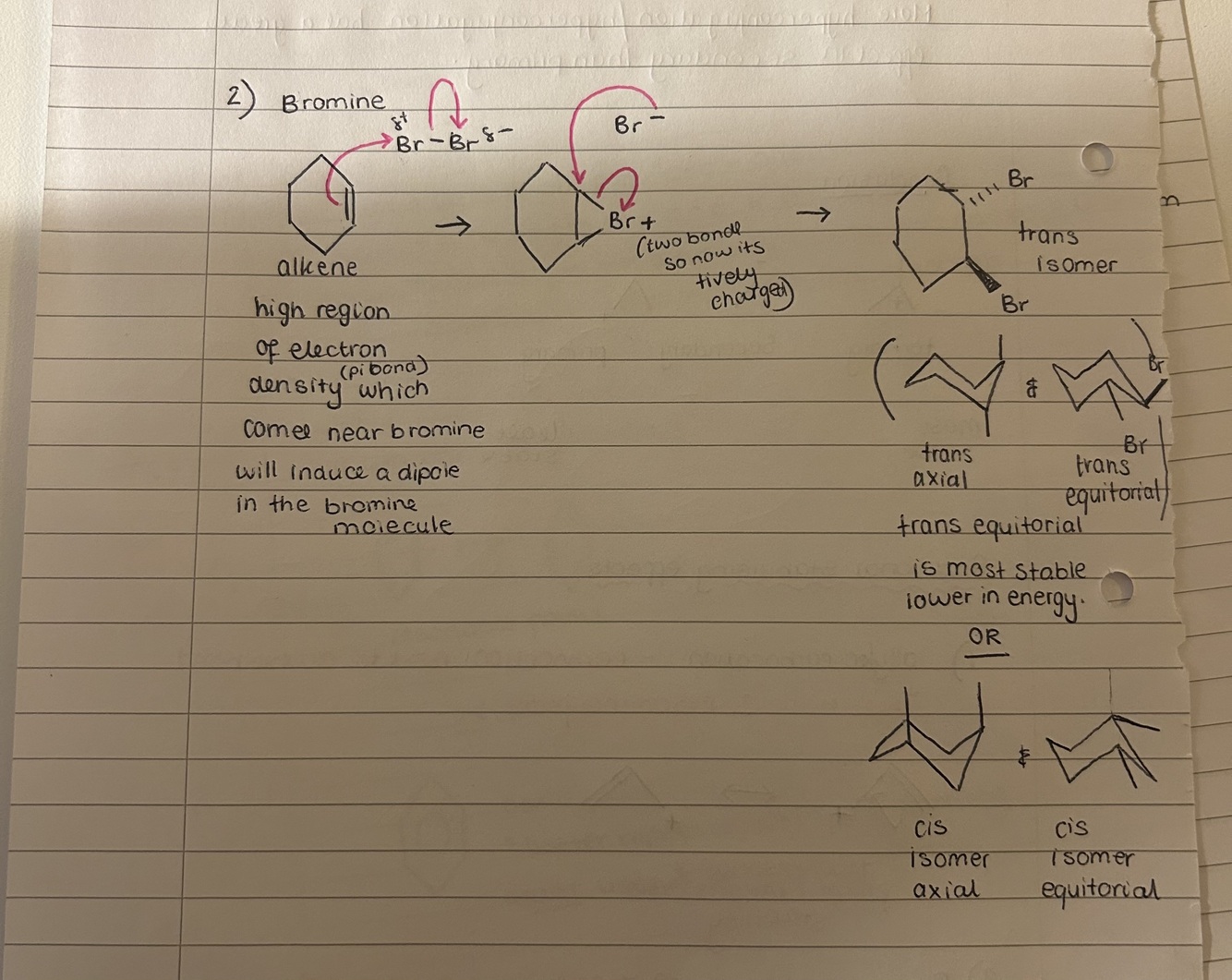
Draw the mechanism between a cyclic alkene and bromine. Draw both isomers using the chair formations.