Week 4 Day 2 Acids Bases
No description yet. This curated deck is ready for daily study.
Card preview (20)
What is an acid?
molecule that donates an H+ in solution or increases H+ concentration when in aqueous solution HA⇔H+ + A- **where A- would be a conjugate base**
What is a base?
molecule that accepts an H+ in solution or molecule that increases OH concentration when in aqueous solution H+ + B ⇔ HB+ **where HB+ is a conjugate acid**
Hydronium Ion
H3O+
Strong acids _______ ionize in solution.
fully ionize (essentially all of the molecular species dissociate into ions) i.e. HCl → H+ + Cl- or HCl + H20 → H30+ + Cl- **where HCl is the strong acid**
Weak acids ______ ionize in solution.
partially Some molecules dissociate, and some do not.
INFO CARD Example and explanation of conjugate bases and pairs
HCl is an acid and wants to give away its H+ ion. There is nothing else in the solution, so the only available base is H2O. Therefore, water in this case behaves as a base and accepts the proton from HCl. In this process, water is converted its conjugate acid, H30+, and HCl is converted into its conjugate base, Cl-.
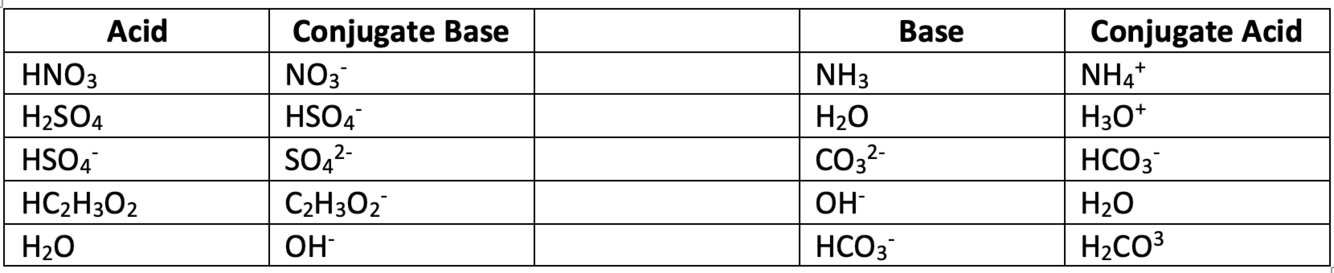
Examples of bases
NaOH - sodium hydroxide NH3 - ammonia
Examples of acids
HCl - hydrochloric acid H2SO4 - sulfuric acid H3PO4 - phosphoric acid CH3COOH - acetic acid
What does Le Chatelier’s Principle state?
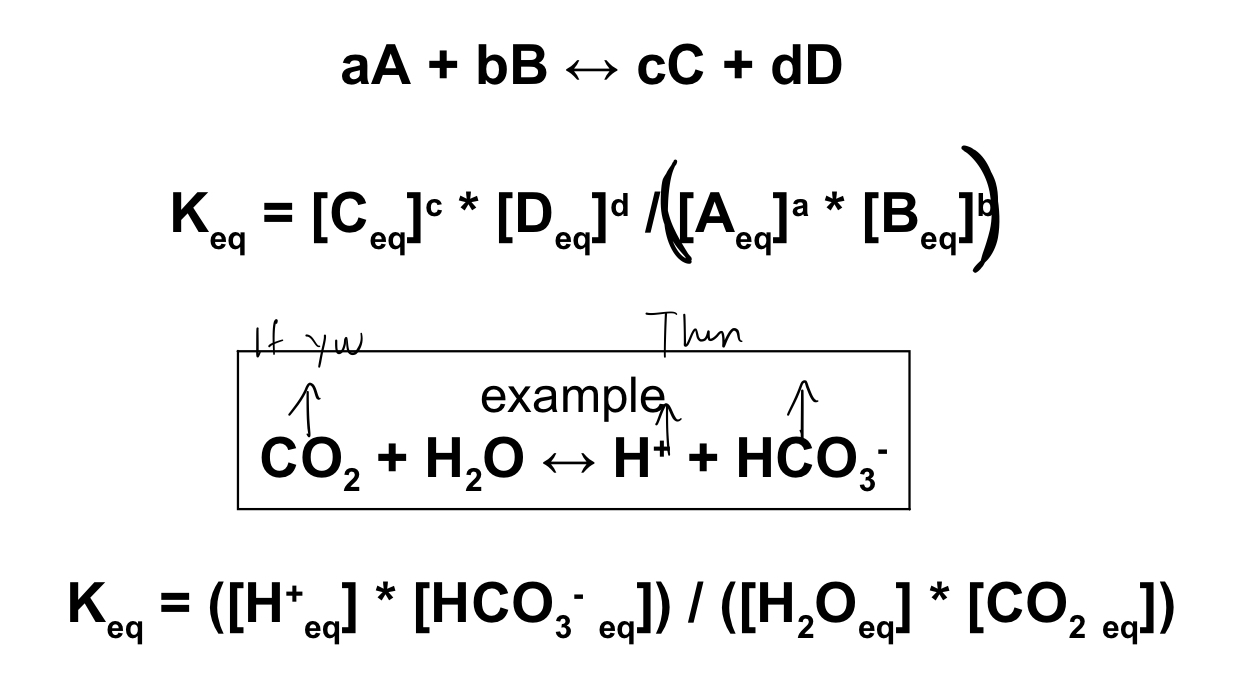
If a system at equilibrium is disturbed so that the ratio of products to reactants no longer equals the equilibrium constant, it will react so as to reestabilsh the equilibrium state. Keq = generic equilibrium contant
Can something have a -pH?
yes pH = -log[H+] or10-pH = H+ if H+ = 2, then pH = -0.3
Henderson-Hasselbalch equation
pH = pKa + log([A-] / [HA]) HA ⇔ H+ + A- **where HA is the acid, and A- is the conjugate base**
Strong acids include…
H2SO4 - sulfuric acid HI - hydroiodic acid HBr - hydrobromic acid HCl - hydrochloric acid HNO3 - nitric acid **Most other acids are weak acids!** **Note: When a strong acid dissolves in water, it dissociates completely. This reaction goes to completion and is not an equilibriating process.**
The equilibrium constant (K) is often applied with a subscript. The subscript denotes the type of equilibrium reaction. K<strong>a</strong> is the equilibrium constant for which kind of reaction?
the ionization of weak acids also stated… Ka is a measure of the acid’s strength
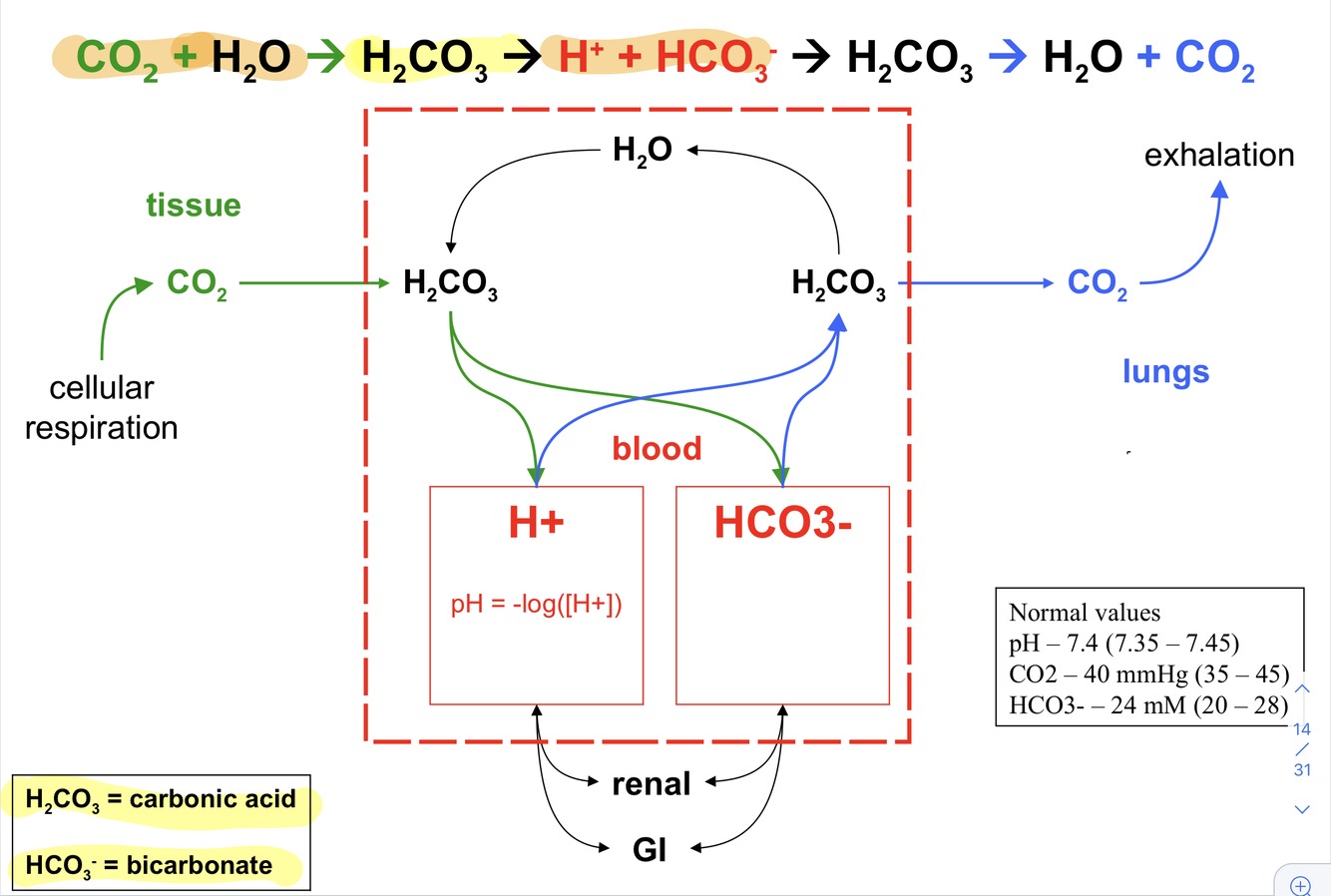
Acid-base regulation Relationship of CO2, H2O, H+, HCO3-, and H2CO3
In regards to the value of K (equilibrium constant), fill in the blanks. As K increases (K>1), the reaction tends to favor ________. As K decreases (K<1), the reaction tends to favor ________.
products; reactants *K > 1 means that the forward reaction becomes more favorable* *K < 1 means that the reverse reaction becomes more favorable*
INFO CARD Conjugates acids and bases simplifed
acid → H+ + conjugate base base + H+ → conjugate acid
The most common nonmetal oxide in physiology
carbon dioxide
A buffer is a solution that contains a weak acid and its conjugate base. Describe 3 additional characteristics of a buffer.
A buffer solution resists changes in pH The weak acid absorbs any added strong base. The weak base absorbs any added strong acid.
T or F: Keq is temperature dependent.
True
INFO Card: memorize this formula
CO2 + H2O ⇔ H+ +HCO3- pH = 6.1 + log ([HCO3-] / .03 * PCO2])