S4) The Medical Profession
No description yet. This curated deck is ready for daily study.
Card preview (17)
What is a profession?
• A profession is a type of occupation able to make distinctive claims about its work practices and status • In healthcare, it usually refers to occupations requiring registration
What is professionalisation?
Professionalisation describes the social and historical process that results in an occupation becoming a profession
In three steps, describe professionalisation – the process of an occupation becoming a profession
⇒ Asserting an exclusive claim over a body of knowledge/expertise ⇒ Establishing control over market and exclusion of competitors ⇒ Establishing control over professional work practice
What is socialisation?
Socialisation is the process by which professionals learn during their education and training the behaviours and attitudes necessary to assume their professional role
What are the three claims for the right to self-regulation?
• Claim 1: non-professionals are not equipped to evaluate/regulate the unusual degree of skill and knowledge involved in professional work • Claim 2: professionals are responsible – they may be trusted to work conscientiously without supervision • Claim 3: the profession may be trusted to undertake the proper regulatory action on rare occasions when an individual doesn’t act competently/ethically
What were Freidson’s criticisms of self-regulatory model in 1970?
Freidson argued that self- regulation promoted a self-deceiving vision of the objectivity and reliability of its knowledge and the virtues of its members
Identify four systemic problems explaining why self-regulation is unsuccessful in the NHS
• Staff who were informed found it difficult to act • Patients who told HCW were often greeted with disbelief / discredited • Whistleblowers were not always believed • NHS disciplinary procedures were found to be ‘cumbersome, costly and inhibiting’
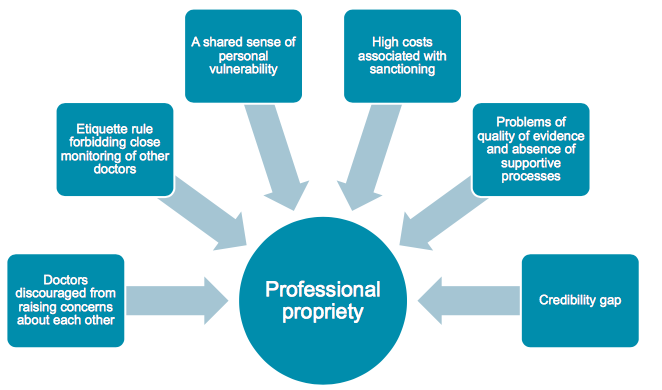
What are the rules on professional propriety?
In five steps, explain how the end of self-regulation occured in the UK
⇒ GMC now has parity of lay and professional members ⇒ All members are appointed independently ⇒ The council is overseen by the professional standards authority for health and social care ⇒ Civil rather than criminal standard of proof ⇒ Sweeping reform of processes
Fitness to practice concerns are referred to the Medical Practitioners Tribunal Services (MPTS). Provide some examples of reasons for referral
• Misconduct • Poor performance • A criminal conviction or caution in the UK • Physical or mental ill-health • Determination by a regulatory body either in the UK/overseas
Fitness to practice concerns are referred to the Medical Practitioners Tribunal Services (MPTS). Provide some actions taken by the MPTS
• Agree undertakings with the doctor • Place conditions on their registration • Suspend their registration • Remove them from the medical register
What is revalidation?
Revalidation is the process by which licensed doctors are required to demonstrate on a regular basis that they are up to date and fit to practise
Identify six aims of revalidation
• Aims to assure patients (positive affirmation) • Maintains and improves practice • Provides support to doctors in keeping their practice up to date • Identifies concerns about doctors at an early stage • Encourages patient feedback • Acts as a driver for improving clinical governance at the local level
In three steps, provide a summary of revalidation
⇒ Medical Royal Colleges set the content and standards for each speciality ⇒ Doctors have to provide evidence that shows they are fit to continue practising ⇒ Responsible officer has to make assessments of the evidence as part of the appraisal process
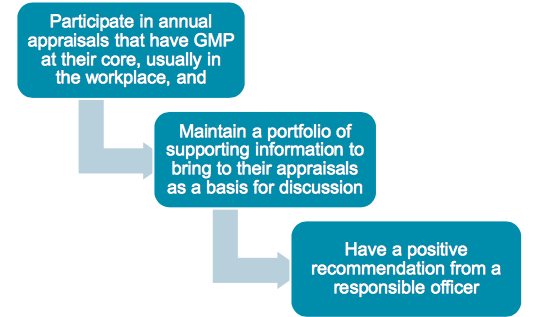
What does revalidation involve?
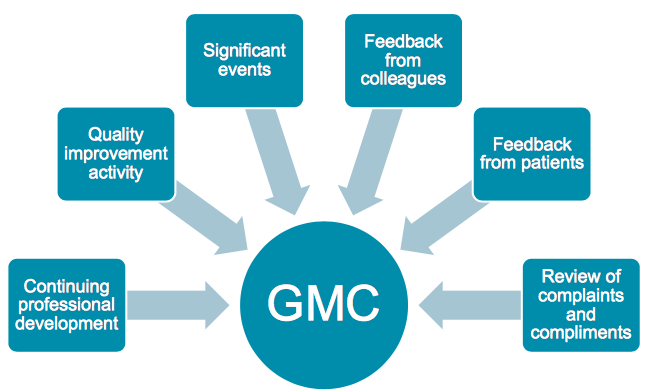
What evidence does a doctor need for revalidation?
Identify six threats to clinical autonomy
• Proliferation of guidelines • Inspection and monitoring • Pay for performance • Performance league tables • Reputational sanctions • Electronic medical records and surveillance