6.3 ANALYSIS
暂无描述。系统推荐的高质量记忆内容,适合每天坚持背诵学习。
卡片预览 (21 张)
Test for alkenes?
Reagents = bromine water Observation = add few drops of bromine water, shake Result = orange to colourless
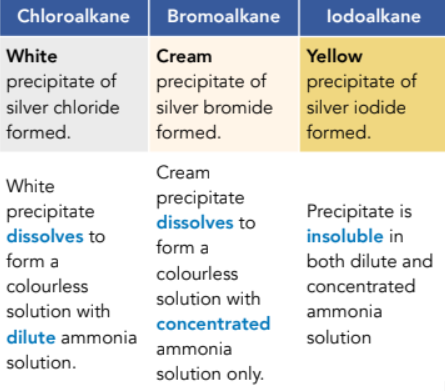
Test for haloalkanes?
Reagents = aqueous silver nitrate and ethanol Observation = add reagents Result =
Test for carbonyl compounds?
Reagents = 2,4- DNP (bradys reagent) Observation = add reagent Result = orange percipitate forms
Test for aldehydes?
Reagents = tollens reagent Observation = add reagent Result = silver mirror coating forms
Test for alcohols?
Reagents = acidified potassium dichromate Observation = distill for primary alcohols, then excess reagent and strong reflux for primary alcohols, reflux for secondary alcohols Result = colour change from orange to green
Test for phenols?
Reagents = carbonate ion and pH probe Observation = check pH is that of a weak acid, add carbonate ion Result = no effervesence, no reaction with carbonate ion
Test for aliphatic carboxylic acids?
Reagents = reactive metal/metal carbonate and pH probe Observation = check pH is that of a weak acid, add reactive metal Result = effervensence produced as carboxylic acid reacts
What is the stationary phase in thin-layer chromatography?
• Metal/glass covered in absorbant chemical (aluminum oxide/silicone dioxide)
What is the mobile phase in thin-layer chromatography?
• An organic liquid solvent
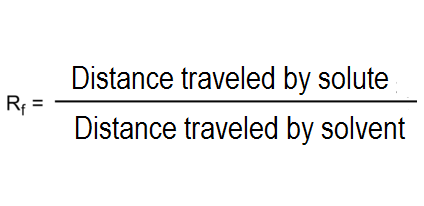
Rf value equation?
What is the stationary phase in gas chromatography?
• A solid/liquid coating on a coiled tube
What is the mobile phase in gas chromatography?
• An unreactive carrier gas
In a gas chromatography chart, what does the area under the peaks show?
• The relative concentration of that chemical in the mixture
What is TMS used for in NMR spectroscopy
• an internal standard for carbon and proton NMR chemical shift
Describe what deuterium is
• An isotope of hydrogen that does not produce signals on a proton NMR as it doesnt contains protons
State the two deuterium solvents
• CDCl3 • D2O
Explain the use of the deuterium solvent CDCl3
• Used as a solvent
Explain the use of the deuterium solvent D2O
• Used to identify OH and NH protons by exchanging protons so that their signals do not show up when D2O is shook vigerously in sample
What does the number of peaks/signals show on carbon/proton NMR
• the number of different environments
What does the peak splitting on signals of proton NMR show?
• the number of hydrogen atoms on adjacent carbon atoms • (n+1)
What does the number above the signals on proton NMR show?
• the number of hydrogen atoms in that environment