AQA A Level Chemistry - Group 7 (Inorganic)
No description yet. This curated deck is ready for daily study.
Card preview (13)
What are the halogens and their properties?
• Fluorine (F2): very pale yellow gas, it is highly reactive • Chlorine (CI2): greenish, reactive gas, it is poisonous in high concentrations • Bromine (Br2): red liquid, that gives off dense brown/orange poisonous fumes • Iodine (I2): shiny grey solid sublimes to purple gas
What is the trend in the melting and boiling point of halogens as you go down the group?
• Increases down the group • As the molecules become larger they have more electrons and so have more van der waals forces between the molecules • As the intermolecular forces get larger more energy is required to break the forces • This increases the melting and boiling points
What is the trend in electronegativity for the halogens as you go down the group?
• Electronegativity is the ability of an atom to attract a pair of electrons in a covalent bond • As one goes down the group the electronegativity of the elements decreases • As one goes down the group the atomic radius increases due to the increasing number of shells • The nucleus is therefore less able to attract the bonding pair of electrons
What is the trend in the oxidising ability of the Halogens as you go down the group?
• The oxidising ability of the halogens decreases as you go down the group • Due to larger atomic radius • Weaker attraction between nucleus and incoming electron (oxidising agents are electron acceptors) • A halogen that is a strong oxidising agent will displace a halogen that has a lower oxidising power from one of its compounds • Chlorine will displace both bromine and iodide ions, bromine will displace iodide ions
What are the observations for the displacement reactions of halide ions by halogens?
• The colour of the test tube in solution shows which free halogen is present in solution • Chlorine = very pale green solution (often colourless) • Bromine = yellow solution • Iodine = brown solution (sometimes black solid present)
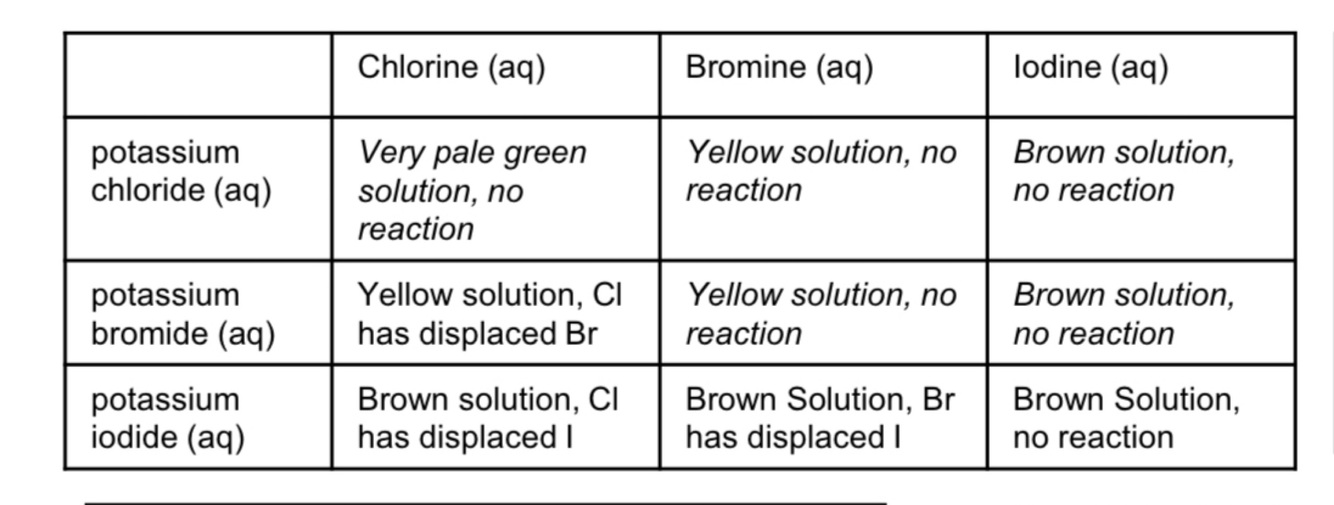
What are the equations and the half equations for the displacement reactions of halide ions by halogens?

The reactions of halide ions with silver nitrate
• This reaction is used as a test to identify which halide ion is present. The test solution is made acidic with nitric acid, and then silver nitrate solution is added dropwise • The role of nitric acid is to react with any carbonates present to prevent formation of the precipitate Ag2CO3. This would mask the desired observations • 2 HNO3 + Na2CO3 ➡️ 2 NaNO3 + H2O + CO2 • Fluorides produce no precipitate • Chlorides produce a white precipitate • Ag+(aq) + Cl- (aq) ➡️ AgCl(s) • Bromides produce a cream precipitate • Ag+(aq) + Br- (aq) AgBr(s) • Iodides produce a pale yellow precipitate • Ag+(aq) + I- (aq) ➡️ AgI(s) • The silver halide precipitates can be treated with ammonia solution to help differentiate between them if the colours look similar: • Silver chloride dissolves in dilute ammonia to form a complex ion • AgCl(s) + 2NH3(aq) ➡️ [Ag(NH3)2]+ (aq) + Cl- (aq) (colourless solution) • Silver bromide dissolves in concentrated ammonia to form a complex ion • AgBr(s) + 2NH3(aq) ➡️ [Ag(NH3)2]+ (aq) + Br- (aq) (colourless solution) • Silver iodide does not react with ammonia - it is too insoluble
The reaction of halide salts with concentrated sulfuric acid
• A reducing agent donates electrons • The reducing power of the halides increases down group 7 • They have a greater tendency to donate electrons • This is because as the ions get bigger it is easier for the outer electrons to be given away as the pull from the nucleus on them becomes smaller • The halides show increasing power as reducing agents as one goes down the group • This can be clearly demonstrated in the various reactions of the solid halides with concentrated sulfuric acid
The reaction of halide salts with concentrated sulfuric acid
• Fluoride and Chloride: • F- and Cl- ions are not strong enough reducing agents to reduce the S in H2SO4. No redox reactions occur. Only acid-base reactions occur • NaF(s) + H2SO4(l) → NaHSO4 (s) + HF(g) • Observation: white steamy fumes of HF are evolved • NaCl(s) + H2SO4(l) → NaHSO4 (s) + HCl (g) • Observation: white steamy fumes of HCl are evolved • These are acid-base reactions and not redox reactions. H2SO4 plays the role of an acid (proton donor) • Bromide: • Br- ions are stronger reducing agents than Cl- and F- and after the initial acid-base reaction, the bromide ions reduce the sulfur in H2SO4 from +6 to +4 in SO2 • Acid-base step: NaBr(s) + H2SO4(l) -> NaHSO4(s) + HBr(g) • Redox step: 2H+ + 2Br- + H2SO4 -> Br2(g) + SO2(g) + 2H2O(l) • Overall equation combining two steps above: 2NaBr + 3H2SO4 -> 2NaHSO4 + SO2 + Br2 + 2H2O • Ox 1/2 equation: 2Br- -> Br2 + 2e- • Re 1/2 equation: H2SO4 + 2H+ + 2e- -> SO2 + 2H2O • Reduction product = sulfur dioxide • Note: the H,SO4 plays the role of acid in the first step producing HBr and then acts as an oxidising agent in the second redox step. • Observation: White steamy fumes of HBr are evolved. orange fumes of bromine are also evolved and a colourless, acidic gas SO,
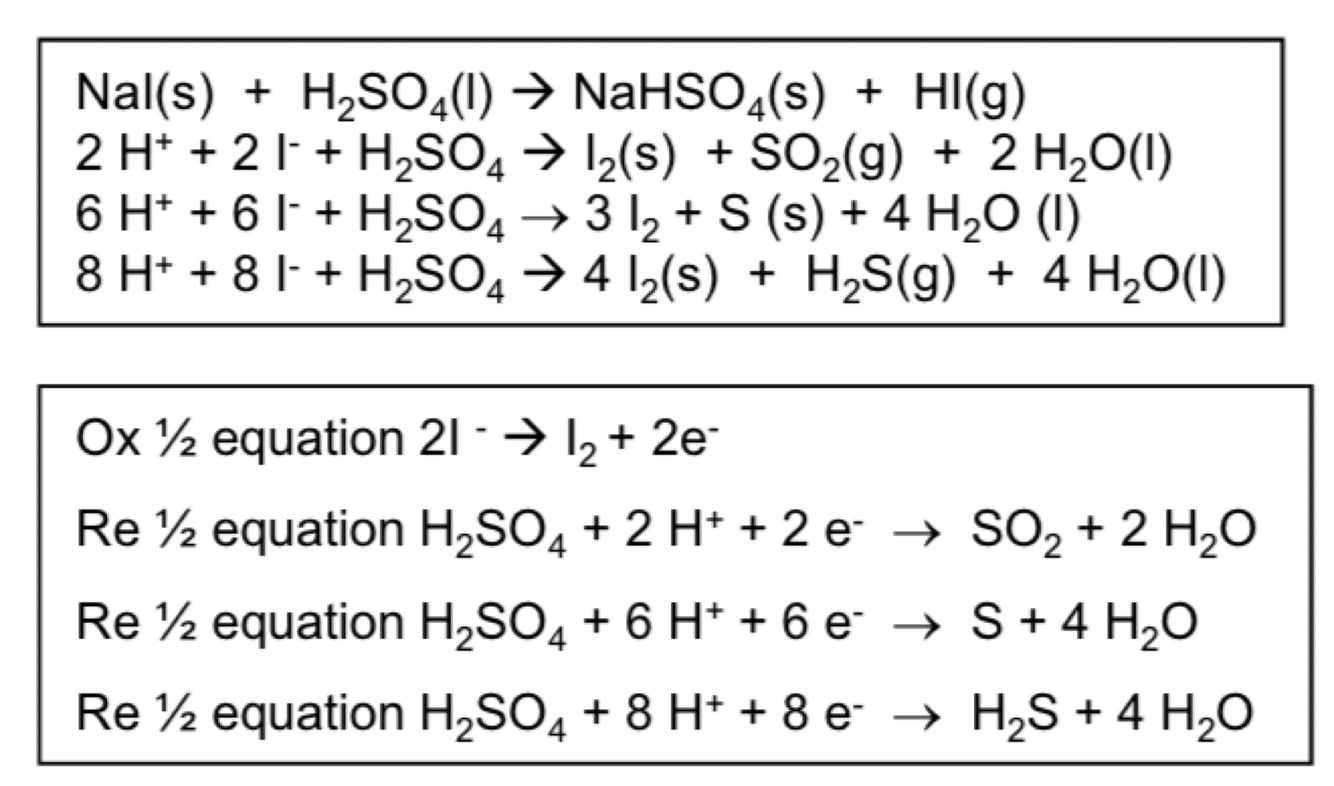
The reaction of halide salts with concentrated sulfuric acid - Iodide
• I- ions are the strongest halide reducing agents. They can reduce the sulfur from +6 in H2SO4 to +4 in SO2, to 0 in S and -2 in H2S • Observations: • White steamy fumes of HI are evolved • Black solid and purple fumes of iodine are also evolved • A colourless, acidic gas, SO2 • A yellow solid of sulfur • H2S, Hydrogen Sulphide, a gas with a bad egg smell • Reduction products = sulphur dioxide, sulphur and hydrogen sulphide • Note the H2SO4 plays the role of acid in the first step producing HI and then acts as an oxidising agent in the three redox steps
The disproportionation reactions of chlorine
• Disproportionation is the name for a reaction where an element simultaneously oxidises and reduces • Chlorine with water: • Cl2 (g) + H2O (l) <=> HClO (aq) + HCl (aq) • In this reaction chlorine is both simultaneously reducing and oxidising • If some universal indicator is added to the solution it will first turn red due to the acidity of both reaction products. It will then turn colourless as the HClO bleaches the colour. • Reaction with water in sunlight: • If the chlorine is bubbled through water in the presence of bright sunlight a different reaction occurs • 2Cl2 (g) + 2H2O (l) -> 4HCl (aq) + O2 (g) • Ionic version: • 2Cl2 + 2H2O -> 4H+ + 4Cl- + O2 • The same reaction occurs to an equilibrium mixture of chlorine water when standing in sunlight. The greenish colour of chlorine water fades as the Cl2 reacts and a colourless gas (O2) is produced • The greenish colour of these solutions is due to the Cl2 • Chlorine is used in water treatment to kill bacteria • It has been used to treat drinking water and the water in swimming pools • The benefits to health of water treatment by chlorine outweigh its toxic effects
Reaction of Chlorine with cold dilute NaOH solution:
• Cl2 (and Br2, I2) in aqueous solutions will react with cold sodium hydroxide. The colour of the halogen solution will fade to colourless • Cl2 (aq) + 2 NaOH (aq) → NaCl (aq) + NaClO (aq) + H2O (l) • The mixture of NaCl and NaClO is used as bleach and to disinfect/kill bacteria
What are the colours of the halogens in water and organic solvent?
Cl2 - very pale green in both (often looks colourless Br2- yellow in water and orange in organic solvent I2 - pale brown in water and violet in organic solvent