AQA A Level Chemistry - Aromatics (Organic)
No description yet. This curated deck is ready for daily study.
Card preview (12)
What are the two major classes of organic chemicals?
• aliphatic : straight or branched chain organic substances • aromatic or arene: includes one or more ring of six carbon atoms with delocalised bonding. benzene belongs to the aromatic class
What is Benzene’s structure?
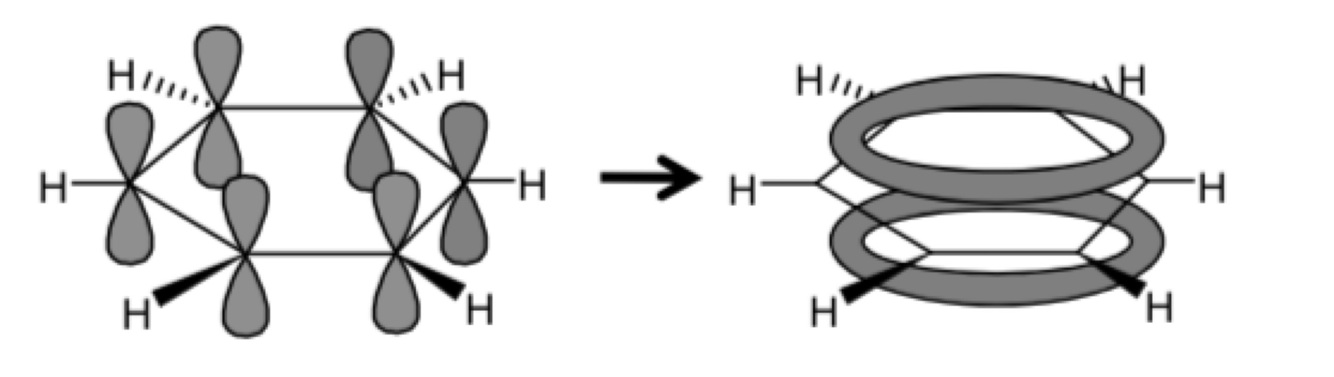
• The simplest arene is benzene. It has the molecular formula C6H6. Its basic structure is 6 C atoms in a hexagonal ring, with one H atom bonded to each C atom. • Each C atom is bonded to two other C atoms and one H atom by single covalent sigma bonds. This leaves one unused electron on each C atom in a p-orbital, perpendicular to the plane of the ring. • The six p electrons are delocalised in a ring structure above and below the plane of carbon atoms • The six electrons in the pi bonds are delocalised and spread out over the whole ring. Delocalised means not attached to a particular atom. • The H-C-C bond angle is 120 degrees in Benzene • Benzene is a planar molecule. The evidence suggests that all the C-C bonds are the same and have a length and bond energy between a C-C single and C=C double bond
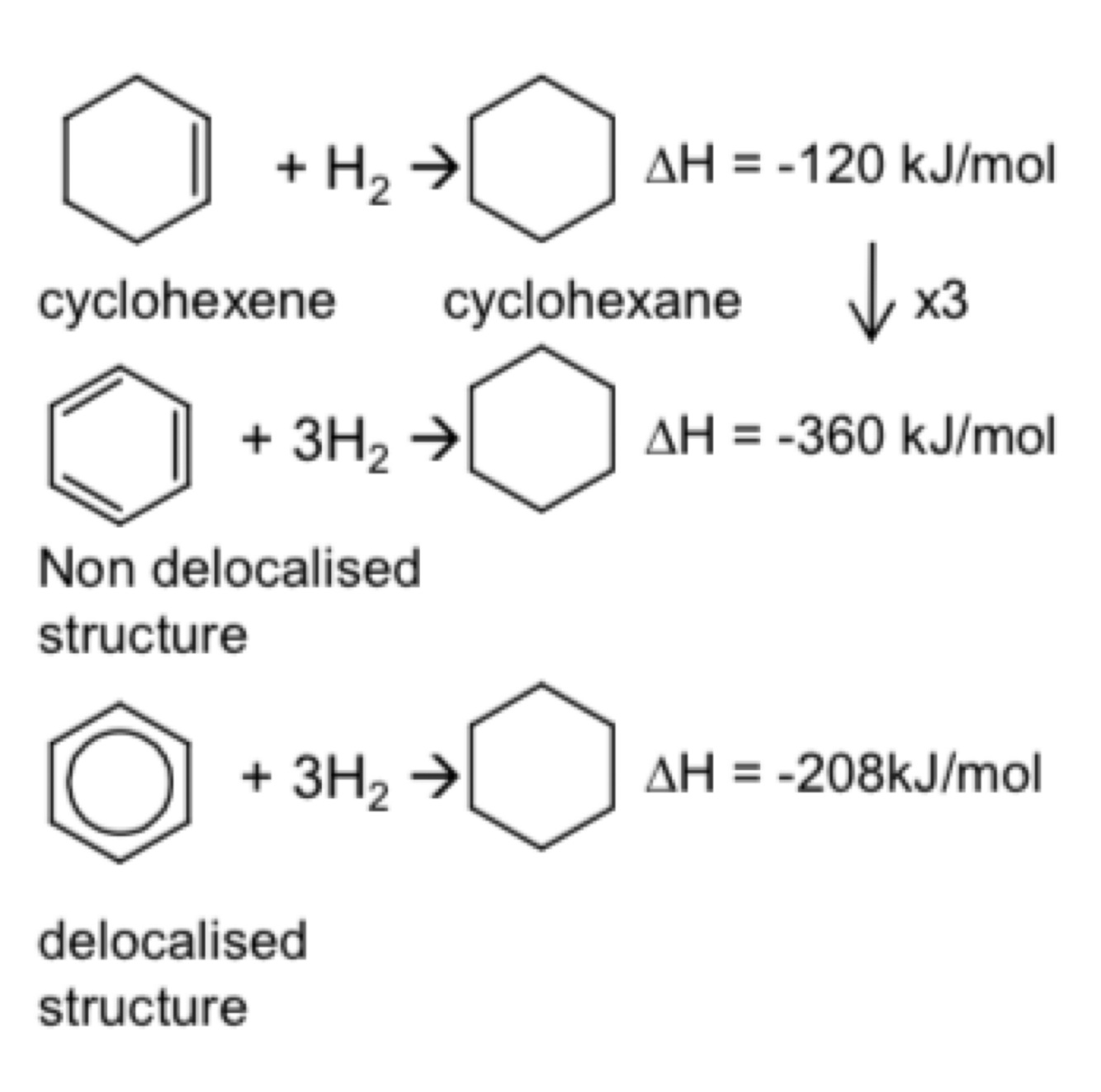
Using enthalpies of hydrogenation to show thermodynamic stability
• Theoretically because there are 3 double bonds in the theoretical cyclohexa-1,3,5-triene one might expect the amount of energy to be 3 times as much as cyclohexene. • However, in actual benzene the amount of energy is less. The 6 pi electrons are delocalised and not arranged in 3 double bonds. • If we do hydrogenate benzene only about -208 KJmol-1 is released, 152kJmol-1 less exothermic than expected • Benzene is 152kJmol-1 more stable than expected. This is what we call the delocalisation stabilisation of benzene • The increase in stability connected to delocalisation is called the delocalisation energy • This when represented on an energy level diagram shows that the delocalised benzene is more thermodynamically stable than the theoretical structure
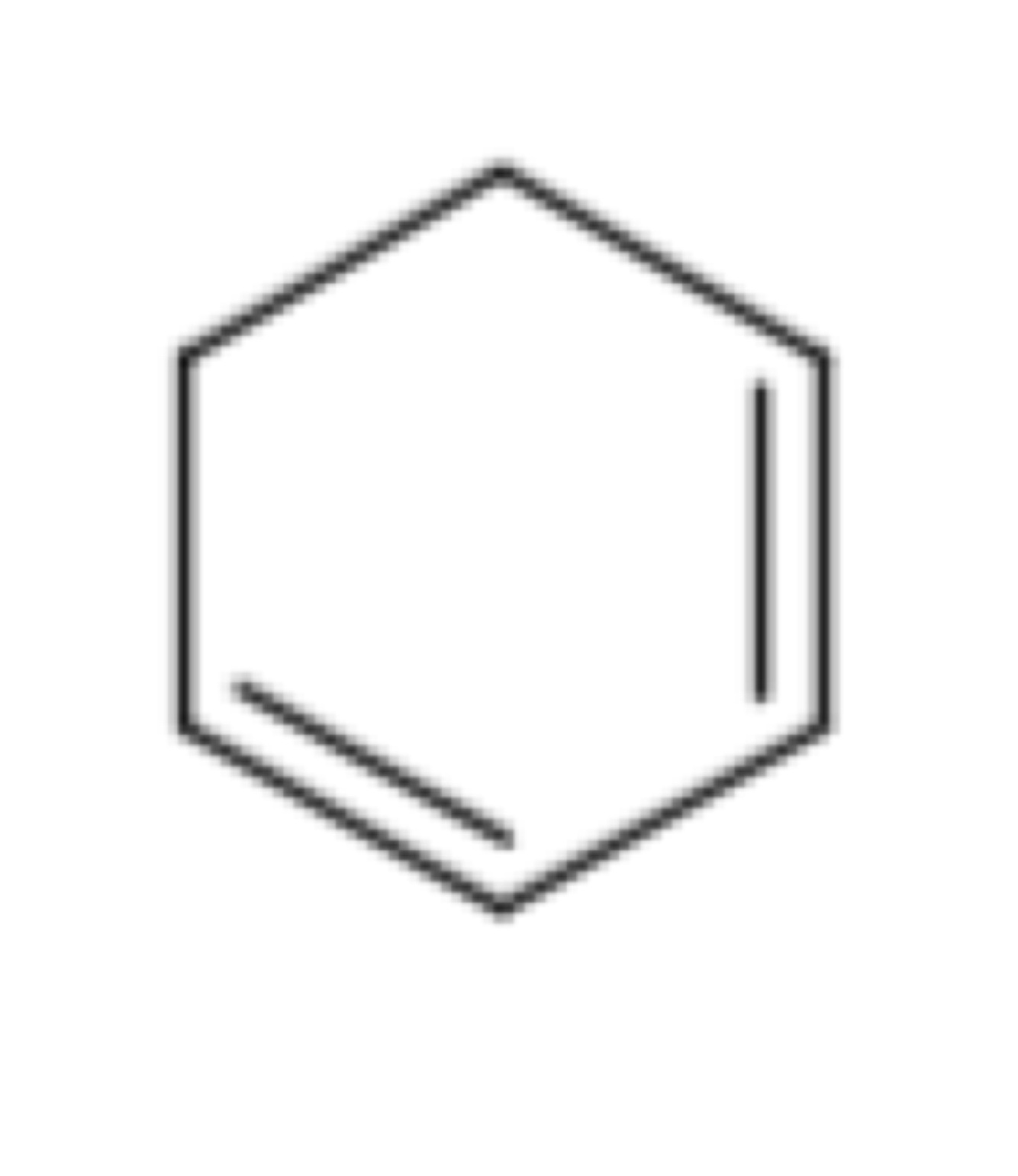
Cyclohexa-1,3-diene
• In cyclohexa-1,3-diene there would be some delocalisation and extra stability as the pi electrons are close together (close enough to allow delocalisation) and so overlap. The hydrogenation value would be less negative than -240Kjmol-1 (showing more stable)
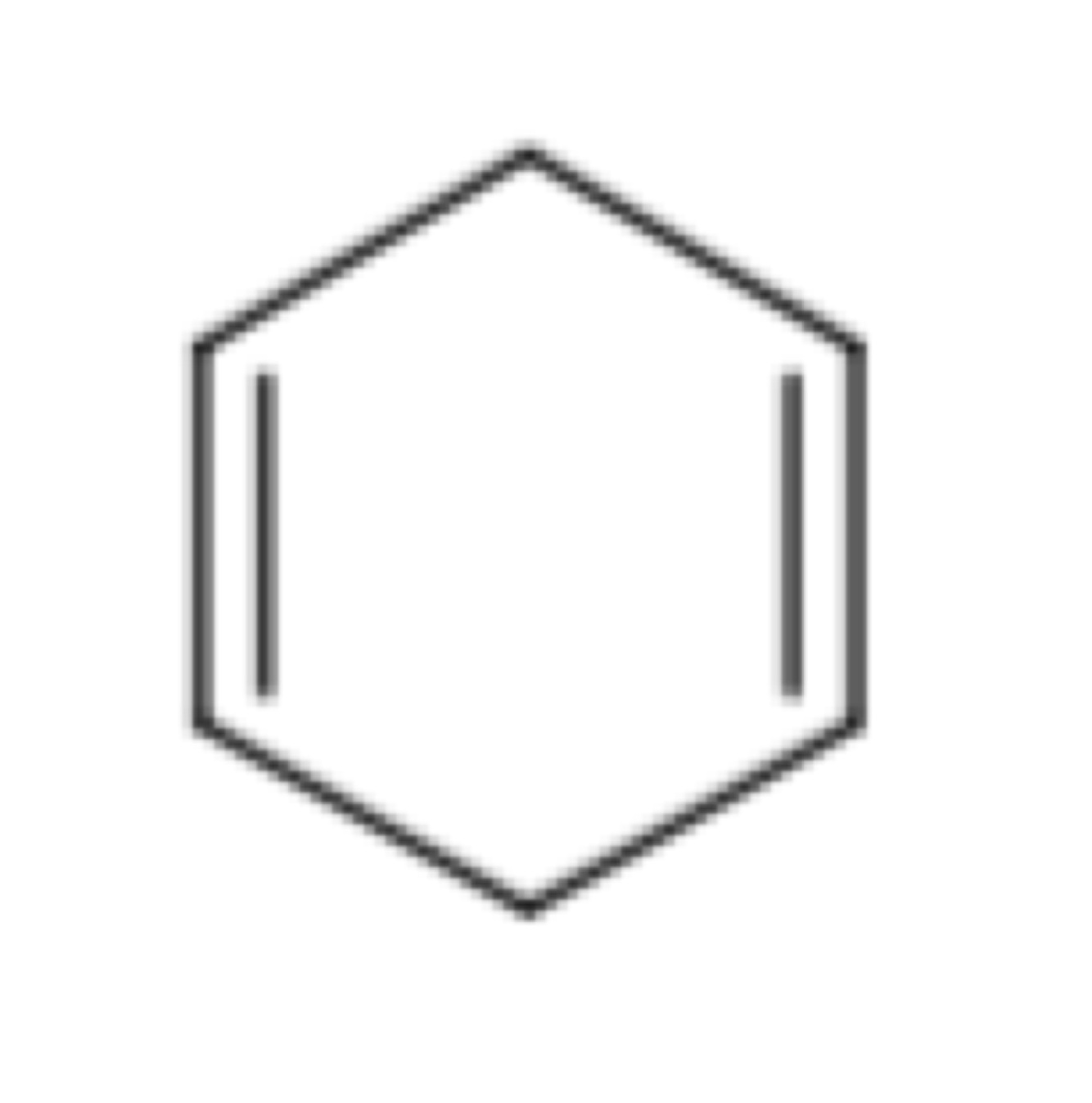
Cyclohexa-1,4-diene
• In cyclohexa-1,4-diene, there would not be delocalisation as the pi electrons are too far apart and so don’t overlap. The hydrogenation value would be -240Kjmol-1
Is Benzene an Alkene? 3 Reasons that it is not:
Cyclohexa-1,3,5-triene vs Benzene 1) Reactivity (with Br2) Cyclohexa-1,3,5-triene undergoes electrophilic addition with Br2. Bromine water would turn from orange to colourless Benzene actually undergoes substitution reactions, not addition reactions. Benzene only reacts with bromine at high temperatures and with a catalyst 2) Enthalpy of hydrogenation Cyclohexa-1,3,5-friend would be expected to release about -360kJmol-1 when fully hydrogenated Benzene only releases -208kJmol-1 when hydrogenated, so about 150kJmol-1 more stable than expected and 150kJmol-1 less exothermic than expected 3) Bond Lengths A technique called X-ray Crystallography allows us to measure bond lengths and angles of molecules. Single (sigma) bonds are longer than double (pi) bonds. X ray crystallographr shows Benzene has bond lengths that are all the same. These bond lengths are a length in between that of a single and a double bond
The bonding, shape and stability of Benzene
1) Bonding Each C has three (covalent) bonds Spare electrons in a p orbital overlap to form a π cloud The 6 electrons in the pi bonds form a delocalised ring of electrons 2) Shape Planar molecule Hexagon/6 carbon ring/120 bond angle C-C bonds equal in length / C-C bond lengths between single and double bond 3) Stability Expected ΔH hydrogen of cyclohexatriene = -360kJmol-1 ΔH hydrogen benzene is less exothermic by 152kJ mol-1 Benzene lower in energy than cyclohexatriene / Benzene is more stable
What are the Physical properties of Arenes?
• Benzene is a colourless liquid at room temperature • Benzene has a BP = 353K. This is very similar to that of hexane (354K) • Benzene has a MP = 279K. This is a lot higher than hexane (178K) because benzene being a planar molecule can stack together very well in the solid state. This makes the Van der Waals intermolecular forces harder to break
The reactivity of aromatic compounds
• There are two important features of the reactions of aromatic molecules: • The ring is an area of high electron density due to the delocalisation. This means that arenes react with electrophiles • The aromatic ring is very stable. Energy has to be put in to break the ring system. This means in almost all reactions the ring remains intact at the end of the reaction
Combustion of Arenes
• Arenes are rarely burned because: • Arenes are extremely useful substances in the pharmaceutical industry and so burning them is wasteful • Arenes, as they are unsaturated, tend to undergo incomplete combustion. This means you don’t get as much energy out from burning the molecule as could be, and they tend to burn with a very smoky flame as solid carbon particles form
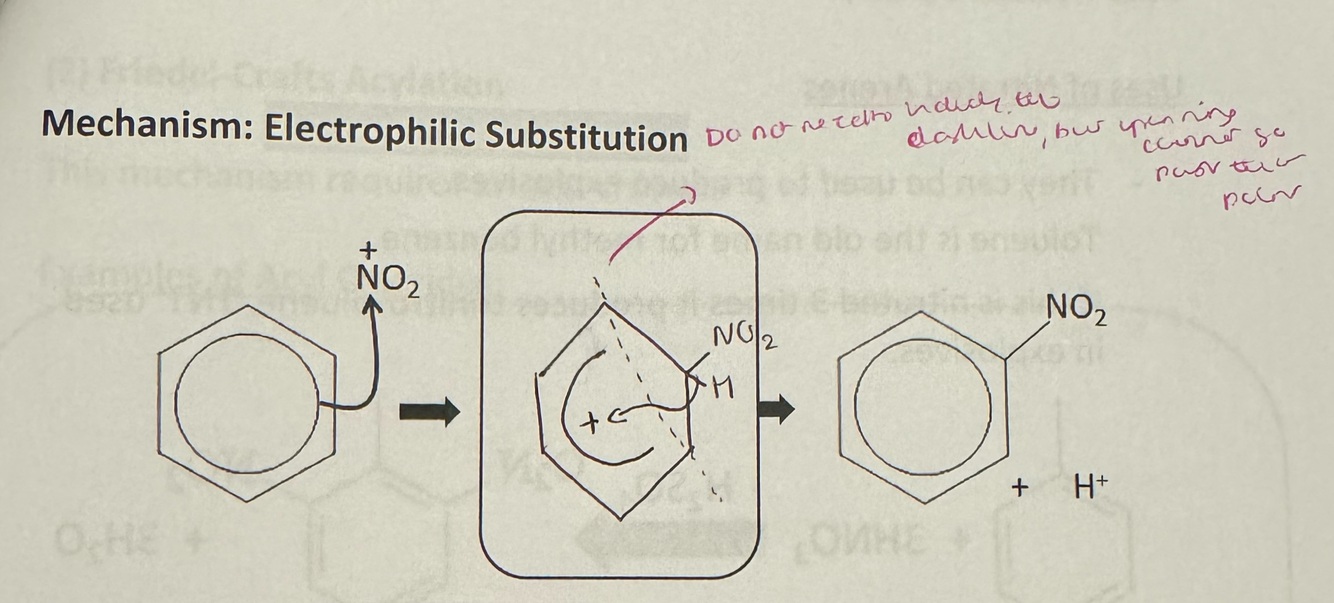
Nitration
• This involves replacing one of the H atoms on a benzene ring with a NO2 group. The electrophile in the reaction is the NO2+ ion • Reagents: Concentrated HNO3 and Concentrated H2SO4 catalyst • Overall reaction: H2SO4 + HNO3 -> H2SO4- + H2O + NO2+ • The NO2+ is the nitronium ion (electrophile) • The H+ formed then reacts with the H2SO4- to reform H2SO4 at the end of the reaction
• Carbon’s electron configuration
• Should be 1s2 2s2 2p2 • But: An electron is promoted from the 2s orbital to the 2p orbital so that carbon has four unpaired electrons and can form four covalent bonds.