2. Cell Division
No description yet. This curated deck is ready for daily study.
Card preview (24)
Fill the blank A ____ is a segment of DNA in which we find genetic information that allows the production of a particular molecule or that determines a specific character.
gene
What name is given to the basic functional and structural unit of all living organisms?
cell
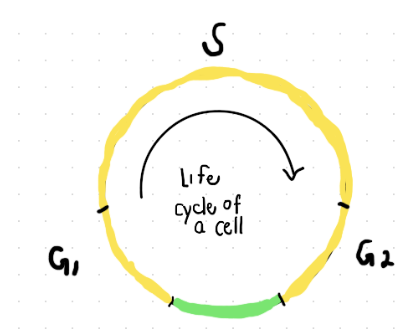
Name the four phases of the cell cycle.
G1 S (synthesis) G2 M (mitosis)
Explain the difference between a haploid and a diploid cell.
Haploid cells have only one full set of chromosomes. In humans, the only haploid cells are germ cells (sperm and eggs) produced by meiosis. Diploid cells have two distinct sets of chromosomes. In humans, all somatic cells are diploid and are produced by mitosis.
Name the two types of (eukaryotic) cell division.
• mitosis • meiosis Mitosis produces (somatic) cells that are identical to the parent, while meiosis produces germ cells with only half of the parental genetic material.
Name four broad differences between mitosis and meiosis.
1.Mitosis involves a single division, while meiosis involves two. 2.Mitosis produces two identical diploid cells, while meiosis produces up to four haploid cells that are not identical. 3.Mitosis is used to form somatic cells, while meiosis produces germ cells (gametes). 4.Crossing over occurs in meiosis, but does not happen in mitosis. somatic cell are cell that are not germ cell
Mitosis is broadly similar, but not identical, to meiosis I. Name three differences between the two processes.
1.Mitosis involves the separation of sister chromatids, while meiosis I involves the separation of homologous chromosomes. 2.Mitosis produces diploid cells, while the products of meiosis I are haploid. 3.Crossing over occurs in prophase of meiosis I, but does not occur at all during mitosis.
Which process of genetic recombination occurs during prophase I of meiosis?
Crossing over, or the trading of DNA segments between homologous chromosomes, occurs when these chromosomes are paired together in prophase I.
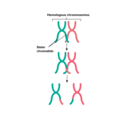
Define sister chromatid
1.Sister chromatids are genetically identical, as they result from the replication of a single chromosome. 2.Sister chromatids separate during meiosis II and mitosis.
Fill in the blank The human genome has around ____
25000 genes
Define: Diploid Cells
Diploid cells have 2 sets of chromosomes - one from the mother and one from the father. Diploid cells are formed during mitosis.
True or False The number of chromosomes can vary in healthy individuals of the same species with no genetic abnormalities.
False!
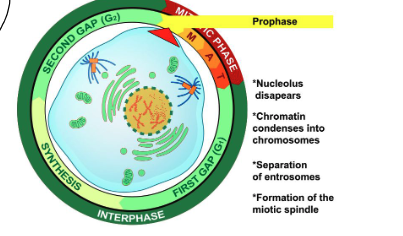
Describe Mitosis: Prophase
1.Phase 1 of Mitosis • Chromosomes are formed (DNA strands arecondensed) • • Nuclear membrane disappears
Fill the blanks: 23rd pair is ___ for females and ___ for males
XX for females XY for males
Fill the blank ____ ____ increases the capacity of a species to adapt and decreases the risk of extinction.
Genetic diversity
True or False: Genes contain the necessary information to manufacture protein.
True Genes contain all the necessary information to manufacture proteins such enzymes and hormones and so on. In turn, each protein has a specific job to do, such as digesting nutrient, repairing wounds, giving the eyes their color, etc…
Identify: Molecule that controls all cell activity.
DNA: deoxyribonucleic acid
Identify Contains all organelles and many other dissolved substances.
Cytosol
True of false DNA contains all the genetic information of an individual.
True
Fill the blank _____ is the form in which chromosomes are entangled and folded up on themselves. This form is found outside the phases of nuclear division
Chromatin
Fill in the blanks: ____is the variety of different genetic combinations amoung members of the same ____
1)Genetic diversity 2)species
Fill in the blank: Every ____ can exist in different variations and forms.
Gene
Fill the blank: At the beginning of cell division, the DNA strands coil and condense to form ____
Chromosomes
What cellular events characterize (mitosis) metaphase?
The chromosomes line up along the center of the cell, a region called the metaphase plate.