Alcohols
No description yet. This curated deck is ready for daily study.
Card preview (24)
have the general formula ROH, with the functional group -OH referred to as a hydroxyl group; named with suffix -ol, if not highest priority named as substituent with prefix hydroxy-
alcohol
benzene ring with hydroxyl groups; named for relative position of hydroxyl group: ortho- (adjacent carbons), meta- (one carbon in between), or para- (opposite sides of ring); more acidic than other alcohols because aromatic ring can delocalize the charge of the conjugate base
phenol
ability raises boiling and melting points of alcohols relative to corresponding alkanes, and increases solubility of alcohols
hydrogen bonding
groups that decrease acidity because they destabilize negative charges, such as alkyl groups
EDG (electron donating group)
groups that increase acidity because they stabilize negative charges, such as electronegative atoms and aromatic rings
EWG (electron withdrawing group)
only reagent that can oxidize primary alcohols only to aldehydes, would be oxidized to carboxylic acids by any stronger oxidizing agents
PCC (pyridinium chlorochromate)
oxidize primary alcohols to carboxylic acids and secondary alcohols to ketones
CrO3, Na2Cr2O7, or K2Cr2O7 ( chromium trioxide, sodium dichromate, or potassium dichromate)
can be oxidized to ketones by any common oxidizing agents
secondary alcohols
other forms alcohols can be converted to to make them better leaving groups for nucleophilic substitution reactions
mesylates and tosylates
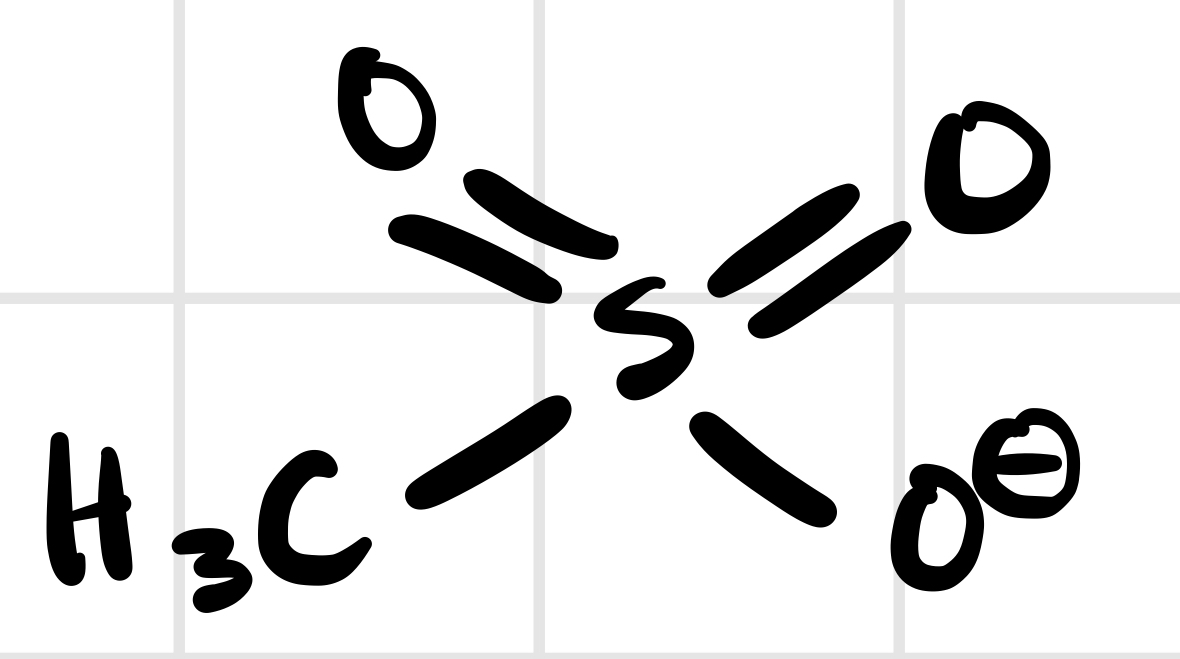
contain functional group -SO3CH3, derived from methanesulfonic acid
mesylates
structure of a mesylate anion
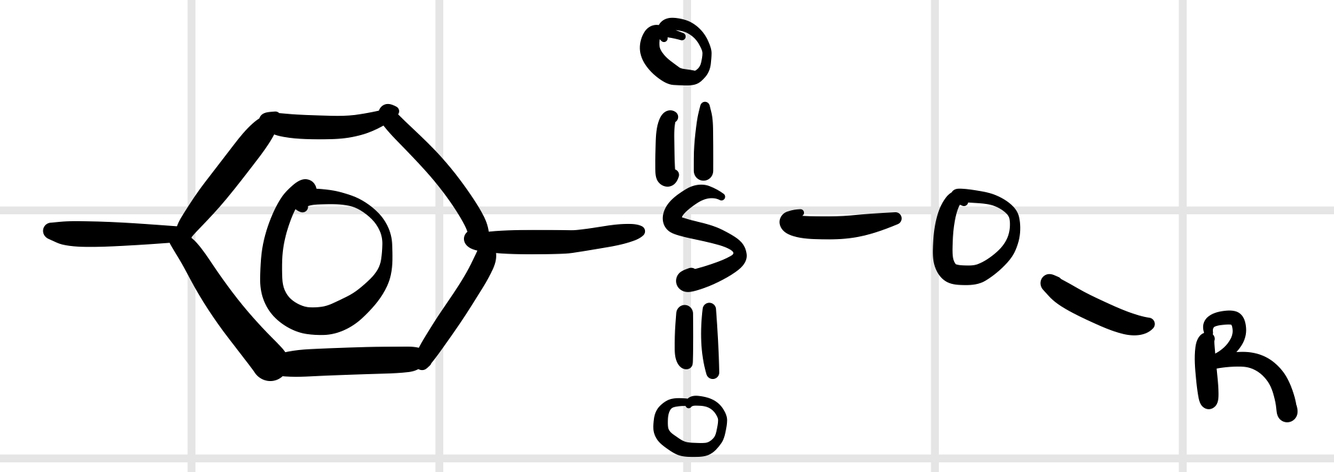
contain functional group -SO3C6H4CH3, derived from toluenesulfonic acid
tosylate
structure of a tosylate
aldehydes and ketones can be protected by being converted to ____ and ____; formed by reacting two equivalents of an alcohol or a diol with a carbonyl
acetals and ketals
a primary carbon with two -OR groups and a H atom
acetal
a secondary carbon with two -OR groups
ketal
conversion of an acetal or ketal back to a carbonyl by catalytic acid
deprotection
what is happening in the reaction towards the right

protection of a ketone by ketal formation using a dialcohol
synthesized through oxidation of phenols; resonance stabilized nucleophiles
quinones
vitamin K(1); biochemically relevant quinone important for photosynthesis and carboxylation of some clotting factors in the blood
phylloquinone
vitamin K(2); biochemically relevant quinone
menaquinone
a benzene ring with two hydroxyl groups
hydroquinone
contains two carbonyls and a variable number of hydroxyl groups produced by oxidation of quinones, adding a variable number of hydroxyl groups
hydroxyquinone
coenzyme Q; a biologically active quinone that acts as an electron acceptor in Complexes I, II, and III of the electron transport chain
ubiquinone