The periodic table: Classification of Elements
No description yet. This curated deck is ready for daily study.
Card preview (24)
What is the periodic table and how is it arranged
The Periodic Table is a list of all known elements arranged in order of increasing atomic number, from 1 to 118 The elements are arranged in rows (periods) and columns (groups)
why are elements arranged in the periodic table?
The elements are arranged so that: - Atoms with the same number of shells are placed together - Atoms with similar electronic configurations in the outer shell are grouped together
what does each period correspond to
each period corresponds to the number of electron shells occupied in an atom • Eg. elements in period 2 (Li to Ne) all have 2 electron shells
what do elements in the same group have in common
Each group contains elements with the same number of valence electrons, resulting in similar chemical properties Group numbers can be shown as Group 1–18 (IUPAC format)
what are some special cases (elements) in terms of arrangement and why
Hydrogen is placed in its own group because its properties do not match any one group closely Helium is placed in Group 18 because it shares the unreactive nature of the noble gases, despite having only 2 electrons
the periodic table can be divided based on
the type of elements: - richa: found on the left and centre of the table (s- and d-blocks, and part of the p- block) • Good conductors of heat and electricity • Malleable / ductile Non-metals: Found on the right-hand side of the table (p-block) • Poor conductors • Brittle when solid • Often form acidic oxides Metalloids: Found along a diagonal boundary between metals and non-metals - Exhibit properties of both metals and non-metals - Includes elements like boron, silicon, arsenic, antimony
what do the blocks to which elements belong depend on?
All elements belong to one of four blocks depending on their electron configuration: s-block: Groups 1 and 2 plus helium - Outer electrons are in s orbitals p-block: Groups 13 to 18 - Outer electrons are in p orbitals d-block: Transition metals (Groups 3 to 12) - Outer electrons are in d orbitals f-block: Lanthanides and actinides - Outer electrons are in f orbitals
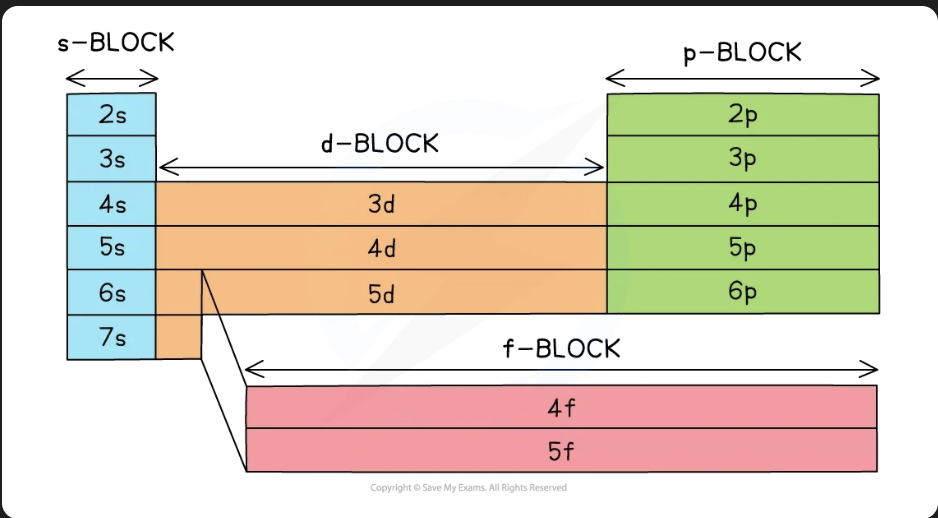
what are the blocks in the periodic table useful for
These blocks are useful for predicting: - Reactivity - Oxidation states - Typical bonding behaviour
what are periodic trends and which field are they important for
The physical and chemical properties of elements follow clear patterns across periods and down groups These repeating trends are called periodic trends and are the basis for the field of periodicity - Elements in the same group show similar reactivity, and properties change predictably across each period
what do electron configurations tell you and what can they be used for
Electron configuration tells you how electrons are arranged in an atom It can be used to find the position of an element in the periodic table This uses information about: Period number - this indicates: - The main energy level (shell) the valence electrons occupy - How many occupied energy levels the atom has - For example, if an element is in Period 4, its outermost electrons are in the 4th shell Group number - This indicates the number of valence electrons - For example, Group 4 means the atom has 4 valence electrons
Group 1
Alkali metals
Groups 17
halogens
group 18
noble gases
groups 3-12
transition elements
blocks
the periodic table is split into four blocks: s,p, d and f - In the p-block, the element’s position from left to right tells you how many electrons are in the p subshell - for example, the 2nd element in the p-block has 2 electrons in the p-subshell
notation for electronic configurations
this tells us how the electons in an atom or ion are arranged in their shells, sub shells and orbitals
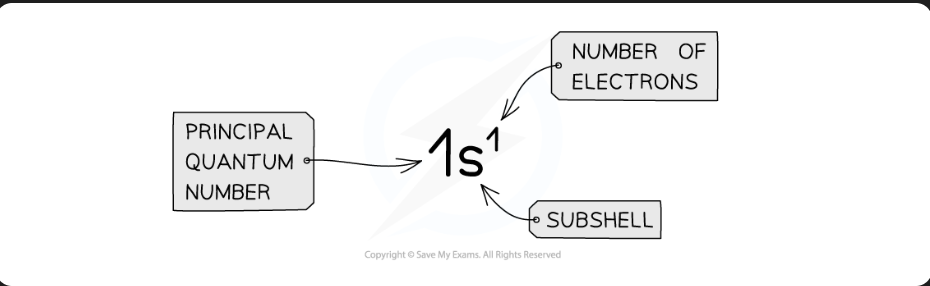
hydrogen electronic configuration
Hydrogen has 1 single electron • The electron is in the s orbital of the first shell • Its electron configuration is 1s1
potassium electronic configuration
Potassium has 19 electrons The first 2 electrons fill the s orbital of the first shell, 1s2 They then continue to fill subsequent orbitals and sub-shells in order of increasing energy The 4s orbital is lower in energy than the 3d subshell, so it is therefore filled first. (exception of the aufban principle) The full electron configuration of potassium is 1s2 2s2 2p6 3s2 3p6 4s1
shorthand electronic configuration
To simplify this electronic structure, we can use shorthand electronic configuration - The nearest preceding noble gas to potassium is argon - This accounts for 18 electrons of the 19 electrons that potassium has The shorthand electron configuration of potassium is [Ar] 4s1
how to interpret electron configurations
Period number: - identify the number before the block letter, this will determine the period Group: - check the number of electrons in the last shell. Ex 2s2 2s2 2p6 3s2 3p5 will have 7 electrons, it will be in Group 7 (17) Block: - the last term 3p5 containing p means that this element is in p-block - p5 indicates that the element is the 5th element along in the p-block Period 3, group 7 and p5 all indicate the element is chlorine
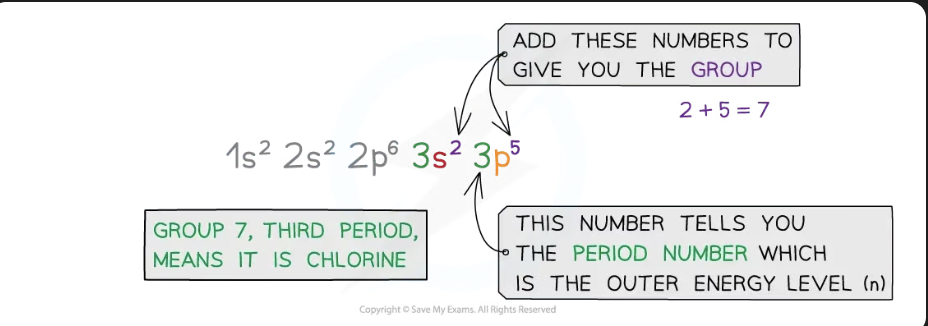
Identify the element with the electron configuration of [Ar] 4s2 4p2.
The period number is 4 The element has 4s and 4p electrons, totalling 4 electrons • This element is in Group 4 (14) • The last term (4p2) containing p means that this element is in the p-block • p2 indicates that the element is the 2nd element along in the p-block
how does the periodic table allow us to predict how properties change
The Periodic Table allows us to predict how certain properties change: Across a period (left to right) Down a group (top to bottom) These predictable patterns are known as periodic trends
define atomic radius and how its determined
The atomic radius is the distance from the nucleus to the outermost electron shell of an atom It can be quite hard to determine exactly where the boundary of an atom lies, so a variety of approaches are taken such as half the mean distance between two adjacent atoms This will vary depending on the type of structure and bonding, but it gives a comparative value for atoms
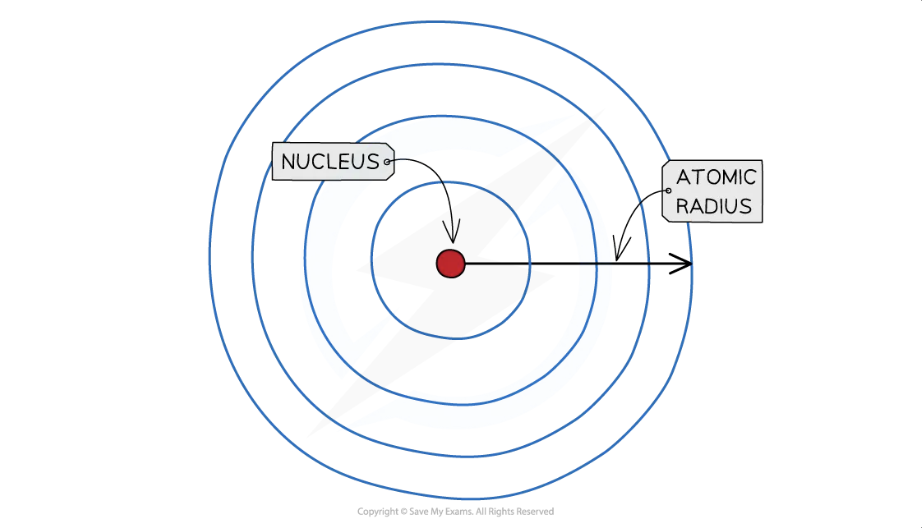
why does the atomic radius increase sharply between the noble gas and alkali metal
• The diagram shows that the atomic radius increases sharply between the noble gas at the end of a period and the alkali metal at the start of the next period • This is because the alkali metals in the next period have one extra principal quantum shell • This increases the shielding of the outermost electrons and therefore increases the atomic radius