Lecture 2
No description yet. This curated deck is ready for daily study.
Card preview (8)
Structure of Deoxyribose and ribose sugar
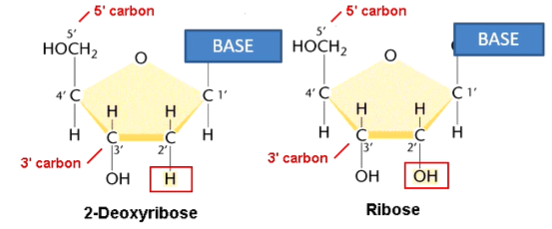
Properties of RNA
• Single stranded • Uracil instead of thymine • RNA sequence comes from DNA • RNA carries genetic information • RNA always shorted than DNA • Can form hairpin structures (Makes RNA less vulnerable to degradation) • At the beginning of transcription, a GTP cap is added at the 5’ end as a recognition signal for ribosomes to bind to mRNA • At the end of transcription, a poly(A) tail made of adenine is capped on the 3’ end to stabilise RNA
What are the 4 types of RNA? What are their functions?
mRNA - Messenger RNA, encodes amino acid sequence of a polypeptide tRNA - Transfer RNA, brings amino acids to ribosomes during translation rRNA - Ribosomal RNA, in ribosomal proteins, makes up ribosomes which are the organelles that translate mRNA snRNA - Small nuclear RNA, forms complexes used in RNA processing within eukaryotes, (NOT PROKARYOTES)
What is the promoter?
• TRANSCRIPTIONAL START SITE on RNA • at 5’ region of gene • variable, some elements highly conserved • Allows transcription factors and RNA polymerase to bind to it • This allows transcription to start
What is the terminator?
Sequence that specifies the end of the mRNA transcript
What is the RNA coding sequence?
The base pair sequence that includes coding information for polypeptide chain within that gene.
What is RNA polymerase?
• Recognises promoter region and begins transcription • Synthesises pre mRNA • WORKS IN 5’ to 3’ DIRECTION • USES THE 3’ to 5’ TEMPLATE STRAND OF DNA • So RNA transcript is the same as the coding 5’ to 3’ strand except uracil instead of thymine (as the RNA polymerase moves along DNA template, the RNA is released and DNA helix reforms)
What is splicing and how does it work?
• pre mRNA undergoes RNA processing • Introns are removed by snRNPs to leave exons • Exons are the useful coding sections of the gene • Ready for translation It works by: - 2 snRNPs bind to either end of an intron - Intron loops - 2 more snRNPs splice the introns and remove them, and the 2 exons are bound together - Mature mRNA is left (only exons) and can exit nucleus for translation in cytoplasm