3.1.1.4 Registers and Buses (B01)
No description yet. This curated deck is ready for daily study.
Card preview (19)
registers
small amounts of high-speed memory contained within the CPU. They are used by the processor to store small amounts of data that are needed during processing, such as: Different processors have different numbers of registers for different purposes.
bus
set of parallel wires that connects 2 devices on a computer can be part of a motherboard a high-speed internal connection. Buses are used to send control signals and data between the processor and other components. TRANSFER
3 types of buses
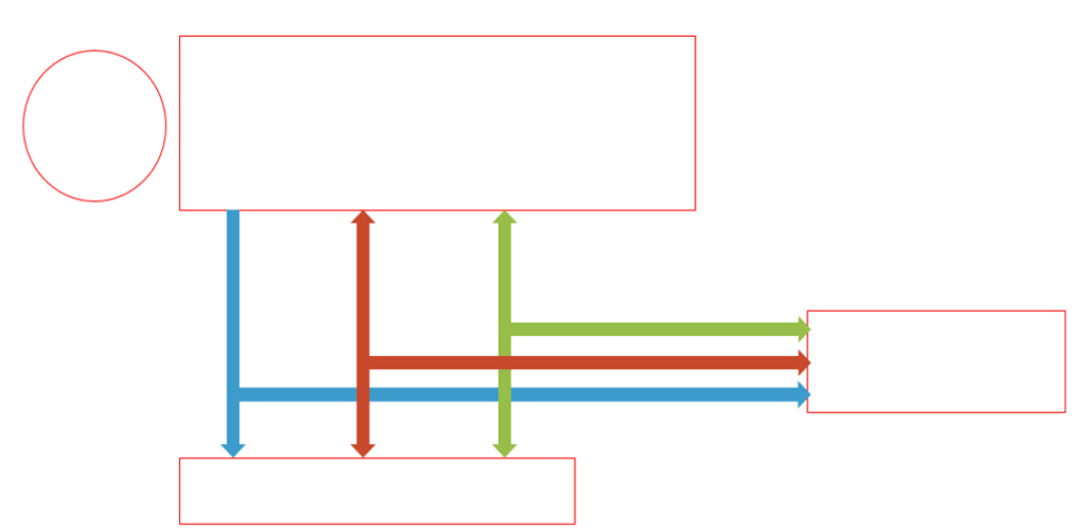
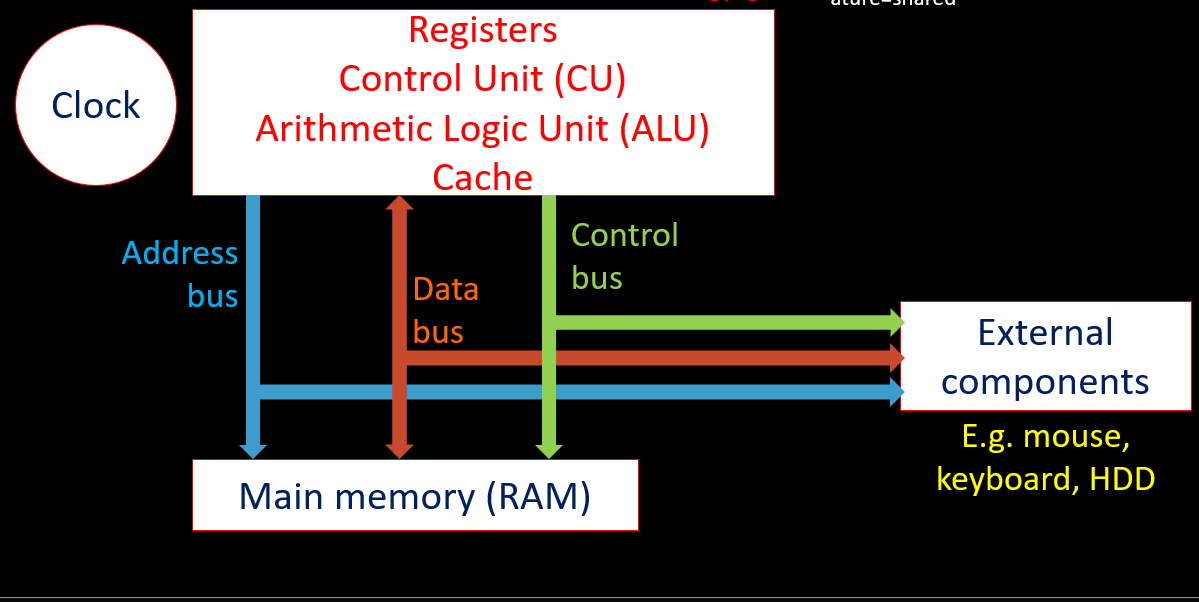
The address bus carries memory addresses from the processor to other components: uni-directional. - carries the memory location of a piece of data The data bus carries data/instructions in both directions between the CPU and other devices: bi-directional. - carries an instruction from main memory to CPU The control bus carries control signals (e.g. read or write) in both directions between the CPU and other devices: bi-directional. - carries a read signal to main memory
cache
a small amount of high-speed random access memory (RAM) built directly within the processor. Used to temporarily hold data and instructions that the processor is likely to reuse. allows for faster processing as the processor does not have to wait for the data and instructions to be fetched from the RAM. a way of dealing with the von Neumann bottleneck
CU
control unit provides several functions: it fetches, decodes and executes instructions it issues control signals that control hardware it moves data around the system
ALU
performs arithmetic and logical operations (decisions). where calculations are done and where decisions are made.
5 different registers and their functions (PC, MAR, MDR, CIR/IR, accumulator)
program counter: holds memory address of next instruction to be fetched from primary storage MAR: holds the address of the current instruction that is to be fetched from memory, or the address in memory to which data is to be transferred MDR: holds the contents found at the address held in the MAR, or data which is to be transferred to primary storage CIR: holds the instruction currently being decoded and executed accumulator: used by ALU to hold data being processed and results of calculations instruction register: holds instruction currently being executed by the CPU
ALU details
The arithmetic and logic unit (ALU) is where the CPU performs the arithmetic and logic operations. Every task that your computer carries out is completed here. Even typing into a word processor involves adding binary digits to the file, and then calculating which pixels on the screen should change so that you can see the characters. The ALU’s operations fall into two parts. The arithmetic part, which deals with calculations, e.g. 1 + 2 = 3. The logic part, which deals with any logical comparisons, e.g. 2 > 1. All the numbers that the ALU works on are in binary – so the examples above, as they are expressed, are not quite right.
CU details
The control unit (CU) is a component of a computer’s central processing unit (CPU) that directs the operation of the processor. It directs the operation of the other units by providing timing and control signals. It tells the computer’s memory, arithmetic and logic unit and input and output devices how to respond to the instructions that have been sent to the processor. Most computer resources are managed by the CU. It directs the flow of data between the CPU and the other devices. John von Neumann included the control unit as part of the von Neumann architecture. In modern computer designs, the control unit is typically an internal part of the CPU with its overall role and operation unchanged since its introduction.
program instructions are stored in memory in _____ a more readable form for humans is called ____
binary/machine code assembly language
instruction set
The full list of instructions that a CPU can carry out
system bus
what the 3 buses are sometimes referred to together as
bus width
number of parallel wires present - more means more parallel signals can be sent
how do buses work
When one device sends a communication to another device, a signal is sent on each parallel wire at the same time. The signal represents either a 0 or a 1. So, all the signals reach the receiving device at the same time, and each of them is either a 0 or a 1. The receiving device combines the signal values to make a single number.
8-bit bus
bus with 8 wires- 256 memory adresses can be sent across
Why would upgrading the amount of RAM from 4 GB to 8GB be a waste of money in in a computer with a 32-bit memory address bus?
A 32-bit bus can access this number of different memory locations: 4,294,967,296, which is just over 4GB of RAM. Memory locations in RAM are each associated with a number, so, with 8GB of RAM, almost half of the locations will have numbers that are too large to be sent across the bus.
von Neumann bottleneck
Both the data and program instructions travel between the CPU and main memory (RAM) using the same data bus, and this means that a program instruction cannot be fetched by the CPU at the same time as it fetches data.
What is the name for a memory cell inside the CPU?
register