2C - Inorganic Chemistry (e) Extraction and uses of metals
No description yet. This curated deck is ready for daily study.
Card preview (9)
How are most metals obtained?
They are extracted from their ores found in the Earth’s crust
How are unreactive metals often found?
They are often found as native metals, unreacted/bonded to anything, just in their element form.
How does the reactivity series play a role in the extraction method of a metal?
If a metal is less reactive than carbon, then it can be obtained by heating with carbon, as the carbon displaces the metal (e.g. Iron) from the compound (e.g. Iron Oxide). If it is more reactive than carbon, then it needs to be obtained in another way, e.g. Aluminium is extracted by electrolysis.
What are three uses of Aluminium, and the properties of aluminium that make it suitable?
Aircrafts & cans - Low density/Resists corrosion Power cables - Conduct electricity/ductile Pots and pans - Low density/ good conductor of heat
What are three uses of copper, and the properties of copper that make it suitable?
Electrical wires - very good conductors of electricity and ductile Pots and Pans - Very good conductor of heat, malleable and very unreactive Water pipes - Unreactive and malleable
What are two uses of iron, and the properties of iron that make it suitable?
Buildings - Strong Saucepans - Conducts heat/high melting point, and malleable.
What is one use for Mild, High-carbon, and stainless steel, and the property of each steel that makes it suitable?
Mild steel - Up to 0.25% Carbon - Nails, car bodies, ship building, malleable High-carbon steel - 0.6-1.2% carbon - cutting tools, hard, brittle Stainless steel - Chromium and nickel - Cutlery, cooking utensils, as it is resistant to corrosion.
What is an alloy?
A mixture of a metal and one or more elements, usually other metals or carbon.
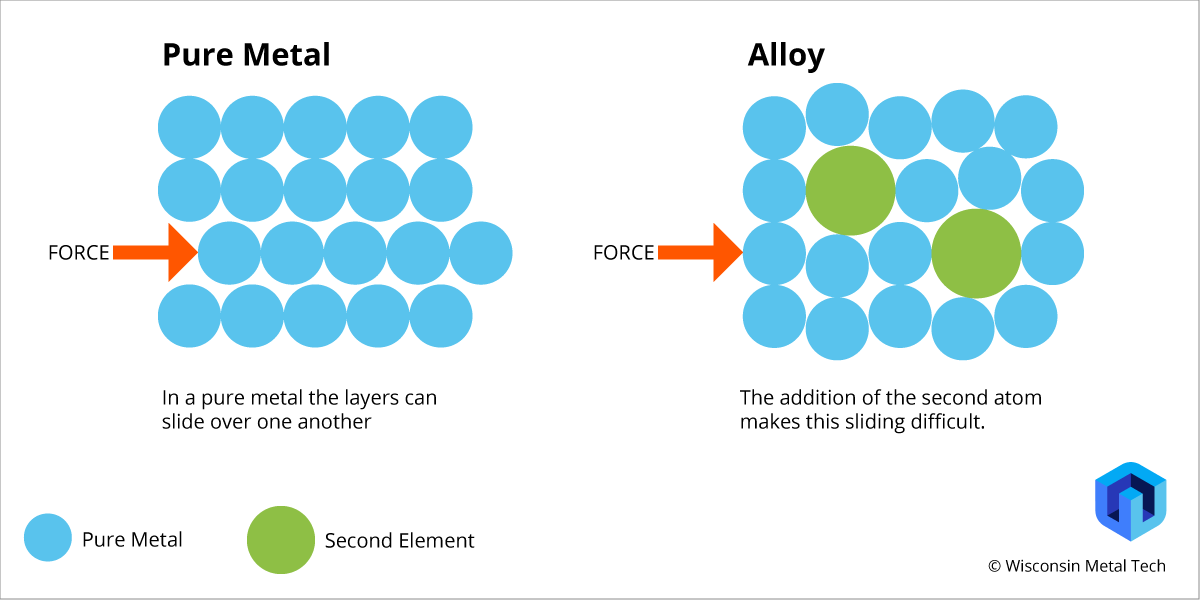
Why are alloys harder than pure metals?
They contain different types of metal atoms, so layers don’t slide as well and it isn’t malleable and is harder.