5. Thermo Chemistry
No description yet. This curated deck is ready for daily study.
Card preview (21)
Enthalpy (definition)
The amount of energy or heat content of a substance. The energy is stored in chemical bonds (including kinetic and potential energy)
Standard Enthalpy Change of Reaction (dH)
The difference between the enthalpy of the products and the enthalpy of the reactants at 298k and 1.00x10⁵Pa dH = p - r
Exothermic Reactions
The temperature of the surroundings increases and dH is negative, energy is given out • combustion and neutralization reactions • products from an exothermic reaction have less stored energy, are more stable and have stronger bonds
Endothermic Reactions
The temperature of the surroundings decreases as dH is positive, energy is absorbed • the higher the nethalpy the less stable the substance
Standard Enthalpy of Combustion (dHc)
The enthalpy change that results when 1 mole of a compound reacts with oxygen at 298K and 1.00 x 10⁵Pa. All reactants and products are in their standard states dH = r - p
Heat Energy Change (2 equations)
Q = mcdT m = mass in g (volume in cm3) c = specific heat capacity of the substance dT = change in temperature in K dH = Q / n Q = heat energy change dH = heat energy change per mole
Calorimetry
The technique used to measure enthalpy change Assumptions and sources of error • that no heat is lost to or gained from the surroundings • significant errors are associated with reactions • heat rises and dT under these conditions are reported to be less than the literature stipulates • Thermometers often have precision uncertainty of +-0.1C or greater
Hess’s Law
In a chemical reaction the total change in chemical potential energy must be equal to the energy lost or gained by the reaction system dH2 = 2dH1 - dH3
Standard Enthalpy Change of Formation (dHf)
The enthalpy change that results when 1 mole of a compound is formed from its elements at 298K and 1.00 x 10⁵ Pa, in the standard states dHf = p - r
Bond Enthalpy
The amount of energy required to break 1 mole of bonds in the gaseous state averaged across a range of compounds containing that bond • breaking bonds = endothermic • making bonds = exothermic dH = r - p
Bond enthalpies of Ozone
Ozone is decomposed more easily than oxygen • O2 requires 498kJ/mol to break • O3 requires 364kJ/mol to break
Enthalpy of Atomization (dHat)
The energy change required to change 1 mole of atoms from their standard state to a gaseous state M(s) –> M(g) 0.5X2(g) –> X(g) dH > 0
Ionization Energy (dHIE)
The standard enthalpy change that occurs by the removal of 1 mole of electrons from 1 mole of atoms or positive ions in the gaseous phase IE1: M(g) –> M+(g) + e- IE2: M+(g) –> M2+(g) + e- dHIE > 0
Electron Affinity (dHEA)
The energy change that occurs when 1 mole of electrons joins to one mole of atoms in the gaseous phase X(g) + e- –> X-(g) dHEA < 0
Lattice Enthalpy (dHlat)
The energy required to convert 1 mole of the solid compound into gaseous ions (association/ dissociation) MX(s) –> M+(g) + X-(g) dH > 0 Magnitude of Lattice Enthalpy • charge on the ions • greater charge, greater the attraction, greater lattice energy • size of the ions • larger the ions the further apart they are and the more separate the charges, the smaller the lattic energy
Born-Haber Cycle
Diagrammatic representation of the formation of ionic compounds, starting from atoms, moving to gaseous atoms to gaseous ions to a solid compound dHf = dHatm + dHIE + dHEA + dHlat
Enthalpy of Solution (dHsol)
The energy change that occurs when 1 mole of substance dissolves in excess solvent MX(s) –> M+(aq) + X-(aq)
Enthalpy of Hydration (dHhyd)
The energy change that occurs when 1 mole of gaseous ions are added to water to form a dilute solution • value is always negative • if another solvent other than water is used it is enthalpy of solvation M+(g) –> M+(aq) X-(g) –> X-(aq)
Entropy
The measure of the distribution of total available energy between the particles. The greater the disorder the particles, the great the entropy G > L > S • The entropy of a substance increases with temperature dS = entropy of p - entropy of r An increase in disorder produces a positive dS • decomposition reactions • changes in state • dissolution reactions • increases in temperature
Gibbs Free Energy
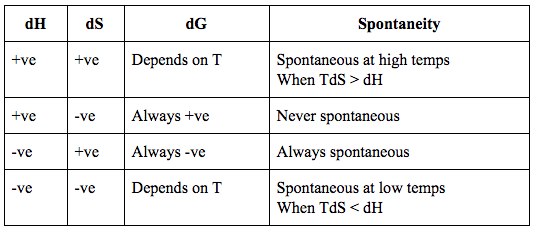
The energy available to do work dG = dH - TdS • negative dG = spontaneous reaction • positive dG = not spontaneous reaction • For any element in its standard state dG = 0
Spontaneity