Chapter 7
No description yet. This curated deck is ready for daily study.
Card preview (24)
Unsaturation
A structural element that decreases the number of hydrogens in the molecule by two • Multiple bonds and rings are elements of unsaturation
How do you calculate degree of saturation?
To calculate: Find number of hydrogens if they were saturated (2n +2; n is # of carbons), subtract the actual number of hydrogens, then divide by 2
Halogens in unsaturation
Halogens replace hydrogen atoms in hydrocarbons, so when calculating unsaturations, count halides as hydrogen atoms
Oxygen in unsaturation
Oxygen does not change the C:H ratio, so ignore oxygen in the formula
Nitrogen in unsaturation
Nitrogen is trivalent, so it acts like half a carbon. Add the number of nitrogen atoms when calculating unsaturations
IUPAC
• Find the longest continuous carbon chain that includes the double-bonded carbons • -ane changes to -ene • Number the chain so that the double bond has the lowest possible number. • In a ring, the double bond is assumed to be between Carbon 1 and Carbon 2
Z Configuration
• If high priority groups are on the same side, the name is Z (for zusammen)
E configuration
• If high priority groups are on opposite sides, the name is E (for entgegen)
Relative Stabilities of Alkenes
(most stable) tetrasubstituted > trisubstituted > disubstituted > monosubstituted
Disubstituted Isomers
cis < geminal < trans isomer (most stable)
Bredt’s Rule
• A bridged bicyclic compound cannot have a double bond at a bridgehead position unless one of the rings contains at least eight carbon atoms
Dehydrohalogenation by the E2 Mechanism
• Strong base abstracts H+ as double bond forms and X- leaves from the adjacent carbon • Tertiary and hindered secondary alkyl halides give good yields
Zaitsev Product
more substituted alkene
Hofmann Product
less substituted alkene
How do bulky bases affect elimination reactions?
Bulky bases produce more of the Hofmann product If the substrate is prone to substitution, a bulky base can minimize the amount of substitution. Large alkyl groups on a bulky base hinder its approach to attack a carbon atom (substitution), yet it can easily abstract a proton (elimination).
Why use a bulky base?
Where both substitution and elimination are possible, using a bulky base gives a clean elimination result.
Dehalogenation of Vicinal Dibromides
Similar to E2 reaction, except Br2 is removed from adjacent carbons instead of H–Br Bromines must also be anti-coplanar (E2) Use NaI in acetone, or Zn in acetic acid
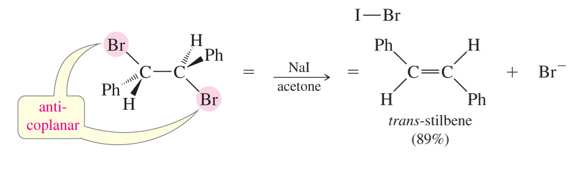
What type of reactant/solvent must be used for dehalogenation of vicinal bromides?
Use NaI in acetone, or Zn in acetic acid
For SN1, what conditions favor elimination over substitution?
High temperature and weak/bulky bases will favor elimination over substitution.
What type of mechanism is dehydration of alchohols?
E1
Dehydration of Alchohols Summary
• Use concentrated sulfuric or phosphoric acid to protonate the alcohol, and make it a good leaving group • Rest of the reaction is the same as an E1 reaction • To increase the yield of the reaction, you can remove the low-boiling alkene as it forms to shift the equilibrium (the reaction is reversible) Mildly acidic solvent: favors elimination
Critical (acid/base) rules for mechanisms
Critical Rules for Mechanisms: • Do not form basic species (neg. charge) in acidic media • Do not form acidic species in basic media
Dehydration of Alchohols Side Reactions
–Substitution products are formed (SN1-nucleophile adds to carbocation) –Amount of substitution depends on temperature and nature of solvent –Low temperature: substitution favored –High Temperature: elimination favored
How does s character affect electronegativity?
Greater s character leads to an increase in electronegativity