Chapter 1
No description yet. This curated deck is ready for daily study.
Card preview (24)
Define: Computer Science [Misconception]
Misconceptions of computer science Computer science is: • The study of computers • The study of how to write computer programs • The study of building or designing computers.
Define: Computer Science
Computer science is the study of algorithms, including: • Their formal and mathematical properties • Their hardware realizations • Their linguistic realizations • Their applications
Define: Algorithm
Step-by-step method for accomplishing some task
What operations are used to construct algorithms?
• Sequential Operations • Conditional Operations • Iterative Operations
Why are formal algorithms in computer science important?
If we can specify an algorithm to solve a problem, then we can automate its solution.
Define: Computing Agent
• Machine, robot, person, or thing carrying out the steps of the algorithm. • OR, abstract concept representing any object capable of understanding and executing our instructions
Describe the structure of an algorithm.
Well-ordered collection of unambiguous and effectively computable operations that, when executed, produces a result and halts in a finite amount of time.
Give examples of ambiguous statements.
• Go back and do it again (Do what again?) • Start over (From where?) • Skip ahead (To where?)
Describe an unambiguous operation.
Can be understood and carried out directly by the computing agent without further simplification or explanation. Also called primitive operation.
It is not enough for an operation to be understandable. What else must an operation be?
It must also be doable (effectively computable) by the computing agent.
What properties must an algorithm have?
A result must be produced after the execution of a finite number of operations. Should have a way to deal with problems • Correct answers may not exist for a given set of input
Why are infinite loops named so?
infinite loops run forever; there is no termination.
How have computers revolutionized the twentieth and twenty-first centuries?
The “computer revolution” has enabled us to implement algorithms that mechanize and automate the drudgery of repetitive mental tasks.
What was John Napier’s contribution to mechanical computations?
John Napier invented lagorithms as a way to simplify difficult mathematical computations.
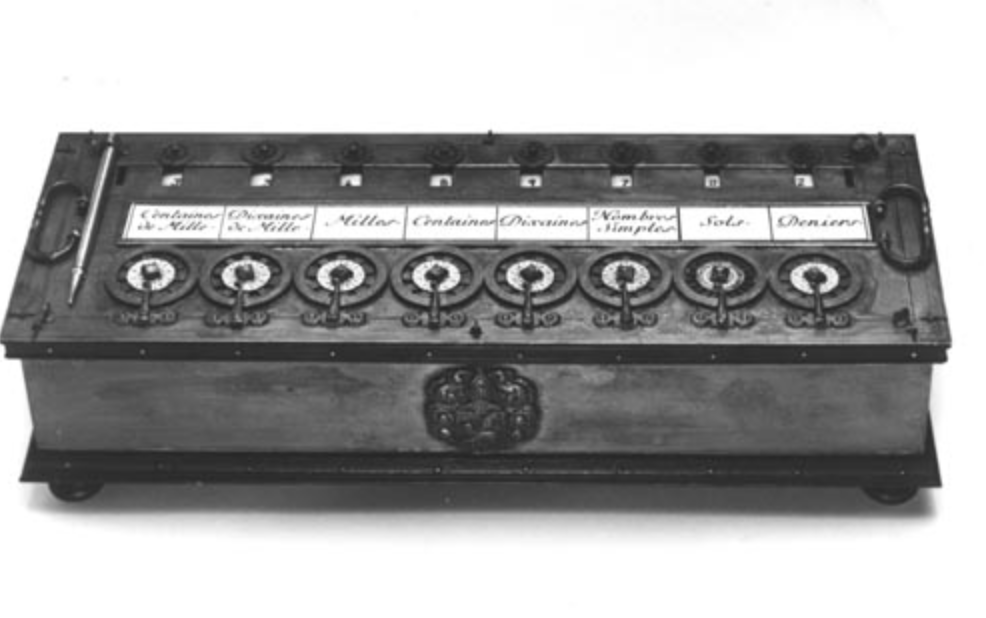
What was Blaise Pascal’s contribution to mechanical computations?
Blaise pascal designed and built one of the first mechanical calculators (named the Pascaline).
What was Gottfried Leibnitz’s contribution to mechanical computations?
• Constructed a mechanical calculator called Leibnitz’s Wheel. • Developed formal logic using a binary numeral system.
Who was Charles Babbage?
• One of the “fathers of the computer” • Designed the Difference Engine • Designed the Analytic Engine
Describe the Difference Engine that was developed by Charles Babbage
• Designed to do addition, substraction, multiplication, and division to six significant digits. • Could solve polynomial equations and other complex mathematical problems. • Was never completed
Describe the Analytic Engine that was developed by Charles Babbage
Amazingly similar in design to a modern computer • Expandable memory • An arithmetic unit • Logic processing capabilities (loops and conditional branching) • Could use, as input, the results of preceding computations Was never actually built
What were Ada Augusta Byron’s achievements in computer history?
Generally regarded as history’s first computer programmer The Ada programming language was named after her Her notes include what is recognized as the first algorithm intended to be carried out by a machine • Computation of Bernoulli numbers using the Analytical Engine • The code was never tested, because the analytical engine was not completed
What were Herman Hollerith achievement in computer history?
The father of modern automatic computation Designed and built programmable card-processing machines that could automatically read, tally, and sort data entered on punched cards • 1880 Census took 8 years to tabulate • 1890 Census took 1 year to tabulate Founded the Computer Tabulating Recording Company • Major census bureaus leased his machines In 1924, Hollerith’s tabulating machine company changed its name to IBM.
What were John Von Neumann’s achievements in computer history?
The Father of Computer Viorology • Designed a self-reproducing computer program (considered to be the world’s first computer virus) A principal member of the Manhattan Project Proposed a radically different computer design based on a model called the stored program computer Part of the research group of the University of Pennsylvania that built on of the first stored program computers, called EDVAC, in 1951. Credited with inventing “merge sort”
What were Grace Hopper’s achievements in computer history?
Developed the first compiler for a computer programming language. Credited with popularizing the term “debugging” for fixing computer glitches. Was a United States Navy rear admiral • The USS Hopper is named after her • Annual Conference celebrating women in computer science (October)
What were Alan Turing’s achievements in computer history?
Considered to be the father of theoretical computer science. Devised techniques for breaking German ciphers Defined a standard for a machine to be called “intelligent” • The Turing Test Wrote a chess program • The program could not be executed by the computers available, so Turing played a game in which he simulated the computer; he lost.