3. Rates of Reaction
No description yet. This curated deck is ready for daily study.
Card preview (21)
What factors affect the rate of a reaction?
• The concentration of the reactants in solution • The pressure of reacting gases • The temperature of the reaction • Surface area of solid reactants • The presence of a catalyst
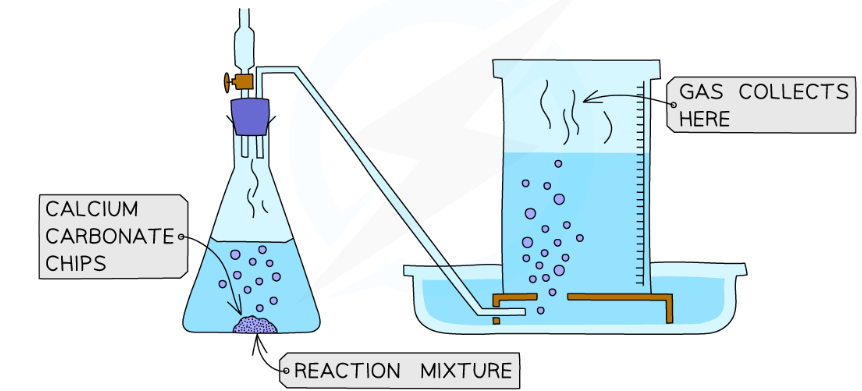
Describe how to investigate changes in surface area of a solid on the rate of a reaction. Hydrochloric Acid and Calcium Carbonate
• Add dilute hydrochloric acid to the conical flask • Use a delivery tube to connect this flask to an inverted measuring cylinder upside down in a water trough • Add calcium carbonate chips into the conical flask and close the bung • Measure the volume of gas produced in a fixed time using the measuring cylinder • Repeat with different sizes of calcium carbonate chips
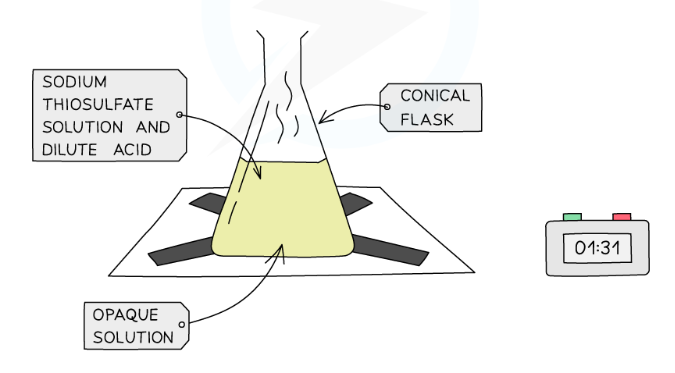
Describe how to investigate changes in concentration of a solution on the rate of a reaction. Sodium Thiosulfate and Acid
• Measure 50 cm³ sodium thiosulfate solution into a flask. • Measure 5 cm³ dilute hydrochloric acid in a measuring cylinder. • Place a paper with a drawn cross under the flask. • Add the acid to the flask and start the stopwatch immediately. • Look from above and stop the stopwatch when the cross disappears. • Repeat with different concentrations of sodium thiosulfate by diluting with water.
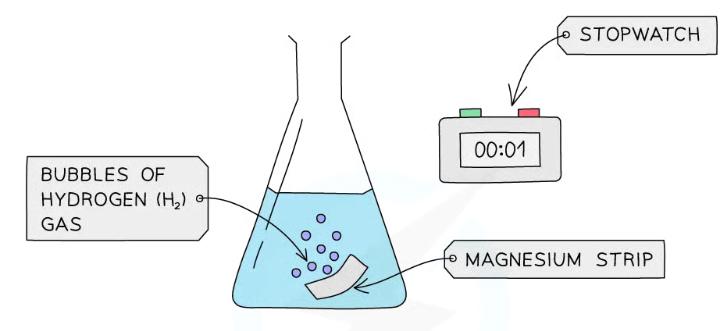
Describe how to investigate changes in temperature on the rate of a reaction. Magnesium and Hydrochloric Acid
• Dilute hydrochloric acid is heated to a set temperature using a water bath • Add the dilute hydrochloric acid into a conical flask • Add a strip of magnesium and start the stopwatch • Stop the time when the magnesium fully dissolves • Repeat at different temperatures and compare results
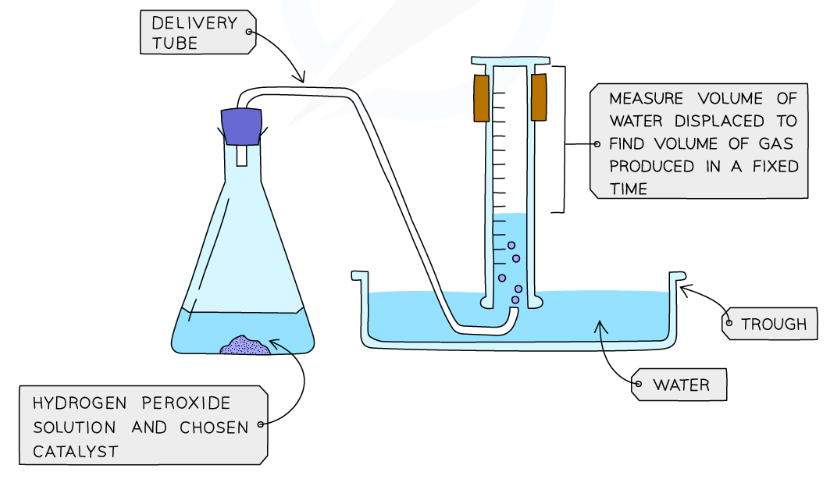
Describe how to investigate the effect of a catalyst on the rate of a reaction.
• Add hydrogen peroxide into a conical flask • Use a delivery tube to connect this flask to a measuring cylinder upside down in water trough • Add the catalyst manganese(IV) oxide into the conical flask and close the bung • Measure the volume of gas produced in a fixed time using the measuring cylinder • Repeat experiment without the catalyst of manganese(IV) oxide and compare results
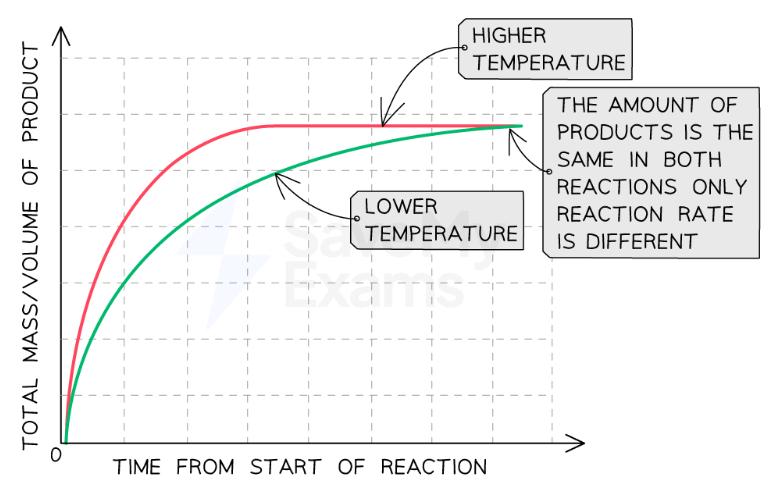
Graph of high vs low rate of reaction.
• Has a steeper gradient at the start • Becomes horizontal sooner • Forms the same amount of product
What is the effect of increasing the surface area of a solid on the rate of reaction?
• Increasing surface area → rate increases • Smaller pieces / powdered solid → reaction is faster
What is the effect of increasing the concentration of a solution on the rate of reaction?
• Increasing concentration → rate increases • Decreasing concentration → rate decreases
What is the effect of increasing the pressure of a gas on the rate of reaction?
• Increasing pressure → rate increases • Only applies to reactions involving gases
What is the effect of increasing temperature on the rate of reaction?
• Increasing temperature → rate increases • Lower temperature → reaction is slower
What is the effect of adding a catalyst on the rate of reaction?
• Catalyst → increases the rate of reaction • Catalyst is not used up and is chemically unchanged at the end
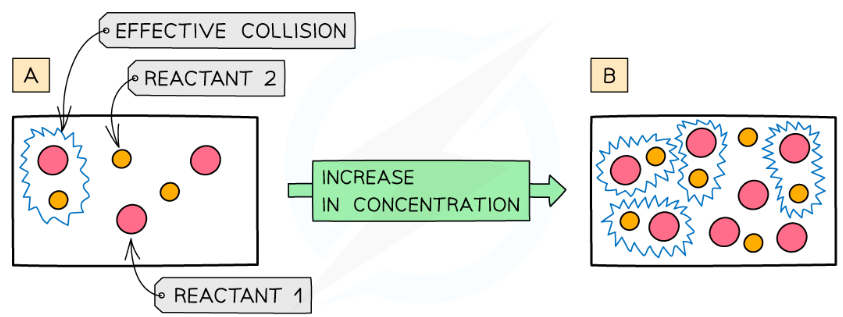
How does increasing the concentration of a solution affect the rate of a reaction? Particle Collision Theory
• Increasing the concentration means that there are more reactant particles in a given volume • This causes more collisions per second • Leading to more frequent and successful collisions per second • Therefore, the rate of reaction increases
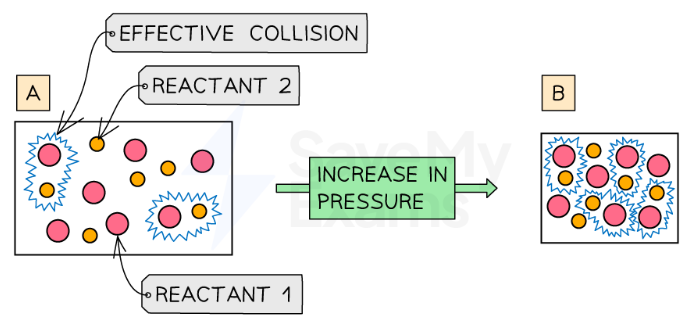
How does increasing the pressure of a gas affect the rate of a reaction? Particle Collision Theory
• Increasing the pressure means that there are the same number of reactant particles in a smaller volume • This causes more collisions per second • Leading to more frequent and successful collisions per second • Therefore, the rate of reaction increases
How does increasing the temperature affect the rate of a reaction? Particle Collision Theory
• Increasing the temperature means that the particles have more kinetic energy • This causes more collisions per second • Leading to more frequent and successful collisions per second • Therefore, the rate of reaction increases
How does increasing the surface area of a solid affect the rate of a reaction? Particle Collision Theory
• Increasing the surface area means that a greater surface area of particles will be exposed to the other reactant • This causes more collisions per second • Leading to more frequent and successful collisions per second • Therefore, the rate of reaction increases
What is meant by a catalyst?
A substance that increases the rate of a reaction, but is chemically unchanged at the end of the reaction
State how a catalyst works.
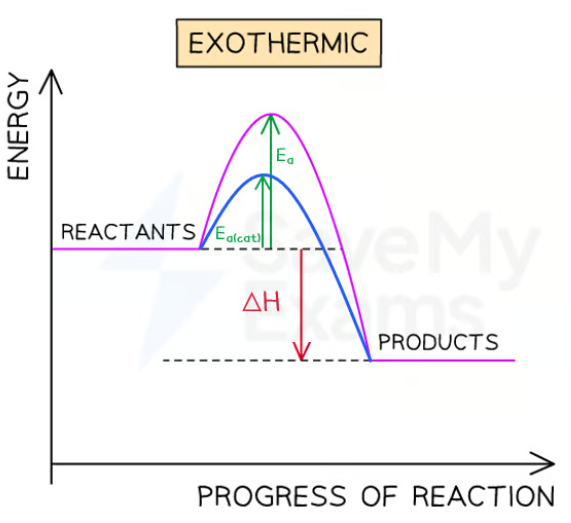
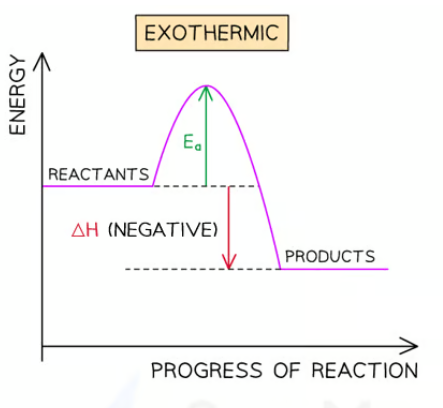
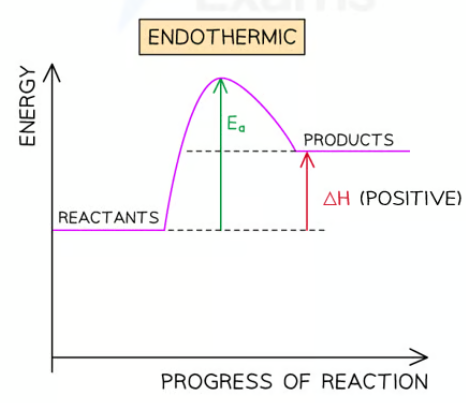
A catalyst works by providing an alternative pathway with lower activation energy.
State what is meant by activation energy. How are is it represented on reaction profiles?
The minimum amount of energy that reacting particles must have in order for a reaction to occur. The initial increase in energy, from the reactants to the peak of the curve, represents the activation energy.
Draw the reaction profile of an exothermic reaction.
Draw the reaction profile of an endothermic reaction.
Draw the reaction profile of an exothermic reaction with and without a catalyst.