1. What is political science?
No description yet. This curated deck is ready for daily study.
Card preview (24)
Who were the first political scientists
Aristotle 20th century: Max Weber (Germany), Robert Micheals (Italy), Lord Bryce (Britain), Woodrow Wilson (USA)
What was the initial focus of political science
Institutions (executives, parliaments, constitutions and political parties) “Institutionalism”
What shift occurred in political science in the mid-20th century
Shift in focus from political institutions to political behaviour Because of collapse of democracy in much of Europe and new methods to study political behaviour (ex: representative opinion polls).
Describe the rational choice approach
1940s-60s Behaviours of voters, parties, interest groups, legislators and bureaucrats is driven by self-interest and strategic calculation
Describe the sociological approach
1940s-60s Adapted theoretical ideas in sociology about the social and cultural determinants of behaviour to try to explain the formation of states, the behaviours and organization of political parties, how citizens voted, and why some countries became stable democracies and others did not
What is new institutionalism
1980s-90s Convergence of the rational choice approach with sociological approach
What is political behaviour
Beliefs and actions of political actors Takes place within a political system
What are political outcomes
Specific policy outcomes (economic growth) or broader political phenomena (social equality) Political behaviour and political institutions interact to produce political outcomes
What is a theoretical explanation
A set of assumptions about how political actors behave and how political institutions influence and shape this behaviour, from which a set of propositions is derived, which can then be tested against empirical observations
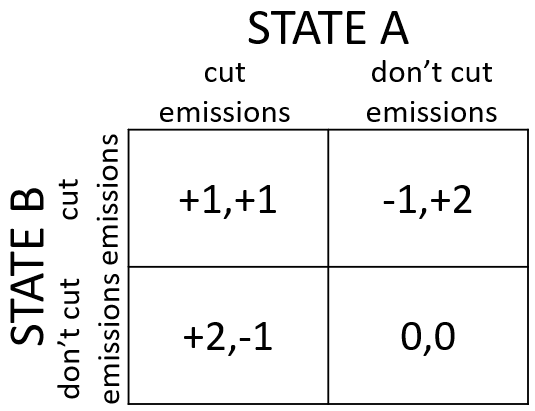
How does the rational choice approach explain why enforcing international environmental treaties is difficult
Similar to the prisoners dilemma 2 states Cost of cutting emissions = -3 Benefit of cutting emissions = +4 (2 each) • If both countries cut emissions then each country has +1 benefit • If one state cuts emissions then the one that cuts has -1 and the one who doesn’t cut has +2 benefits • If neither cuts, they both have 0 benefits So, each country will always have an incentive not to cut emissions
What are the main criticisms of the rational choice approach
• A citizen may be influenced by a social norm or habit and not vote rationally • Deciding to vote in of itself isn’t rational since the benefit of voting (how likely it is that your vote will change the outcome) is much smaller than the cost of voting (taking the time to go)
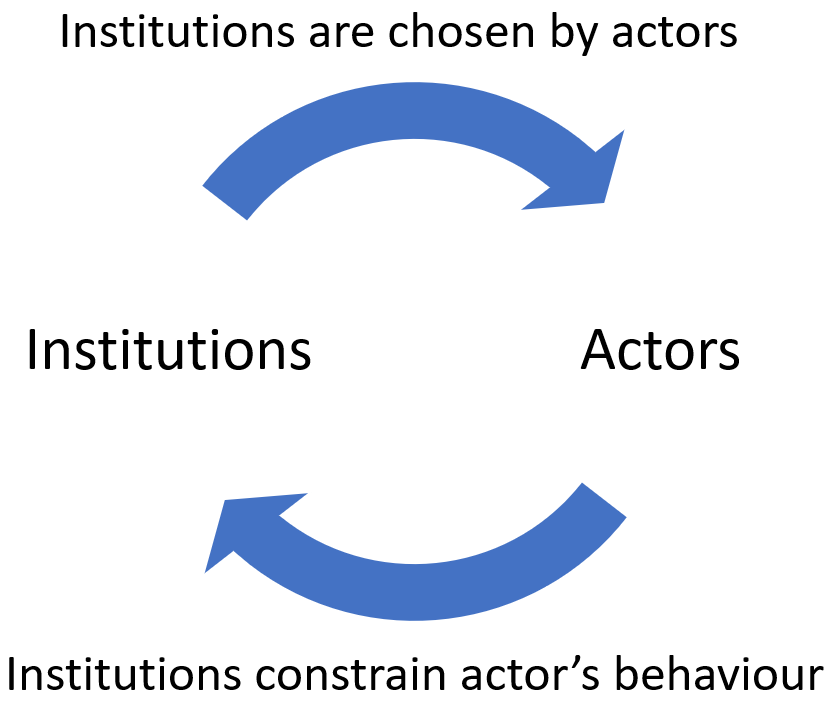
What is the Institutional approach
Formal and information institutions restrict actors behaviour in political situations, and so shape political actions and outcomes
What are some examples of formal institutions
• Provisions in a constitution • Rules of procedure in a parliament • Electoral systems • Campaign finance regulations • Rules on how a party chooses a leader
What are some examples of informal institutions
• Social structures (such as class) • Social norms and cultural practices • Metaphysical beliefs • Ideological values
What influence does a majoritarian parliamentary system have on policy-making
Since the government has a majority, they can dominate policy-making and make radical changes
What influence does a political system with many veto players (presidency with competing party in legislature, coalitions…) have on policy-making
Policy change is more difficult Compromise and collaboration is required
What is the Ultimatum game and what does it demonstrate
Rules: • 2 players • Player 1 proposes how to devide a dollar between them • Player 2 can accept or reject (then neither of them will get anything) If both players are purely rational: • Player 1 will over a 99 to 1 cent split to maximize their profit • Player 2 will accept since 1 cent is greater than nothing In practice this is rarely the outcome The outcome also differs in different cultures This proves that the rational choice approach is not always accurate
What is path dependency
An aspect of the institutional approach Once formal or informal institutions influence a particular policy or political outcome, they tend to be “locked-in” for a long term For example: In western Europe, though the 1990s brought 2 world wars and significan economic and social change, the same political parties dominate in all countries
How do the rational choice and institutional approaches interract
Today most political scientists combine ideas from both approaches
What are qualitative methods
Describes how a variable is related to another Non-numeric
What are quantitative methods
Describes whether a variable is related to another Statistical measures to identify correlations and causal relationships between variables
What is a dependent variable
Variable representing the outcome that is trying to be explained
What is an independent variable
Factors which the researcher believes cause variation in the dependent variable
What is a hypothesis
A proposed explanation for a causal relationship between dependent and independent variables