Addition Reactions of Alkynes
No description yet. This curated deck is ready for daily study.
Card preview (24)
How do I form an alkyne from an alkane?
An alkyl dihalide must be treated with excess NaNH2/NH3, followed by H2O. This prompts a series of 2 elimination reactions. First, the first halogen serves as a leaving group while a base attacks a H and the proton leaves; electrons from the H create an alkene. Then, the second halogen leaves and a H is attacked by a stronger base, creating an alkyne.
What are the reagents for the formation of an alkyne from an alkyl dihalide?
Excess NH2/NH3 followed by H2O
What is the process that reduces alkynes to alkanes?
catalytic hydrogenation
What are the reagents in a catalytic hydrogentation that produce an alkane?
H2 followed by a metal catalyst (Pt, Ni, or Pd)
What are the reagents in a catalytic hydrogenation of an alkyne into a cis alkene?
H2 followed by a poisoned catalyst (Lindlar’s catalyst OR Ni2B)
What are the reagents in a catalytic hydrogenation of a geminal alkyne into a trans alkene?
Na followed by NH3 (l)
What does of hydrohalogenation produce?
Markovnikov reaction of halogens
What is the difference between treating alkynes with HX and treating them with excess HX?
Treating with just some HX prompts a Markovnikov addition and creates an alkene. Treating with excess HX prompts a Markovnikov addition, a geminal dihalide is produced
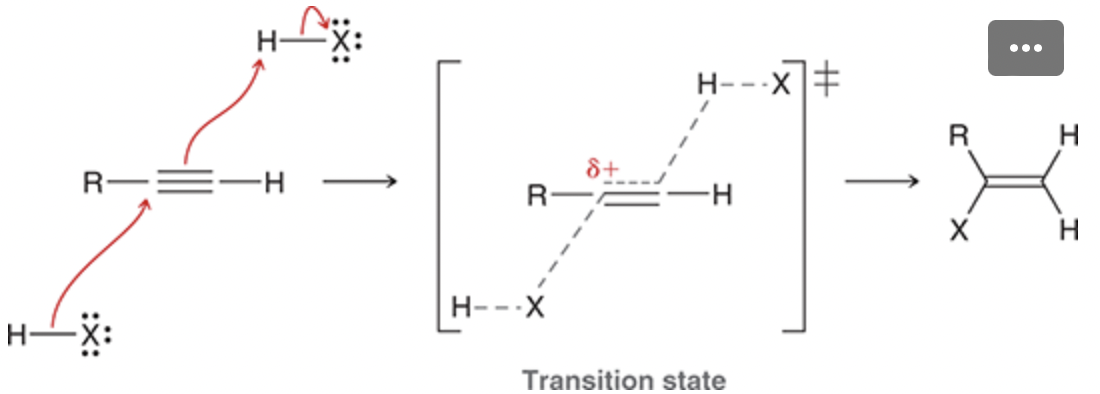
What is the mechanism for the hydrohalogenation of alkynes?
Termolecular one-step process during which a carbocation intermediate is NOT created, but the transition state has some partial carbocationic behavior, leading to Markovnikov regioselectivity.
What are the reagents for an anti-Markovnikov hydrohalogenation of an alkyne?
HX followed by peroxides (ROOR)
How to create a geminal dihalide?
Treat an alkyne with excess HX.
How to turn a dihalide into a terminal alkyne?
Treat a dihalide with excess NaNH2/NH3 followed by H2O.
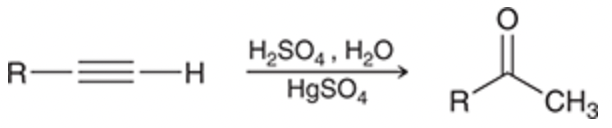
What are the reagents for an acid-catalyzed hydration reaction?
Either H3O+ or H2SO4,H2O, followed by HgSO4.
What is the effect of an acid-catalyzed hydration reaction of an alkyne?
A ketone is added to the more substituted side.
Describe the acid-catalyzed hydration reaction of an alkyne.
The alkyne attacks an Hg+2 ion and a resonance-stabilized mercurinium ion is formed. The cation on the intermediate is attacked by H2O acting as a nucleophile, then another H2O molecule participates as a base, deprotonating the overall molecule. Then the remaining alkene attacks a proton from H3O+. 2 resonance structures form, with the oxygen atom attacking the newly formed cation. The Hg+ acts as a leaving group, leaving behind an enol that rapidly converts into a ketone via acid-catalyzed tautomerization.
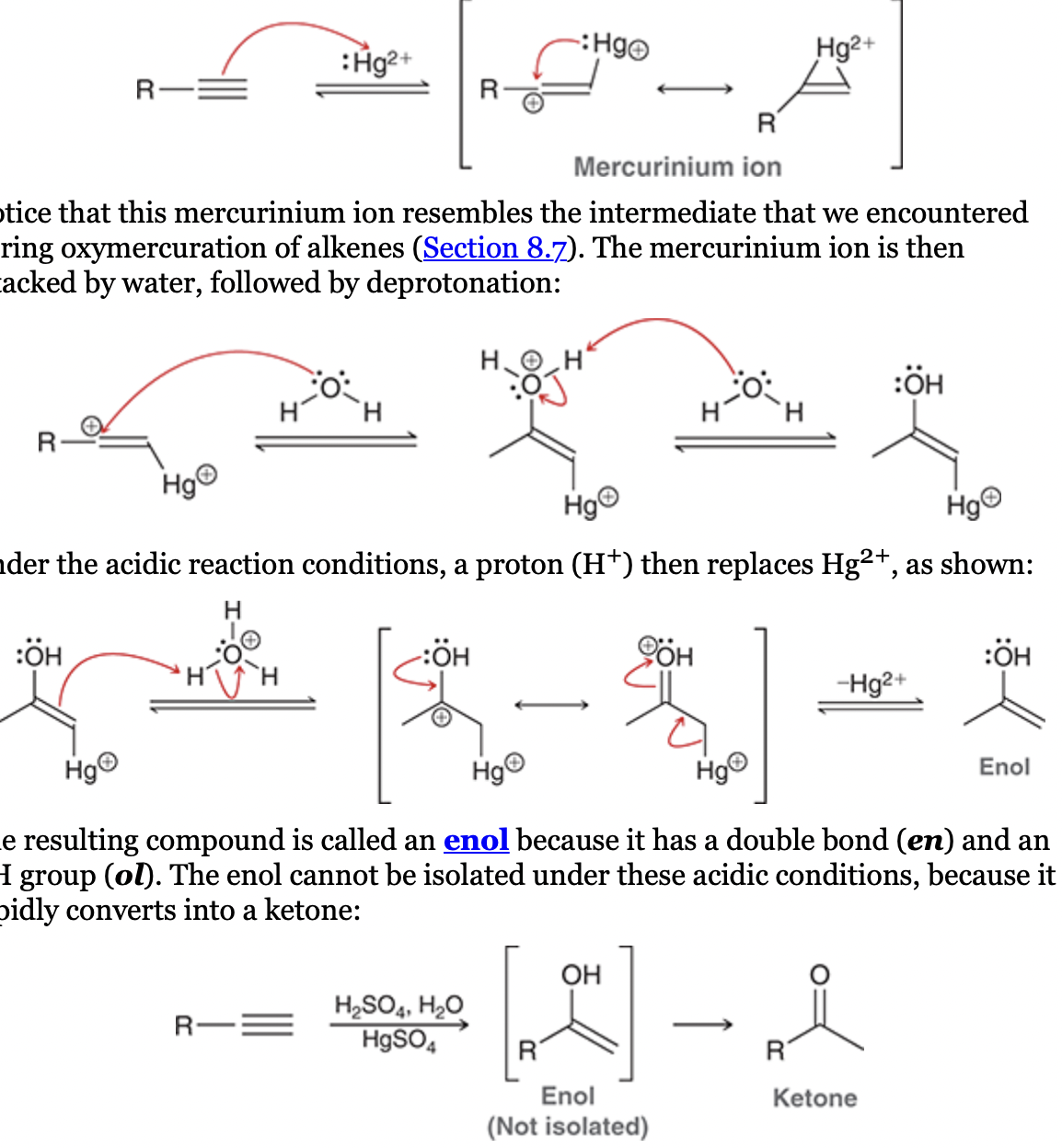
What is an enol?
a compound with a double bond and an alcohol that rapidly converts into a ketone via acid-catalyzed tautomerization
How does an enol become a ketone via acid-catalyzed tautomerization?
The alkene on the enol attacks H3O+ during a proton transfer, generating a resonance-stabilized intermediate with a transferring positive charge. The intermediate is deprotonated by H2O to give a ketone. This entire process migrates a proton and an alkene from one location to another.
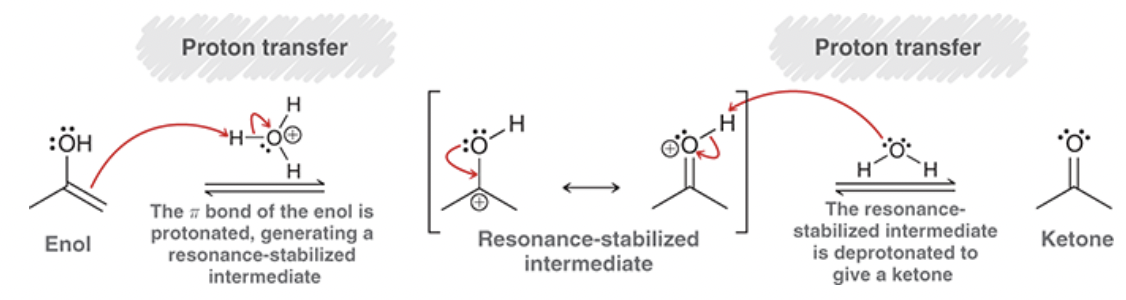
What are tautomers?
constitutional isomers that rapidly interconvert via the migration of a proton
What is the product of the acid-catalyzed hydration of unsymmetrical internal alkynes?
a mixture of ketones, placed on opposite ends of the former triple bond

What is the product of the acid-catalyzed hydration of a terminal alkyne?
a methyl ketone
What are the reagents of a hydroboration-oxidation of alkynes?
• Dialkyl borane (either Disiamylborane or 9-BBN) • H2O2, NaOH
What is the result of a hydroboration-oxidation of alkynes?
the addition of an aldehyde at the less substituted side of the alkyne; converts a terminal alkyne into an aldehyde

Is tautomerization during acid-catalyzed hydration acid or base-catalyzed?
acid
Is tautomerization during hydroboration oxidation acid or base-catalyzed?
base