9.1 Enthalpy Changes
No description yet. This curated deck is ready for daily study.
Card preview (24)
What is enthalpy?
heat energy stored in a chemical system
In an exothermic reaction, is energy overall released or absorbed by the reacting molecules?
released
In an endothermic reaction, is energy overall released or absorbed by the reacting molecules?
absorbed
In an exothermic reaction, how does the temperature of the surroundings change?
increases (reactant molecules overall release energy to molecules in surroundings)
In an endothermic reaction, how does the temperature of the surroundings change?
decreases (reactant molecules overall absorb energy from molecules in surroundings)
In an exothermic reaction, the enthalpy of the reactants is _____ than the products.
greater (since energy is overall released by the reactant molecules)
In an endothermic reaction, the enthalpy of the reactants is ____ than the enthalpy of the products.
lower (since reactant molecules overall absorb energy to form products)
Is this reaction exothermic or endothermic?
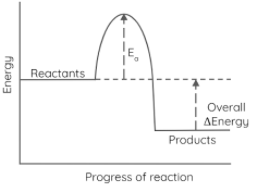
exothermic (as seen from diagram, enthalpy of products is lower than reactants. therefore overall, energy is released.)
Is this reaction exothermic or endothermic?
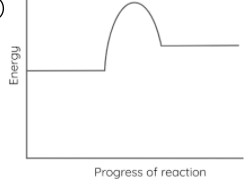
endothermic (as seen from diagram, enthalpy of products is greater than reactants. so overall, energy is absorbed.)
Draw an enthalpy profile diagram for a general exothermic reaction, labelling the activation energy & overall energy change.
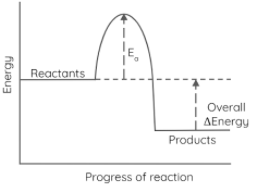
In terms of the relative energies when making/breaking bonds, what makes a reaction exothermic?
the energy required to break bonds is less than the energy released when bonds are formed.
In terms of the relative energies when making/breaking bonds, what makes a reaction endothermic?
the energy required to break bonds is greater than the energy released when bonds are formed
Is forming bonds exothermic or endothermic?
exothermic
Is breaking bonds exothermic or endothermic?
endothermic
What is the formula for calculating enthalpy change?
ΔH = H(products) - H(reactants)
What is average bond enthalpy?
energy required to break 1 mole of a specified type of bond in a gaseous molecule
What is standard enthalpy change of formation, ∆fH⊖?
Enthalpy change when 1 mole of a compound is formed from its elements under standard conditions with all reactants & products in standard states
What is standard enthalpy change of combustion, ∆cH⊖?
Enthalpy change when 1 mole of a substance completely reacts with O2 under standard conditions with all reactants & products in standard states
What is standard enthalpy change of reaction, ∆rH⊖?
Enthalpy change when reactants react in their molar quantities shown in a balanced equation under standard conditions with all reactants & products in their standard states
What is standard enthalpy change of neutralisation, ∆neutH⊖?
Enthalpy change when 1 mole of H2O is formed from an acid & base under standard conditions with reactants & products under standard states
What is activation energy, Ea?
minimum energy required to start a reaction by breaking bonds
What does a higher activation energy mean in terms of the rate of reaction?
slower rate of reaction more energy required so molecules reach activation energy less frequently
What does a lower activation energy mean in terms of the rate of reaction?
faster rate of reaction less energy required therefore molecules reach activation energy more frequently
What are standard conditions?
PRESSURE: 100kPa TEMPERATURE: 298K/25°C CONCENTRATION: 1moldm3