C9 Electrolysis and Energy
No description yet. This curated deck is ready for daily study.
Card preview (24)
what is electrolysis?
breaking down ionic compounds by the passage of electricity
electrolysis can only take place under what conditions? why?
in solution or molten cuz electrons must be free to move
what is ELECTROLYTE?
substance being broken down
what must an electrolyte be able to do? how do you test it?
must conduct electricity test: ammeter
what materials is the ELECTRODE usually made of? why?
graphite/platinum cuz they are INERT
is CATHODE (+) or (-) ?
(-)
is ANODE (+) or (-) ?
(+)
ELECTROLYSIS: what happens as electric current passes through the cell? (explain in terms of electrodes and ions)
CATIONS+ attracted to CATHODE- → gain electrons → form atoms ANIONS- attracted to ANODE+ → lose electrons → form atoms
MOLTEN: what is produced at the CATHODE?
metal
MOLTEN: what is produced at the ANODE?
non-metal
IN SOLUTION: what is produced at the CATHODE if the ion is MORE reactive than H? why?
hydrogen gas cuz more reactive ions prefer to stay as ions
IN SOLUTION: what is produced at the CATHODE if the ion is LESS reactive than H?
metal
IN SOLUTION: what is produced at the ANODE if the ions are HALOGEN?
halogen gas
IN SOLUTION: what is produced at the ANODE if the ions are NOT HALOGEN?
oxygen gas
IN SOLUTION: what happens if the halide solution is VERY DILUTE? why?
OXYGEN gas will be given off instead of the halogen gas cuz the halogen ions are outnumbered by the OH ions in water.
how do you PURIFY COPPER? what do you put at the cathode and the anode? (pure/impure copper)
pass electricity through solutions containing copper compounds • cathode: pure copper • anode: impure copper
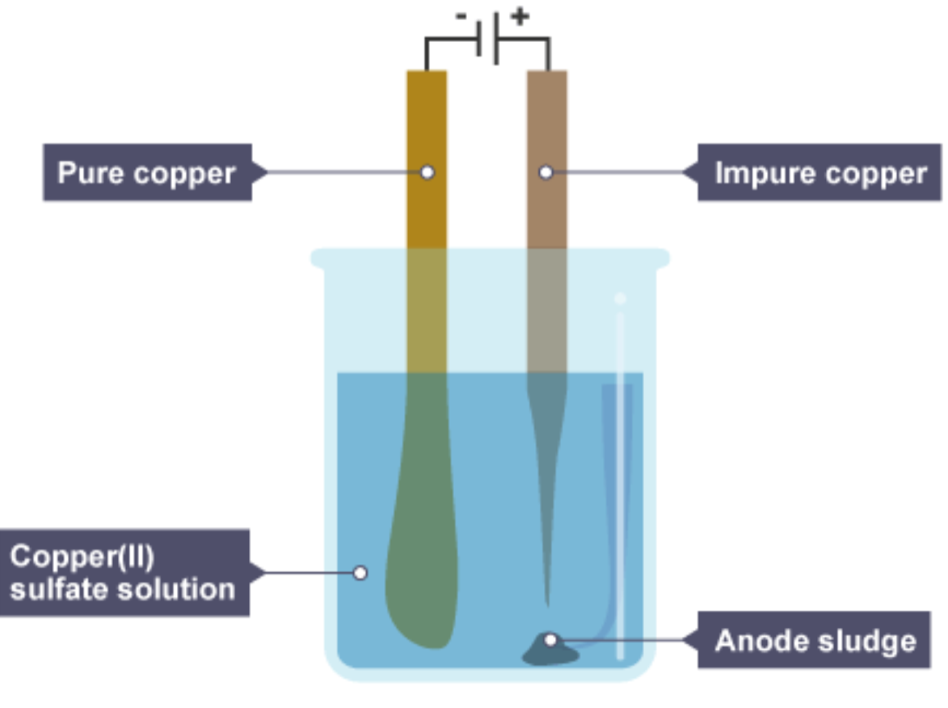
PURIFY COPPER: what happens as electric current passes through? (3)
• ANODE: Cu atoms lose electrons → enter solution as Cu+ ions • CATHODE: Cu+ ions are attracted → gain electrons and form atoms → pure copper • impurities at anode drop to bottom as SLIME
coating one metal with another by the pass of electricity is called?
electroplating
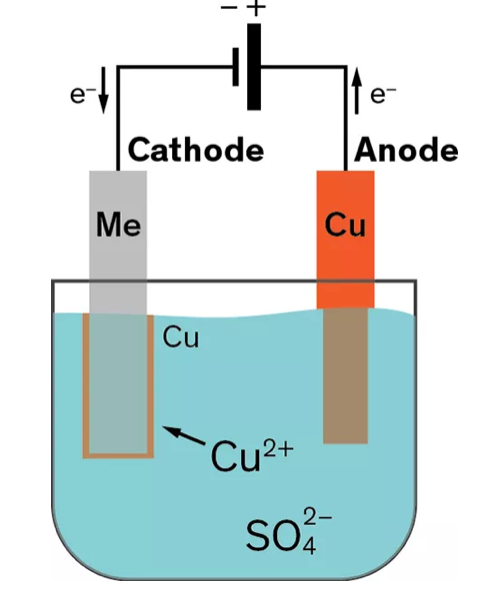
ELECTROPLATING: what do you put at the cathode and the anode?
cathode: object to be coated anode: what coats the object
formula of LIMESTONE
CaCO3
formula of LIME
CaO
formula of LIMEWATER (slaked lime)
Ca(OH)2
how do you THERMALLY DECOMPOSE LIMESTONE? what is the EQUATION and what OBSERVATION shows this reaction is happening?
heat: CaCO3 → CaO + CO2 limestone becomes white
how do you turn LIME → LIMEWATER (slaked lime)? what is the EQUATION and what OBSERVATION shows this reaction is happening?
add water: CaO + H2O → Ca(OH)2 exothermic, water hisses