Organic 10: Aromatic Chemistry
No description yet. This curated deck is ready for daily study.
Card preview (20)
What are arenes?
Hydrocarbons of benzene
Describe the structure of benzene.
Flat regular hexagon of carbon atoms Each of which is bonded to a single hydrogen atom Each carbon atom forms three covalent bonds, so one is delocalised These delocalised electrons from a ring of electron density above and below the ring Each carbon is an intermediate between a single and double bond
Why is benzene stable?
Aromatic stability Due to then delocalised system
Why is the enthalpy of hydrogenation of cyclohexa-1,3-diene higher but not double that of cyclohexene?
Because the double bonds are separated by one single bond Allowing some delocalisation of p-orbitals Enthalpy change of cyclohexa-1,3-diene could be -200kJmol-1
Describe how enthalpy of hydrogenation changes from one cyclic compound to another.
A cyclic compound with more double bonds will have the most exothermic enthalpy of hydrogenation Even distribution of electron density leads to less repulsion between adjacent electron clouds
Why is benzene more stable than cyclohexene?
Because benzene has a ring of delocalised electrons which provides stability to the molecule Cyclohexene is unsaturated
Describe benzene at room temperature.
Colourless liquid
Compare the boiling point of benzene with hexane.
Boiling point of benzene is much higher than hexane’s because benzene’s flat hexagonal molecules pack together well in the solid state They are therefore harder to separate during melting
Why are arenes insoluble in water?
Because they are non-polar But they can mix with hydrocarbons and other non-polar solvents
Describe how arenes combust.
Burn in air with smoky flames Arenes have a higher carbon:hydrogen ratio compared with alkanes So there is usually unburnt carbon remaining when they burn in air, which produces soot
What is the most typical reaction for benzene and why?
Electrophilic substitution Delocalised electron system has a high electron density so attracts positive electrophiles
Describe the general mechanism of electrophilic substitution reactions.
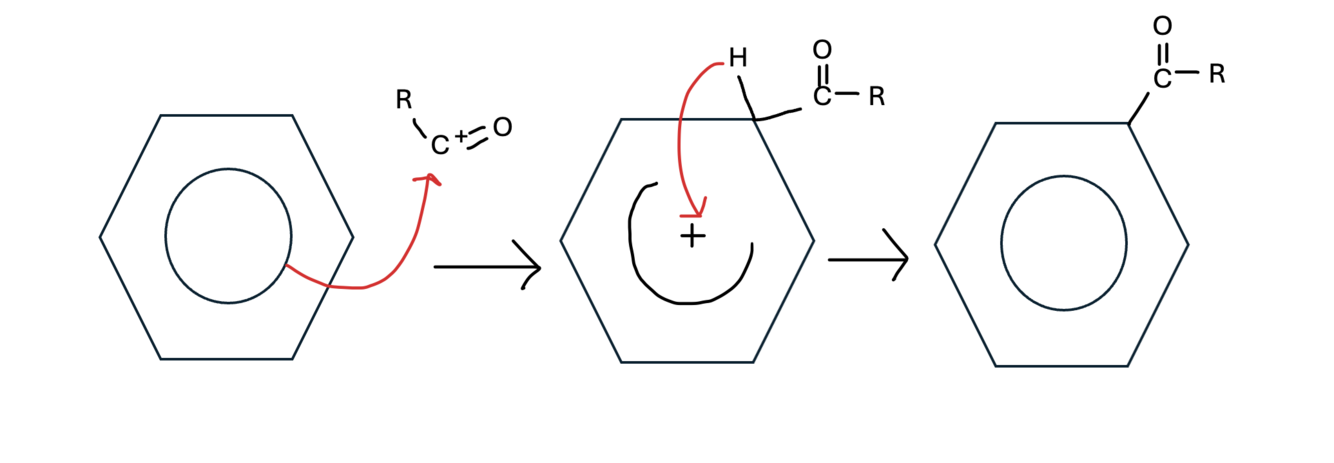
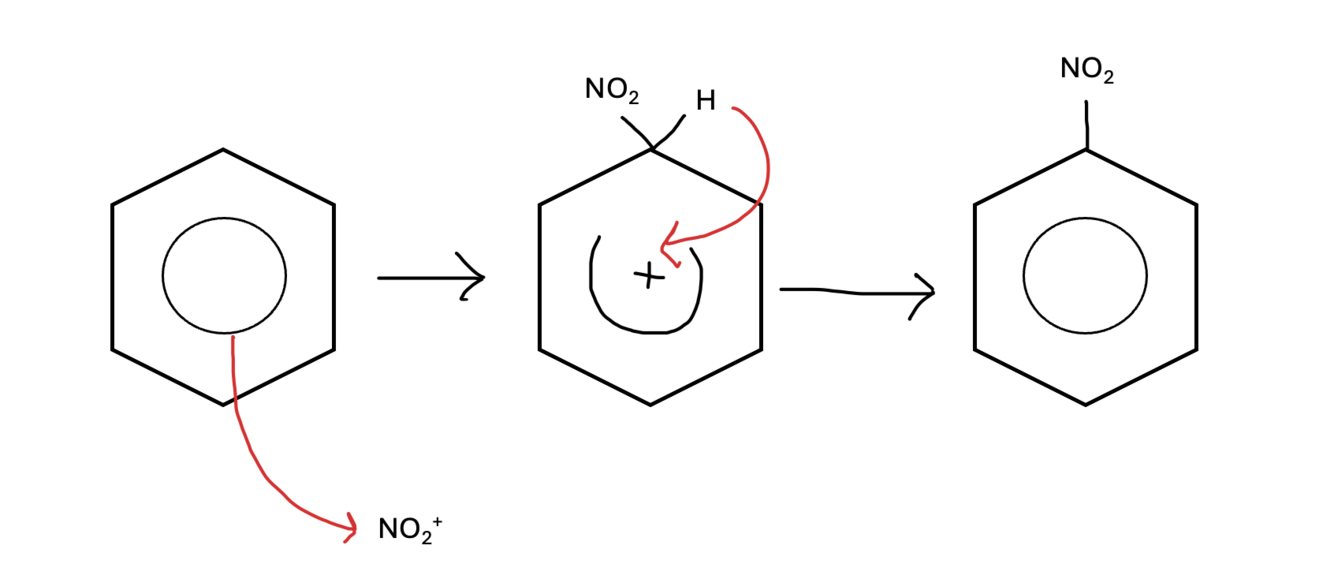
1) The aromatic ring attracts electrophile due to its high electron density 2) Bond forms between carbon and electrophile using electrons from the delocalised ring, destroying the aromatic system 3) The carbon must then lost a H+, and the electron in the C-H bond returns to the delocalised system
How is the electrophile generated for nitration?
Using concentrated nitric acid and concentrated sulfuric acid (catalyst) H2SO4 + HNO3 –> HSO4- + NO2+ + H2O
How is the catalyst regenerated in nitration?
The H+ produced from the electrophilic substitution reaction reacts with HSO4- to regenerate H2SO4
What are nitrated arenes used for?
Production of TNT Making aromatic amines to be used to make industrial dyes
What catalyst is used for Friedel-Crafts acylation?
Aluminium chloride
Give an equation to show how the electrophile is generated in Friedel-Crafts acylation.
RCOCl+ AlCl3 –> AlCl4- + RCO+
How is aluminium chloride regenerated in Friedel-Crafts acylation?
AlCl4- H+ –> AlCl3 + HCl
Draw the mechanism for nitration of benzene.
Draw the mechanism for Friedel-Crafts acylation.