Week 4 Day 3 Advanced Physics
No description yet. This curated deck is ready for daily study.
Card preview (24)
Density of water
1 g/ml 1 g/cm3 1000 kg/m3
Remember: Pressures are additive
P2 = P1 + p * g * h On Dr. G’s formula sheet: ‘delta P’ = p * g * ‘delta h’
Pascal’s Principle
When an external pressure is applied to a confined fluid, it is transmitted unchanged to every point within the fluid P1 = P2, so F1/A1 = F1/F2 at balance
Hydrodynamics: Equation for flow rate.
Flow = Area (cross sectional area)(m2) * velcoity (m/s) Flow = volume (m3) / time (sec) Flow = Av = V/t
Hydrodynamics: Equation of continuity (for an incompressible fluid)
fluid flows thru a tube with variable area sections (think of fluid moving through the barrel a syringe and then into the needle) A1 * v1 = A2 * v2
Viscosity
measure of a fluid’s resistance to flow
1 m3 = ___ L
1000 L
What is a Coulomb?
SI unit of electrical charge; the magnitude of a charge e = 1.602 x 10⁻¹⁹ C 1 C = 6.24 x 10¹⁸ e
How would you describe the movement of electrons?
Electric current Current is measured in charge/time 1 Amp = 1 C/sec
Describe an electrical conductor.
Conductors carry electrical current efficiently Materials in which charges can move easily *Most metals are generally good conductors*
Describe an insulator.
Insulators resist carrying electrical current. Materials in which charges cannot freely move. *Most non-metals are insulators*
The energy required to push electrons through a material is a measure of the _________ of the material.
resistance Resistance is measured in Ohms 1 Ohm = 1 Volt/Amp
Ohms law relates which 3 variables?
V = IR Where: V = voltage (force trying to move electrons) I = current (Coloumbs/sec) R = resistance (resistance against force ^) The voltage driving electrons through a circuit is directly proportional to the volume of electron flow and the resistance of the medium to that flow.
What is the the reciprocal of resistance?
Conductance (G) measured in: siemens (S) OR mho G = 1 / R G = 1 / Ohm G = 1 / (Volt / Amp) becasue 1 Ohm = Volt / Amp G = Amp / Volt
What does this symbol represent?
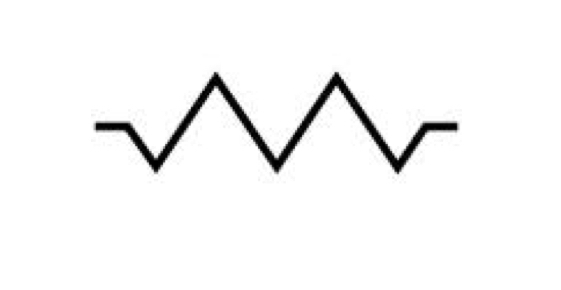
The symbol for a resistor
What does this symbol represent?
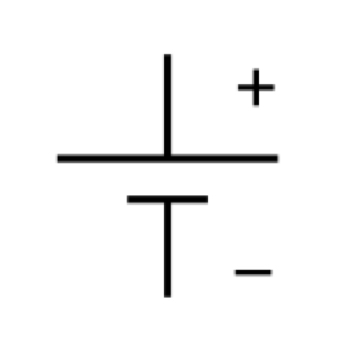
symbol for a battery
What does this symbol represent?
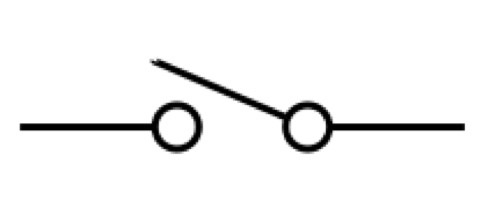
symbol for a switch (SPST - single pole single throw) i.e. simple on/off switch
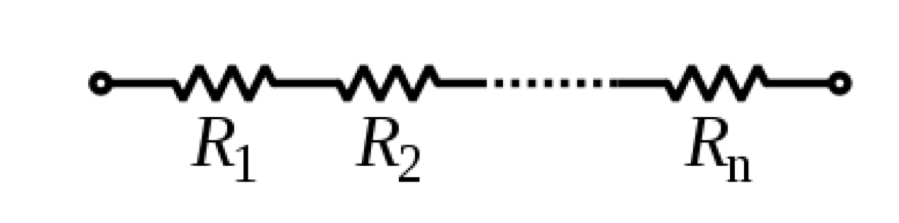
Equation for Resistors in Series
Rtotal = R1 + R2 + ……….Rn the longer the length, the longer the resistance
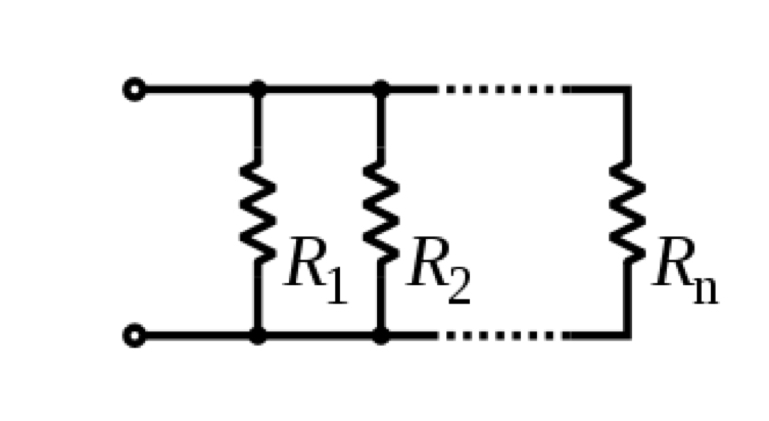
Describe a parallel circuit.
When resistors are connected in parallel, the current has more than one path that it can take. Thus, there will be a unique current that flows through each resistor independently. 1/Rtotal = 1/R1 + 1/R2 + ……1/Rn
In terms of electical power, what is power?
Current times voltage P (W) = I (A) * V (V) where W = watts A = amp V = Volt
How to calcuate an energy unit.
energy = power * time electrical energy is often expressed as kilowatt-hour (kWh)
What is a semicondcutor?
materials with electrical conducting properties somewhere between those of insulators and conductors.
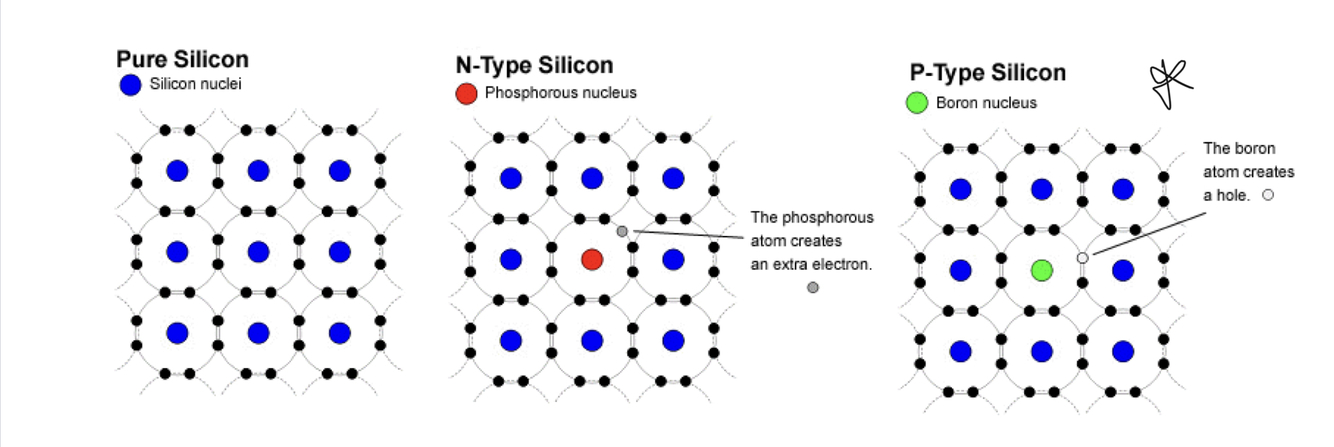
P type semiconductuors
Group IV semi - metal (i.e silicon) doped with a Group III material (i.e. Boron) Boron has a valence of 3 and so wherever a B sits in the crystal, some Si is missing an electron. This leaves a positive hole in the structure.
Is silicon a good semicondcutor?
Pure crystalline silicon is a very poor conductor of electricity.