Endocrinology
No description yet. This curated deck is ready for daily study.
Card preview (24)
What is the function of endocrine glands?
Endocrine – glands secrete hormone into blood stream which acts at some distant tissue site. Pancreatic insulin (ß-cells) → muscle and fat
What is the function of exocrine glands?
Exocrine – glands secrete non-hormone into ductal system for delivery to distant or adjacent site. Pancreatic enzymes (acinar cells) → intestinal contents
Function of paracrine sys.?
Paracrine – cells secrete hormone that acts directly on other nearby cells Testosterone (Leydig cells) → seminiferous tubules
What are hormones?
Hormones are chemical messengers (signaling molecules) that are secreted directly into the blood, which carries them to organs and tissues of the body to exert their functions. There are many types of hormones that act on different aspects of bodily functions and processes.
What types of substances can be hormones? Where are they secreted/ or derived from?
Proteins or polypeptides: Hypothalamus, pituitary, pancreas, intestines, stomach, kidney, heart, parathyroids, liver. Steroids: Cholesterol derived Aromatic amino acid derivatives : Derived from tyrosine Catchecolamines (soluble, neurological actions)
What are the differences between proteins and steroids concerning solubility and function as hormones?
-Proteins are water soluble and usually circulate without a carrier protein. -They interact with cell membrane receptors. EXAMPLE: -Inducing intracellular protein kinase action (G-coupled proteins) -Steroids are lipid soluble and transported bound to protein. -Internalized into cell, interact with nuclear receptors Modulate gene transcription
What are examples of hormones that are Aromatic amino acid derivatives?
T3 and T4 (Thyroid hormones) -Transported bound to protein -Internalized into cell, interact with nuclear receptors (modulate gene transcription) Catecholamines (epinephrine, norepinephrine, dopamine) —-Soluble —-Mostly neurological actions
What concept does this diagram depict?
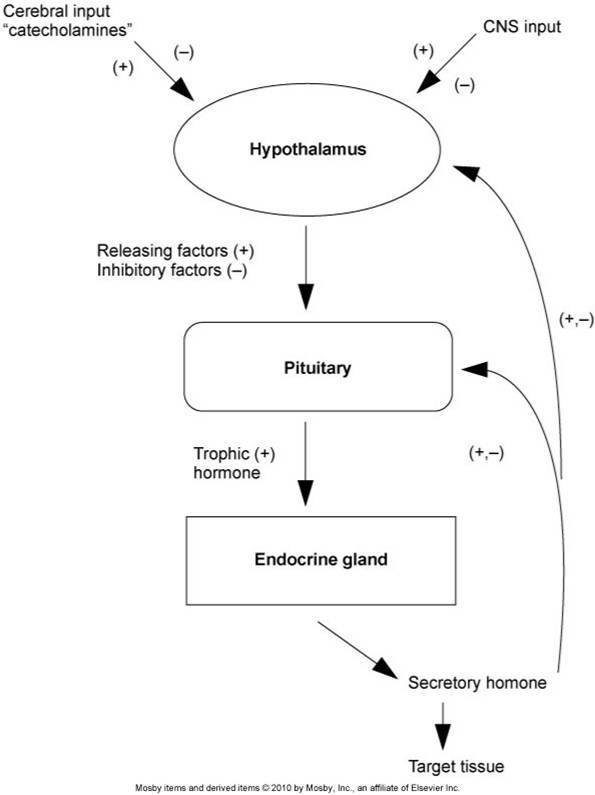
The Endocrine “Axis” Concept Hypothalamic releasing hormones stimulate pituitary secretion of trophic hormones Trophic hormones stimulate endocrine gland synthesis or secretion of primary hormone Endocrine hormone binds to specific receptors and effects action at target tissue(s)
Explain the concept of positive & negative feedback.
Negative feedback: ———-An endocrine hormone acts upon either pituitary or hypothalamus to decrease secretion of the releasing factor or trophic hormone responsible for its secretion ———-More common Positive feedback: ———–An endocrine hormone acts upon either pituitary or hypothalamus to increase secretion of the releasing factor or trophic hormone responsible for its secretion ————Estradiol from developing follicle
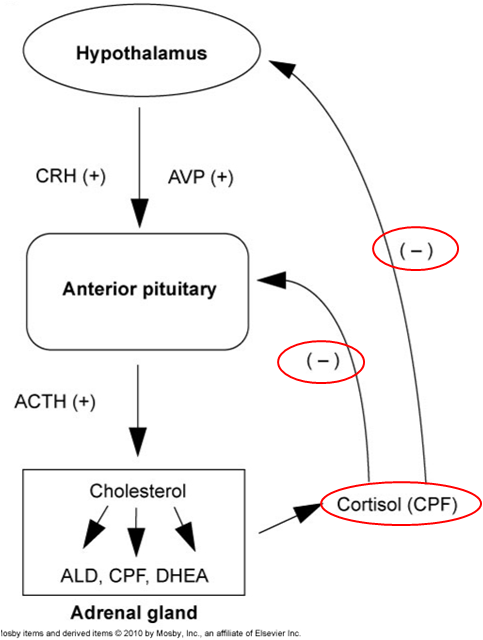
Defects in the hypothalamus, pituitary gland and target organs/tissues each represent what level of endocrine disease?
Hypothalamus- Tertiary (rare) Pituitary- Secondary Tissues/organs- Primary
Where is the pituitary gland located?
The midline base of the brain
What are the posterior and anterior pituitary? How does the hypothalamus act upon them?
Anterior pituitary (adeno-hypophysis) – gland nature ————Hypothalamic neurons secrete releasing factors into circulation which directly feeds pituitary Posterior pituitary (neuro-hypophysis) – neural nature ———–Hypothalamic neurons extend into neurohypophysis and secrete their hormones there
Where are nuerohypophysial hormones made? Examples and their actions?
Synthesized in the hypothalamus and transported via axons for storage in posterior pituitary Arginine vasopressin (AVP, antidiuretic hormone, ADH) Cyclic nonapeptide Acts on kidney tubules to increase water reabsorption Vasoconstrictor Hypothalamic osmoreceptors & cardiac/carotid baroreceptors Oxytocin Cyclic nonapeptide differs from AVP by two amino acids Involved in lactation and parturition Milk letdown Uterine contraction Pitocin® – synthetic oxytocin to induce labor
What are the two categories of Adenohypophysial Hormones? List the hormones in each group.
Direct effector hormones • Growth hormone (GH, hGH) • Prolactin (Prl) Trophic hormones: • Adrenocorticotropic hormone (ACTH) • Follicle stimulating hormone (FSH) • Luteinizing hormone (LH) • Thyroid stimulating hormone (thyrotropin, TSH)
What secretes Growth Hormone? What inhibits it?
Somatotrophs (secrete GH) comprise over 1/3 of pituitary wt Stimulated by growth hormone releasing hormone (GHRH) – 44 aa peptide Inhibited by somatostatin – 14 or 28 aa peptide ——–Hypothalamus and pancreatic δ-cells
HOW is Growth Hormone GH secreted?
Secreted in pulsatile fashion (avg interval 2-3 hrs) —Greatest secretion during sleep —Spikes occur after meals and exercise —Blood GH may be undetectable between pulses ———Poor value of isolated GH blood samples
What are the anabolic actions of GH?
Anabolic: Increases protein synthesis, esp. in muscle Soft tissue, bone and cartilage growth Gluconeogenesis (glucogenic)
What is the catabolic function of GH?
Stimulating lipolyisis.
What does IGF stand for? Examples?
insulin-like growth factor (IGFs, somatomedins, sulfation factor)
GH stimulates the formation of ______ in the liver acting as a _______hormone as well and the liver an endocrine organ.
IGFs trophic
What is the most important IGF? Where is it made? What does it respond to? Howis it measured?
IGF-1 – most important IGF Previously known as somatomedin C Synthesized by the liver in response to GH Insulin structural homology Bound to IGF-binding protein 3 (IGF-BP3) Both IGF-1 and IGF-BP3 blood levels are positively correlated with GH secretion Blood levels are more stable than GH Preferred testing marker (± IGF-BP3) Measure by immunoassay (limited platforms)
What is the name of this disorder? What is it a result of?
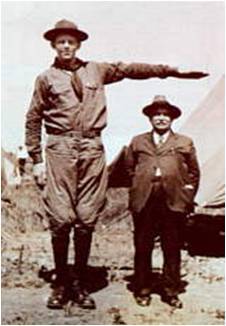
Hypersecretion: Gigantism – GH excess during growth phase
What is this disorder?
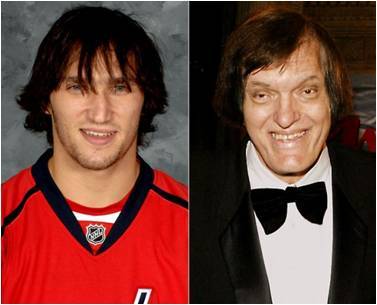
Acromegaly – GH excess after growth complete commonly result from pituitary tumor
What disorders result from GH HYPOsecretion?
Hyposecretion: Pituitary dwarfism – not the same as achondroplasia Autosomal dominant FGFR3 mutation; homozygous fatal May result from tumors that interfere with GH secretion May also result from genetic defects in GHRH gene, GH gene, GH receptor, IGF-1 synthesis or receptor Adult deficiency Mental issues (vague) - social withdrawal, fatigue, … Osteoporosis Decreased lean body mass (muscle) Inc. total and LDL cholesterol