Topic 8 Enthalpy Changes
No description yet. This curated deck is ready for daily study.
Card preview (17)
Exothermic
-ΔH increase in temperature
Endothermic
+ΔH decrease in temperature
What is thermochemistry?
The study of energy changes in chemistry.
System
Just the material or mixture of chemicals being studied.
Surroundings
Everything around the system (eg. apparatus or air in the lab).
Closed system
System can’t exchange matter with the surroundings because the reaction flask is closed with a bung. Energy can’t be transferred.
Open system
A material system in which mass or energy can be lost to or gained from the surroundings.
Examples exothermic reactions
-Combustion reactions -Neutralisation reactions -Displacement reactions
The standard enthalpy change of combustion
The enthalpy change when 1 mole of a substance is burned completely in oxygen under standard conditions (100kPa, 298K, 1atm).
What is the formula for specific heat capacity?
q=mcΔT q=energy transferred (J) m=mass of substance (kg) c=specific heat capacity ΔT=temperature change (K or °C)
The standard enthalpy change of neutralisation
When one mole of water is produced by the neutralisation of an acid with an alkali. The enthalpy change measured at 100kPa and a specific temperature, usually 289K.
The standard enthalpy of formation
When one mole of a substance is formed from its elements in their standard states. The enthalpy change measured at 100kPa and a specific temperature, usually 298K.
Hess’s law
The enthalpy change of a reaction is independent of the route taken in converting the reactants into products provided the initial and final conditions are the same in each case.
Enthalpy cycle of combustion
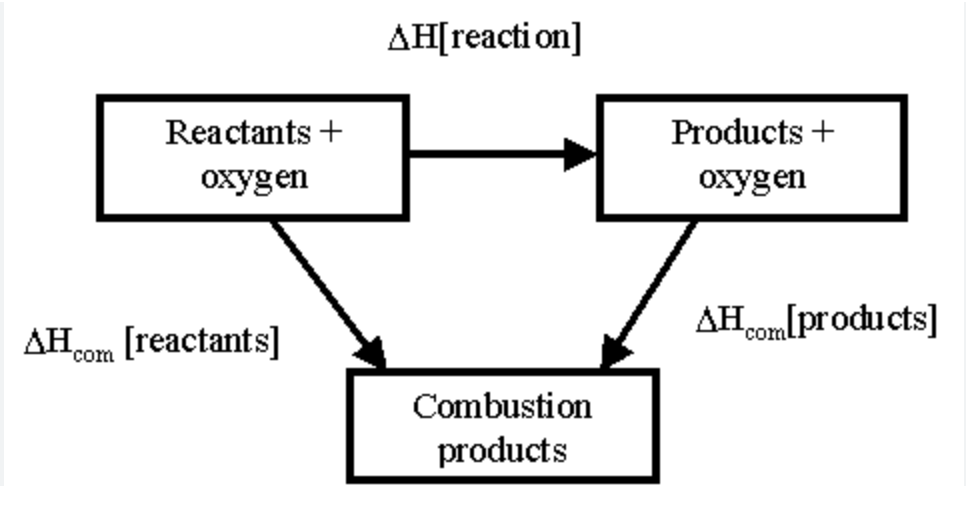
Bond enthalpy (basic definition)
The amount of energy needed to break bonds.
Making bonds
Negative
Breaking bonds
Positive