Concrete
No description yet. This curated deck is ready for daily study.
Card preview (24)
Why is concrete used in industry?
• High strength • Good acoustics • Takes time to set allowing you to play with its form
How do you make concrete?
Water Cement: • Provides strength to harden concrete. • Fills voids between the aggregate, providing lubrications of fresh concrete as well as water-tightness in the hardened concrete. Fine aggregate (sand) Coarse aggregate: • Provide a cheap fill for the cementing material. • Provide a mass of particles suitable for resisting the action of applied loads, abrasion and percolation. • Reduces volume change resulting from the setting process as well as moisture changes in cement paste. Air
What is the process of making cement?
• When you mix cement and water together you produce a paste. • You then mix this paste with your fine aggregate to form mortar. • You then mix the mortar with the coarse aggregate to produce concrete.
What is hydraulic cement?
• Hydraulic cement prevents water and leaks in concrete. • It is a type of cement similar to mortar, that sets extremely fast and gardens after it has been mixed with water.
What are the main materials which make up Portland cement?
Limestone/chalk: • Lime (CaO) Clay / shale: • Silica (SiO2) • Alumina (Al2O3) • Iron oxide (Fe2O3) • Gypsum (CaSO4)
How is Portland cement produced?
• Grind the raw materials. • Burn in a large rotary kiln at 1450oC to form balls known as clinker. • Cool the clinker and grind them to a fine powder. • Add gypsum. During burning the raw materials are firstly dried out, and then calcination occurs before the materials are finally sintered (a process where clay and limestone combine).
What percentage of the Portland Cement clinker do alite and belite comprise of?
70%
What are the main problems associated with the sustainability of Portland cement?
Fuelling of kilns: • Traditionally use fossil shells leading to direct CO2 emissions. Calcination of raw materials: • During calcination, CO2 is released due to the decomposition of calcium carbonate (CaCO3) into lime (CaO). • CaCO3 + heat -> CaO + CO2 Consumption of natural resources Research has introduced a wide range of sustainable replacements such as: • Nanomaterials • Bacteria • Alternative sources of fuel
What are the composition compounds of Portland cement?
• Tricalcium Silicate (C3S) • Dicalcium Silicate (C2S) • Tricalcium Aluminate (C3A) • Calcium Aluminium Ferrite (C4AF) • Gypsum (CaSO4)
What is Tricalcium Silicate (C3S)?
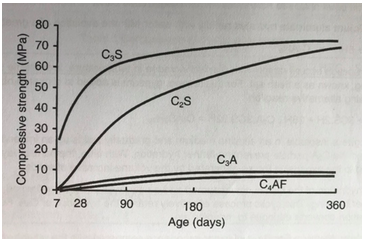
• Known as alite. • Responsible for the rapid hardening and early strength gain of cement. • Reaction generates significant heat so has limited presence in low heat Portland cements.
What is Dicalcium Silicate (C2S)?
• Known as belite. • Responsible for the late strength gain of cement.
What is Tricalcium Aluminate (C3A)?
• Has a large influence on cement properties. • Rarely present in excess of 15%.
What is Calcium Alumino Ferrite (C4AF)?
• Provides Portland cement with its characteristic colour.
What is Gypsum (CaSO4)?
• Slows down the hydration of C3A to prevent cement early set.
What is the composition compound code used in Portland Cement?
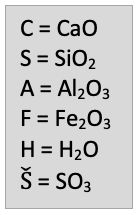
What is the hydration of Portland cement?
The hydration causes it to set and harden. Cement + Water -> Calcium hydroxide + Hydration products (gel) Hydration can occur through two mechanisms: • In solution - reactants dissolve to produce ions in solution which combine to form solid products. • In solid state - reactions take place directly at the surface without entering solution.
What are the hydration reactions?
• Alite + Water -> Calcium hydroxide + Calcium silicate hydrate (C-S-H gel) • Belite + Water -> Calcium hydroxide + Calcium silicate hydrate (C-S-H gel) • Tricalcium Aluminate + Water + (Calcium hydroxide) -> Calcium Aluminate hydrate (C-A-H gel) • Tricalcium Aluminate + Water + Gypsum + (Calcium hydroxide) -> Ettringite (gel) • Calcium Alumino Ferrite + Calcium hydroxide + Gypsum + Water -> “solid solution of sulfoferrite and sulfoalluminate”
What is calcium hydroxide?
• Formed mainly from alite hydration. • Makes paste highly alkaline.
What is Calcium Silicate Hydrate (C-S-H gel)?
• Main source of concrete strength. • Dashes indicate there is no strict ratio of the compounds which make up the gel.
What is Calcium Aluminate Hydrate (C-A-H gel)?
• Produces ‘flash set’. • Therefore we add gypsum in order to slow the rate of reaction. • This produces a gel known as ettringite.
How is ettringite gel formed?
• Ettringite gel forms on the surface of tricalcium aluminate particle, causing the pressure to increase. • This causes the Ettringite layer to burst, exposing part of the tricalcium aluminate particle. • Therefore, more Ettringite is able to form. • This process repeats until the tricalcium aluminate particle is fully immersed in paste.
What is Ettringite (gel)?
• Consists of rod-like crystals. • Compound of water, Gypsum and tricalcium aluminate.
What is monosulfate (gel)?
• Occurs in later stage of hydration, replacing Ettringite. • Compound of water, Gypsum and tricalcium aluminate.
How does cement strength develop over time?
• Tricalcium and dicalcium sulfate are the main compounds responsible for strength. • Tricalcium sulfate is the compound responsible for the early strength of the cement.