Kinetics 2: Experimental derivation of rate laws & constants
No description yet. This curated deck is ready for daily study.
Card preview (20)
NB: Collision theory is useful only for simple reactions. We propose rate laws, then see whether data is consistent, rather than trying to infer rate laws from data. Rate laws are differential equations, the simplest of which can be solved manually.
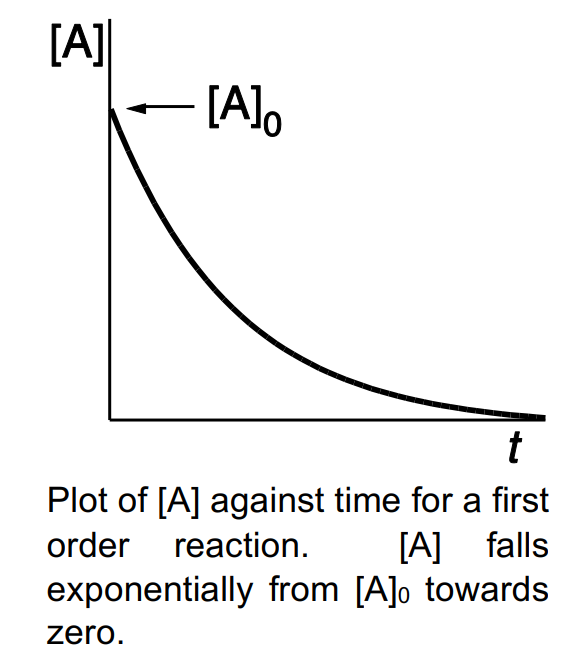
• Write the rate law of the following first order reaction, in terms of A, both in terms of the rate constant, and in differential form: A –> products • Sketch [A] against time
r = k1st[A] d[A]/dt = -k1st[A] since recall r = -d[A]/dt
Solve the rate law below, between t = 0 and t = t A –> products r = -d[A]/dt = k1st[A]
result should be [A]t = [A]0exp(-k1stt) exp decay in accordance with graph
Prove that, for first order reactions, you can use a quantity proportional to conc in order to determine the rate constant - ie you don’t need to know the absolute rate.
Say the quantity I is proportional to conc. Then I = y[A], where y is unknown. [A]0 = I0/y, [A]t = I/y Recall [A]t = [A]0exp(-k1st) ln[A]t = -kistt + ln[A]0 ^straight line, slope -k1st ln(I/y) = -k1stt + ln(Io/y) lnI - lny = -kstt - lny + lnI0 lnI = -k1stt + lnI0 ^also a straight line, slope k1st, so serves as a relative measure of conc
A first order reaction has stoichiometric eq A –> B. Produce and solve the rate law in terms of B.
d[B]/dt = k1st[A] quantity of B formed results from loss of same quantity of A, so: [A]t = [A]0 - [B]t Recall [A]t = [A]0exp(-k1stt) [A]0 - [B]t = [A]0exp(-k1stt) [B]t = [A]0(1 - exp(-k1stt)) as expected, this predicts [B] rises from 0 and tends towards [A]0
Produce and solve the rate law for the second order reaction A –> products. Show how this gives a straight line plot.
rate law d[A]/dt = -k2nd[A]2 ∫(from [A]t to [A]0) 1/[A] d[A] = k2nd ∫(from t=t to t=0) dt 1/[A]t = k2ndt + 1/[A]0 straight line Plot 1/[A]t against k2ndt, slope = k2nd, intercept = 1/[A]0 whereas [A] against time decreaes hyperbolically from [A]0, then falls asymptotically towards 0
Can relative concentrations be used to find the value of the 2nd order rate constant?
No, only absolute concs
The reaction A + B –> C has rate law d[A]/dt = -k2nd[A][B]. Simplify and solve this law.
1: 1 stoichiometry means [A] = [B] always, so d[A]/dt = -k2nd[A]2 * As before:* ∫(from [A]t to [A]0) 1/[A] d[A] = k2nd ∫(from t=t to t=0) dt 1/[A]t = k2ndt + 1/[A]0 or 1/[B]t = k2ndt + 1/[B]0
Describe the use of the isolation method
Reaction measurements are taken with one reagent in significant excess, so that its conc doesn’t change significantly throughout the reaction. This is repeated for all reagents in order to obtain pseudo-rate laws
Describe the limitations of the isolation method.
Putting one reagent in excess may • make reaction too fast to measure accurately • alter the mechanism
The reaction A + B –> products is thought to have rate law d[B]/dt = -k3rd[A]2[B]. • Use the isolation method to simplify this law • Explain how the isolation method is used to determine 3rd experimentally
law simplification Say we put A in excess. d[A]/dt ~ 0, so k3rd[A]2 is effectively constant Rate law becomes d[B]/dt = -keff[B] where keff = k3rd[A]2, and is a pseudo-1st-order rate constant (but isn’t really since it’s conc-dependent) determining k3rd • Measure [B] throughout reaction, for several different excess concs of A • Obtain keff, the gradient, from each graph • Plot keff against [A]02, giving a straight line. k3rd is the gradient
A rate law has the form r = k[A]n. Explain how the differential method is used to determine the value of n.
r = k[A]n lnr = nln[A] + lnk Plot lnr against ln[A] –> straight-line graph with gradient = n
What is the drawback of the differential method?
Requires plotting functions of rates, rather than concs, but rates are much harder to measure. This is since taking the accurate slope of a graph of conc against time is hard, esp if reactions are fast such that rates change quickly.
define half-life
time taken for the conc of a given reagent to reach half its initial value
Give the expression for the half-life for a first-order reaction.
t1/2 = ln2/k1st
Prove that the half-life for a first-order reaction is independent of inital concentration.
Begin with integrated rate law Recall [A]t = [A]0exp(-k1st) ln[A]t = -k1st + ln[A]0 When t = 11/2, [A]t/2 = [A]0/2 So ln([A]0/2) = -k1stt1/2 + ln[A]0 k1stt1/2 = ln[A]0 - ln([A]0/2) = ln(2[A]0/[A]0) = ln2 t1/2 = ln2/k1st Expression doesn’t contain [A]0 so is independent of it
Give the expression for the half-life for a second order reaction.
t1/2 = 1/(k2nd[A]0)
Prove that the half-life for a second order reaction is dependent on the initial concentration.
2nd order integrated rate law 1/[A]t = k2ndt + 1/[A]0 At t1/2, [A]t/2 = [A]0/2 So 2/[A]0 = k2ndt1/2 + 1/[A]0 t1/2 = 1/(k2nd[A]0) half-life contains initial conc so is dependent on it
A reaction has a 1st order rate constant of 2000 s-1 at 400 K. Calculate the half-life.
t1/2 = ln2/k1st = ln2/2000 = 0.3 ms = 3 x 10⁻⁴ s
rates of reactions can’t be compared using rate constants- have to take conc into account A second-order reaction 2A –> B + C has rate contant 0.8 mol-1 dm3 s-1 at 280 K, and the initial conc of A = 4.4 x 10⁻³ mol dm-3. Calculate the half-life.
t1/2 = 1/(k2nd[A]0) = 1/(0.8 x 4.4 x 10-3) = 280 s