Polymers
No description yet. This curated deck is ready for daily study.
Card preview (24)
What are the features of plastics?
• Good thermal/electrical insulation • Low density • Easy to manufacture • Low cost • Useful as adhesives • Good transparency
What are polymers?
• Polymers are materials with large macro-molecules, of which plastics are just one group. • The extent of cross-linking between chains influences the final material. • Stronger attractive forces between chains leads to a stronger, less flexible polymer (e.g. nylon). • If chains are less able to slide past each other, the polymer is likely to be flexible.
What are the different types of polymer?
• Thermoplastics • Thermosets • Elastomers • Polysiloxanes
What are thermoplastics?
• Linear/branches chains with minimal cross-linking. • Weak intermolecular bonds allow melting when heated. • Greater ability to form crystalline regions. • Ductile. • e.g. polyethylene, polypropylene, polystyrene
What are thermosets?
• Heavily cross-linked. • React and harden causing the material to burn when heated. • Brittle. • e.g. vulcanised rubber, epoxies, phenolic resin
What are elastomers?
• Linear with some cross-linking, allowing them to carry much higher strains. • Shape memory. • Useful for heat shrink, insulating electrical cables, and structural bearing pads.
What are the different types of chains in polymers?
Linear polymers: • Single chains • Flexible Branched polymers: • Side branches • Less efficient packing • Lower density • Less crystalline Cross-linked polymers: • Adjacent chains are joined at various positions by covalent bonds • Sometimes referred to as a network
What are copolymers?
Copolymers consist of two ‘met’ units, resulting in an irregular chain structure which can improve or tailor specific properties by modifying the intermolecular bonds. Random copolymers: • ABBABA Alternating copolymers: • ABABAB Block copolymers: • AAABBB Graft copolymers: • AAAAAA BB (active site)
What is polymerisation?
Polymerisation is the chemical process of reacting monomer molecules to form 3D networks or polymer chains. Condensation polymerisation: • Elimination of small molecules Free radical polymerisation: • Produces an addition reaction • Initiation - free bonds produced • Propagation - chains get longer • Termination - longer molecules join together
What is the molecular weight?
• The mass of a mol of chains. • It affects the tensile strength, stiffness and viscosity of the material. • Longer chains are more likely to entangle and therefore can ‘anchor’ better. • The critical length before strength increases is 100 ‘mers’ (40 for nylon).
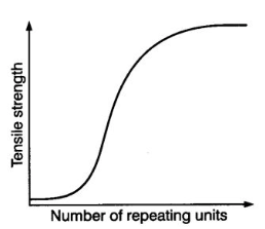
How do you solidify a polymer?
• Annealing causes crystalline regions to grow. • These crystalline regions are resistant to solvents. • Secondary bonding such as hydrogen bonds and dipole - dipole reactions are very important.
How are crystalline regions discouraged?
• Random copolymerisation • Bulky side groups • Chain branching
What is the difference between semi-crystalline and amorphous structures?
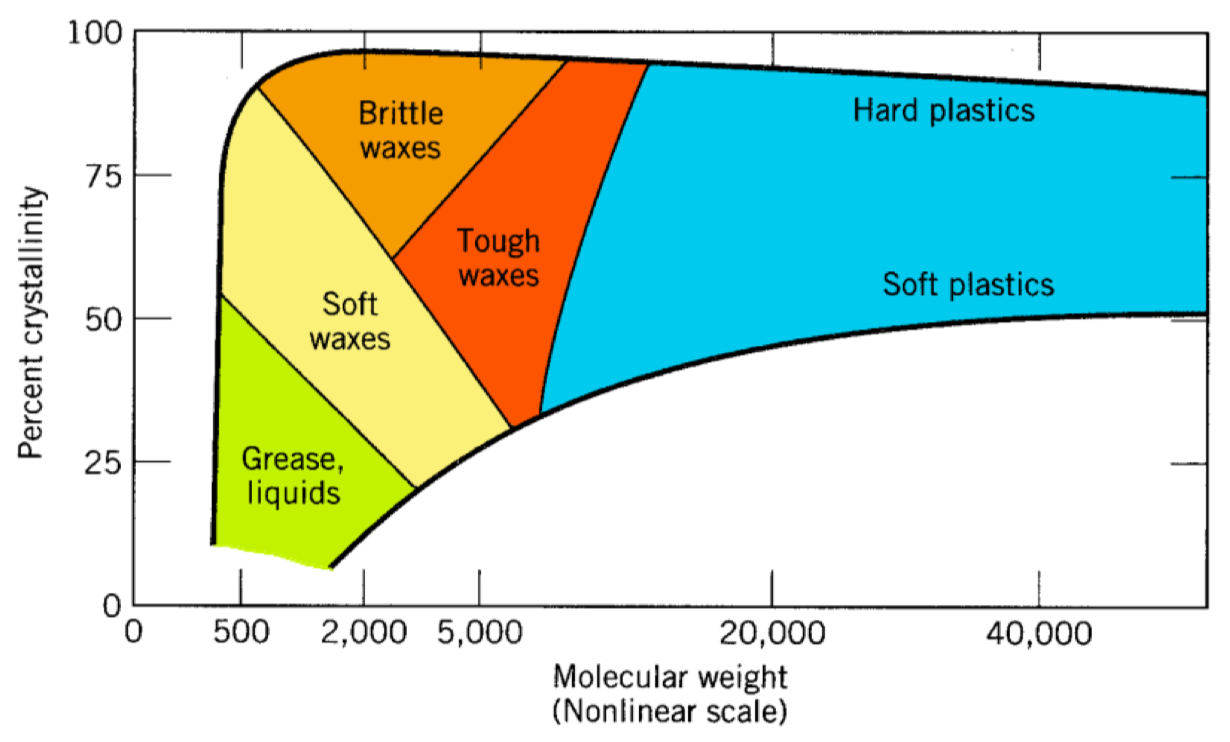
Semi-crystalline: • Stiff • Less ductile • High tensile strength Amorphous: • Less stiff • Ductile • Low tensile strength
What is the crystallinity and molecular weight of plastics/waxes/grease?
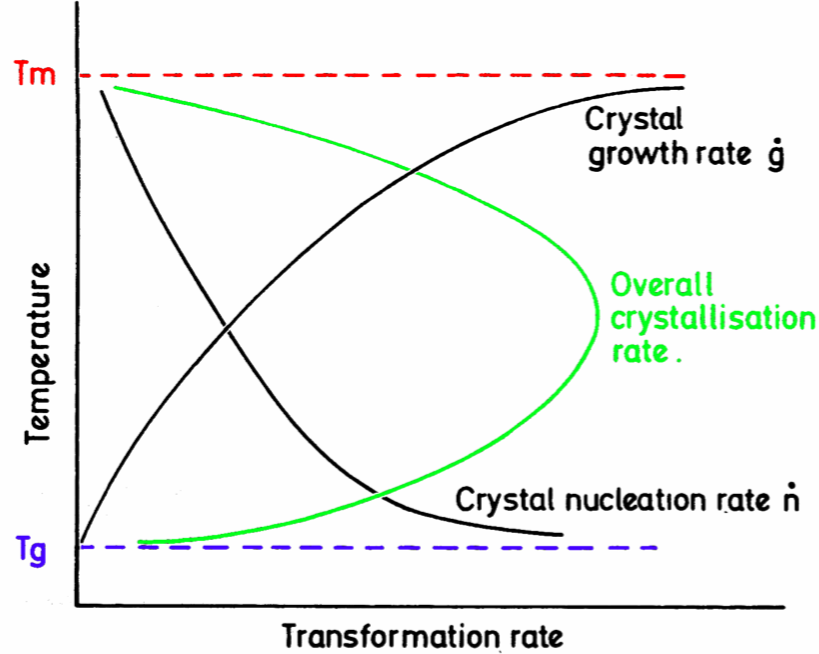
Which factors affect the rate of crystallisation?
• For crystallisation, considerable molecular mobility is necessary. • The formation rate of these crystals is the product of the nucleation rate and the growth rate. • Growth rate diffusion is controlled and at a maximum just below the melting point. • Nucleation rate is at a maximum just above the glass transition temperature. • Overall formation rate is maximum half way between these two temperatures.
What is the affect of crazing?
• Crazing in linear polymers produces voids which scatter light. • Molecules are drawn out on a very small scale producing strong strands which bridge microcracks.
Which factors affect the mechanical properties of polymers?
• Molecular structure • Operating temperature
What is the affect of cold drawing?
• Cold drawing causes molecules to be drawn out and aligned. • This makes the material much stronger in a particular direction that it once was. • Therefore, elasticity and tensile strength are increased but the ductility is reduced.
What does the stress-strain graph for different polymers look like?
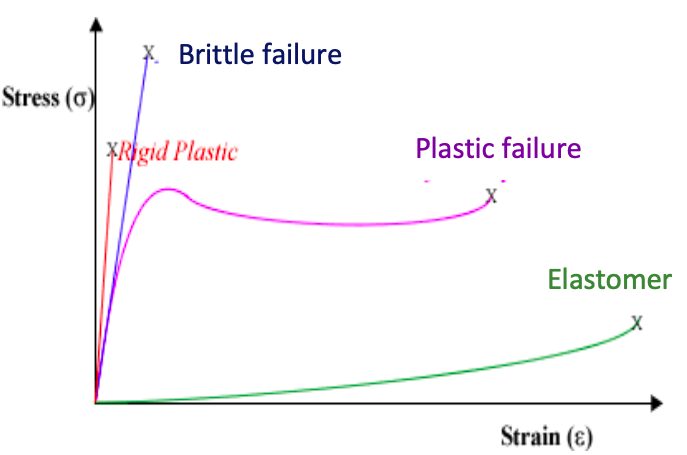
What effect does temperature have on polymers?
• When heated, polymers deform plastically. • Therefore ductility increases, but stiffness and strength decrease. • Chain stiffness and the bulkiness affects the ease of rotation of side groups. • Bulkier side groups are harder to rotate, and so melting temperature is higher. • The presence of polar side groups can also lead to significant intermolecular bonding forces.
What is the glass transition temperature equation?
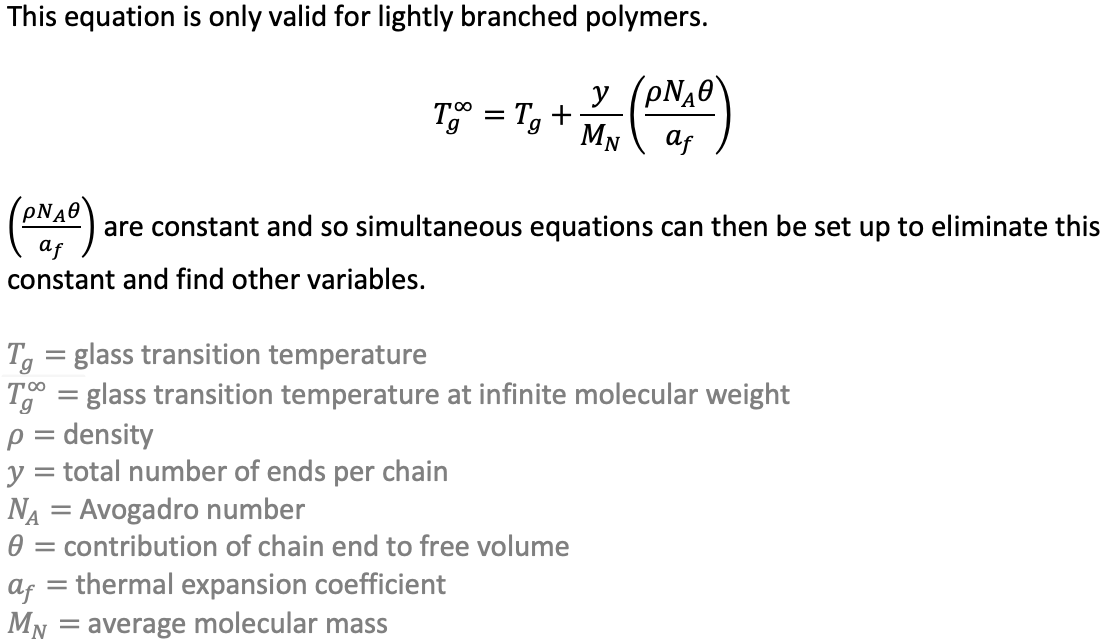
How are polymers formed?
• Injection moulding • Extrusion • Thermoforming • Blow moulding • Compression moulding
What is injection moulding?
Thermoplastic - two hoppers feed resin and colourant onto a tapered screw root which forces them into a cooled mould. Thermoset - a hopper feeds resin onto a screw root which forces it into a heated mould. • Produces complex shapes. • Rapidly manufactured. • Moulds are expensive, but production is very cheap once installed.
What is extrusion?
• The polymer is heated causing it to melt into a liquid. • This is then forced through a die of required cross-section. • The polymer is then extruded out of the die and cooled. • This produces complex shapes. • Rapidly manufactured. • Moulds are expensive, but production is very cheap.