A8 Redox + Electrochemistry
No description yet. This curated deck is ready for daily study.
Card preview (24)
Define oxidising agent
• Removes electrons from another species by accepting them • Increasing species oxidation number
Define reducing agent
• Donates electrons to another species by loosing them • Decreasing the species oxidation number
How to convert acidic half-equation to alkaline half-equation
• Swap H+ and H2O, so they on other sides of equation • Replace all H+ with OH-
How to write half-equations for acidic conditions
• Balance the element changing oxidation state • For every oxygen, add an H2O to the other side • For every hydrogen, add an H+ to the other side • Use electrons to ensure both sides have the same charge
How to write alkaline half-equation
• Write for acidic conditions • Swap H+ with H2O so they are on opposite sides of equation • Replace all H+ ions with OH- ions
What is colour of manganate ion (MnO4-)
Purple
Colour change for manganate redox titration
Colourless to pink
What must be remebered when calculating a redox titration
Factor of x10
Why is excess of KI added in first step of thiosulphate titration
Ensure all I2 is formed for the second titration
What is the indicator used for a thiosulfate redox titration and what is result
• Starch (add just before end point) • Colour change from blue-black to colourless
When to add starch to indicate thiosulfate redox titration
Just before end point
Define standard electrode potential
• The potential difference of a half-cell, compared to a standard hydrogen half-cell • Under standard conditions (100kPa, 298K and all solutions at 1mol dm-3)
What are standard conditions for half-cells
• 100 kPa • 298 K • 1mol dm-3
When a half-cell is established with two aqueous ions, what electrode is used
Platinum (Pt)
At what electrode does oxidation occur
Negative (cathode)
At what electrode does reduction occur
Positve (anode)
What must be included when drawing a cell potential diagram
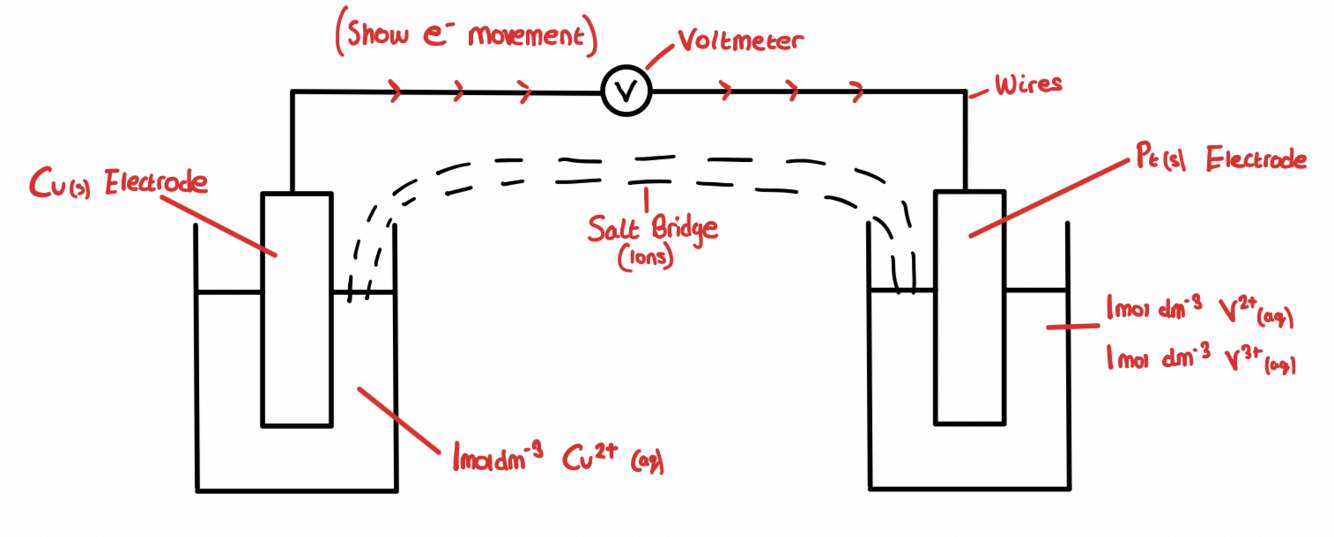
• e- movement (negative to positive electrode) • Salt bridge (ions) • Electrode • Solutions • Wires • Voltmeter
Diagram of system used to measure cell potential
Equation for calculating Ecell
more POSITIVE electode potential - more NEGATIVE electrode potential
What direction does the big arrow always go to predict feasibility
Anti-clockwise
When explaining redox system feasibility, which half-equation goes forwards
More positive
When explaining redox system feasibility, which half-equation goes backwards
More negative
What is the direction of the big arrow in redox system feasibility
More negative to more positive
When combining two redox half-equations, what must be ensured FIRST
Electrons are balanced