Ch4- Acids and Redox
No description yet. This curated deck is ready for daily study.
Card preview (20)
What is the definition of an acid?
An acid is a proton donor.
What do acids do in aqueous solutions?
Acids release H+ ions in an aqueous solution. HCl(aq) —-→ H+(aq) + Cl -(aq)
What do alkalis do in aqueous solutions?
Alkalis release OH- ions in an aqueous solutions. NaOH (aq) —-→ Na+(aq) + OH- (aq)
How do strong acids behave in aqueous solutions?
Strong Acids completely dissociate into ions in aqueous solution. HCl(aq) —→ H+(aq) + Cl-(aq)
How do weak acids behave in aqueous solution?
Weak Acids only partially dissociate into ions in aqueous solution. CH3COOH(aq) ←—–→ CH3COO-(aq) + H+(aq)
What is a base?
Bases can neutralise acids to form salt + water. A base is a proton accepter.
What is an alkali?
An Alkali is a base that dissolves in water releasing OH- ions into solution. Alkali is a proton acceptor.
What is the ionic equation for neutralisation?
H+(aq) + OH-(aq) —→ H2O(l)
What is a neutralisation reaction?
In a neutralisation, the H+ ions from acid react with base/alkali to form (ionic compound) salt + neutral water. H+ ions are replaced by metal or ammonium ions from base. (remember all bases are alkalis but not all alkalis are bases)
What are carbonates?
Carbonates are special types of bases. They neutralise acids to form salt + water + carbon dioxide gas.
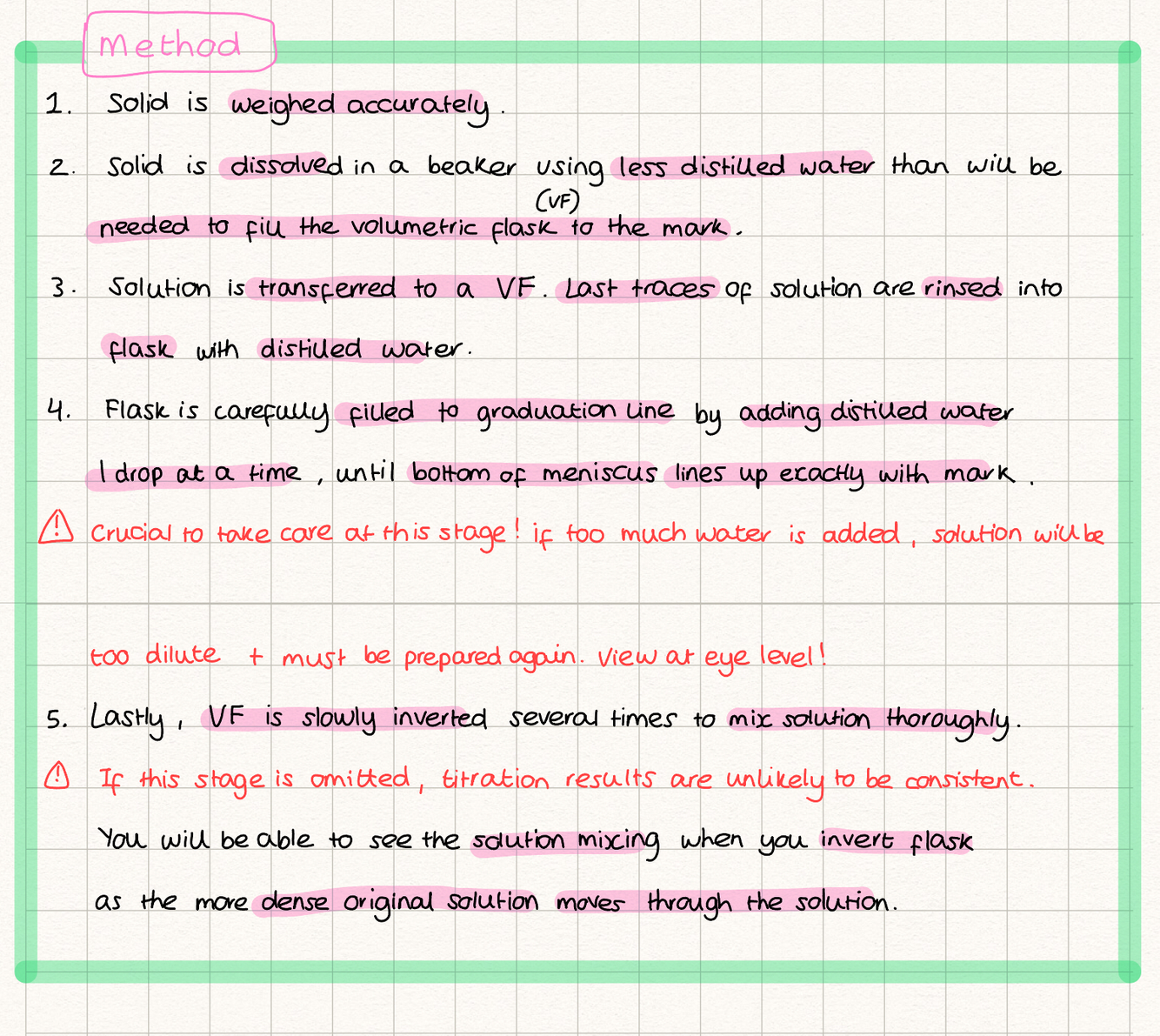
What piece of equipment is used to prepare a standard solution?
Volumetric Flask.
What is the method of preparing a standard solution?
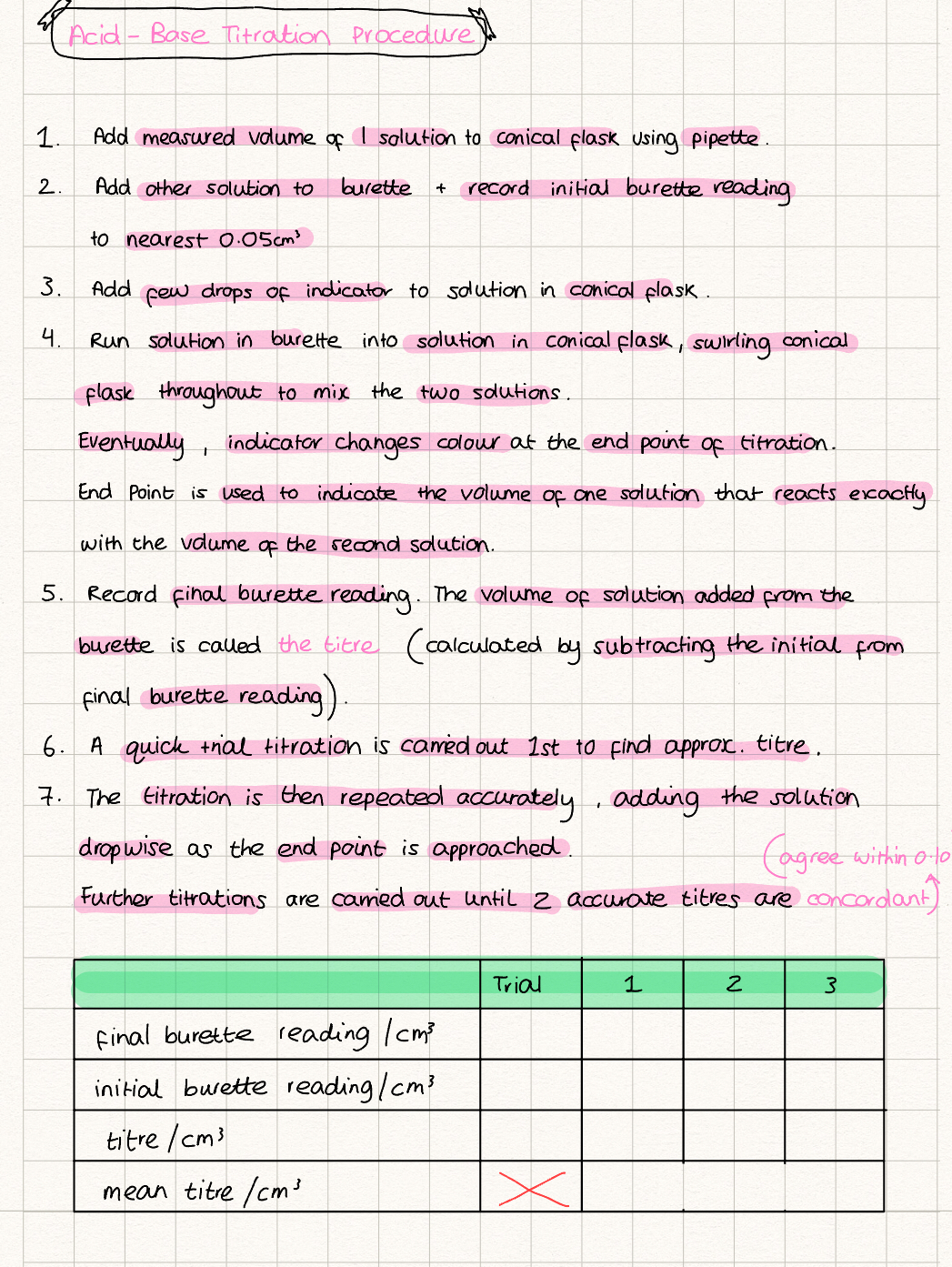
What pieces of equipment are used for Acid-Base Titrations?
A graduated pipette and Burette.
When deciding on an accurate titre reading, what should you do?
Record Burette readings from bottom of meniscus. Measure each burette reading to nearest +/- 0.05. When two titres are concordant, use them to calculate mean.
What is the procedure for carrying out an Acid-Base Titration (after standard solution made)
What are the rules for Assigning Oxidation Numbers?
• Oxidation no. for uncombined element = 0 • Oxidation for monoatomic ion = charge on ion • More electronegative element in binary compound is assigned number equal to charge it would have as an ion. • Oxidation no. in F = always -1 • O has oxidation -2 unless with F (where it is +2) OR in peroxide (where it is -1) • H has oxidation +1 unless combined with metal, where = -1 • Elements in Gr1 = +1, Gr2 = +2, Gr3 = +3 etc… • Sum of Oxidation numbers of all atoms in neutral compound = 0 • Sum of oxidation numbers of all atoms in polyatomic ion = charge of ion
What is a disproportionation reaction?
a reaction in which a compound undergoes oxidation as well as reduction
LOOK OVER ROMAN NUMERAL to indicate magnitude of oxidation number
What is oxidation?
removal of electrons. Species will get more positive.
What is reduction?
gain of electrons. species will get more negative.