Alkenes
No description yet. This curated deck is ready for daily study.
Card preview (8)
What do all alkenes contain?
One double covalent bond between two carbon atoms
What is the general formula for alkenes?
CₙH₂ₙ
Why are alkenes considered unsaturated hydrocarbons?
• They have a double bond, which can open up to form single bonds to additional atoms meaning they are not maximally bonded • They are comprised of hydrogen and carbon only This means alkenes are much more reactive than alkanes
What are the first four alkenes and their molecular formulae?
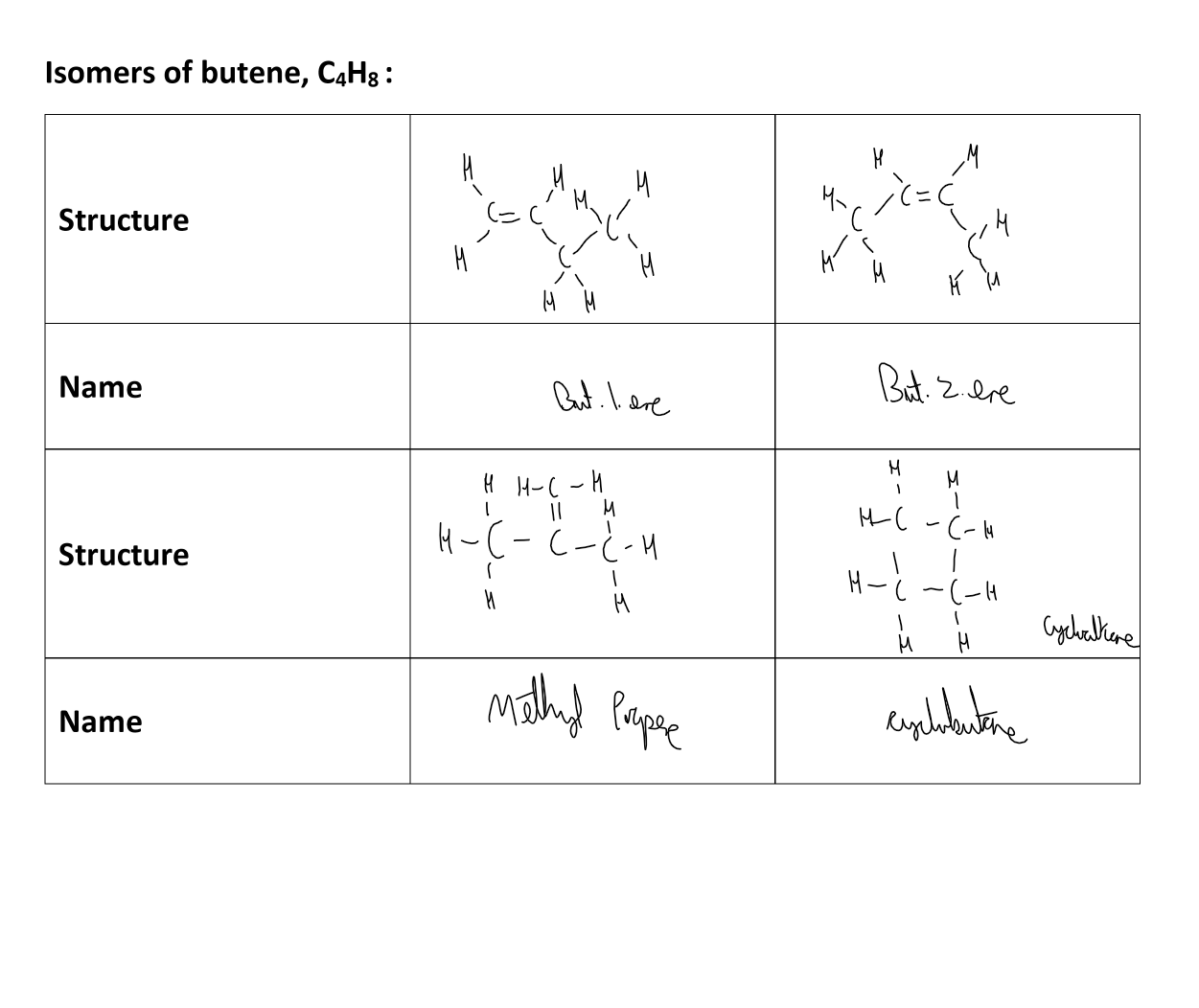
• Ethene - C₂H₄ • Propene - C₃H₆ • Butene - C₄H₈ • Pentene - C₅H₁₀ Make sure you know how to draw their displayed formulae
How do you name isomers of alkenes? Just flip over
As shown: Make sure you understand
What type of reaction is the reaction between alkenes and bromine?
Addition
What is the word and symbol equation for alkenes reacting with bromine? (Using ethene as an example)
• Ethene + Bromine –> 1,2-Dibromoethane • C₂H₄ + Br₂ –> C₂H₄Br₂ • The double bond opens up, allowing the two carbon atoms to bond to another atom each • The 1,2 indicates which of the carbon atoms along the chain has bromine bonded to it
What is the test to distinguish between an alkane and an alkene and why are the results the way they are?
• Add bromine water, an orange solution to the sample of either an alkene or an alkane • If it is added to an alkene, the solution will go colourless, if it is added to an alkane, nothing will happen and the solution will remain orange • This is because alkenes are unsaturated, so can accept bromine in an addition reaction forming a colourless solution, however alkanes are saturated, so there is no reaction and it stays orange • Both alkanes and alkenes are colourless to begin with • A flame test can also be used where alkenes burn with a smoky flame and alkanes with a less smoky one