Structure of Crystalline Solids
No description yet. This curated deck is ready for daily study.
Card preview (22)
What are crystalline materials?
Crystalline materials have atoms situated in a periodic 3D array over large atomic distances. • Examples include metals and most ceramics. • Properties such as ductility and density depend on the crystal structure of the material.
What are amorphous materials?
Amorphous materials have no periodic packing / long-range order. • Examples include glasses, plastics and other rapidly cooled materials. • Sometimes known as non-crystalline.
How are polycrystalline materials formed?
• ‘Nuclei’ form during solidification, each of which grow into crystals. • These grains are separated by amorphous grain boundaries.
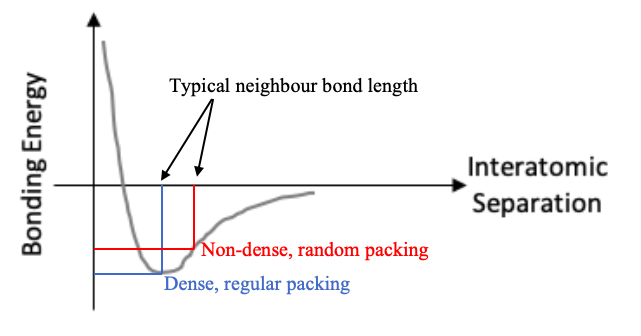
How does the density/packing of a material affect its bonding energy.
• Dense, regularly packed materials have a high bonding energy. • Non-dense, randomly packed materials have a low bonding energy.
What is a unit cell?
A unit cell is the smallest repeating arrangement of a material.
What is the coordination number (CN)?
The number of nearest neighbours or touching atoms.
What is the atomic packing factor (APF)?
The volume of atoms within a unit cell.
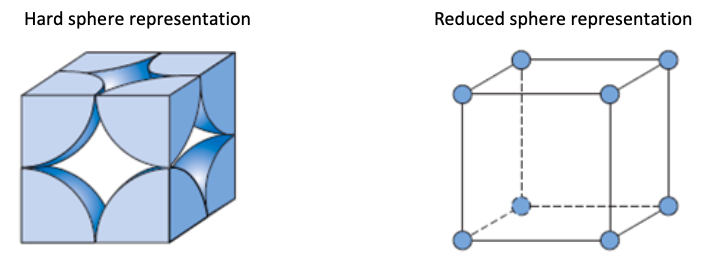
What is a simple cubic (SC) structure?
• Close packing direction is on the cube edges • CN = 6 • APF = 0.52 • Rare, only Po has this structure
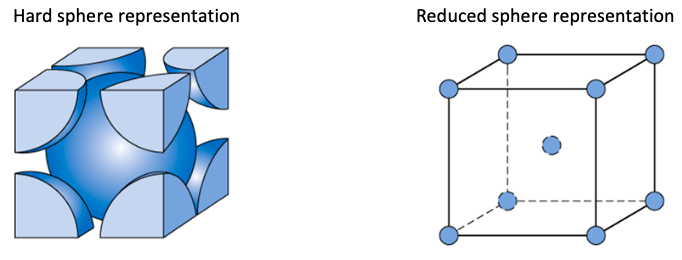
What is a body centred cubic (BCC) structure?
• Close packing direction is in the body diagonal • CN = 8 • APF = 0.68 • Slip systems = 6 x 2 = 12 • E.g. chromium, a-iron, tungsten
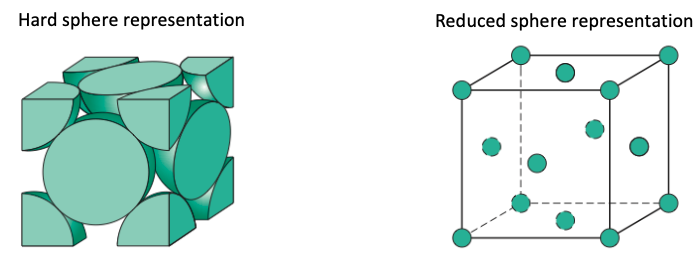
What is a face centred cubic (FCC) structure?
• Close packing direction is on the face diagonal • CN = 12 • APF = 0.74 • Slip systems = 4 x 3 = 12 • E.g. copper, aluminium, gold, (ductile materials)
What is a hexagonal close packed (HCP) structure?
• CN = 12 • APF = 0.74 • Slip systems = 3 • E.g. cadmium, magnesium, titanium, (non-ductile materials)
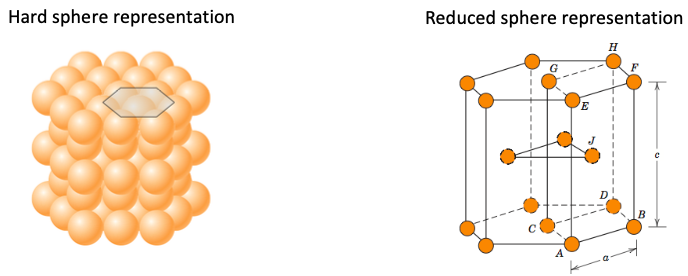
What are slip systems?
Slip systems = slip planes x slip directions • Slip planes are the most densely packed plane of the unit cell. • Slip occurs on specific atomic planes and in specific slip directions. • Ductility is linked to the crystal structure and close packed planes.
What are single-crystalline materials?
Single crystal materials ones where the repeating arrangements of atoms are perfect and extend throughout the entire specimen. • Benefit electronic and optical materials • Improve strength. • Anisotropic meaning properties vary with direction.
What are poly-crystalline materials?
• Isotropic if grains are randomly orientated. • Anisotropic if grains are textured.
What is the difference between isotropic and anisotropic materials?
• Isotropic = properties do not vary with direction. • Anisotropic = properties vary with direction.
What are the different types of defect?
Point defects (0D): • Vacancy atoms • Interstitial atoms • Substitutionary atoms Line defects (1D): • Dislocations Area defects (2D): • Grain boundaries Volume defects (3D): • Precipitates • Cracks • Porosity
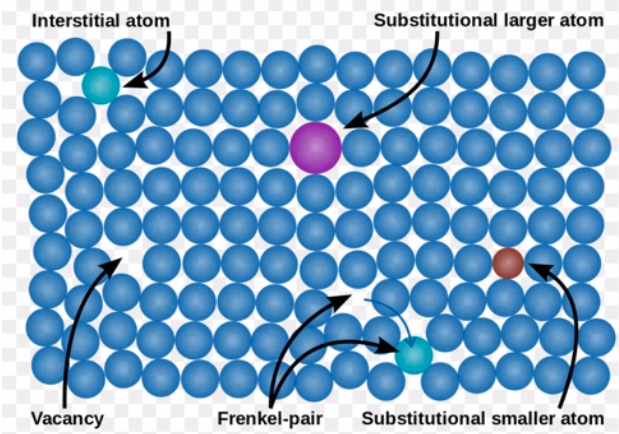
What is the effect of dislocations / imperfections on a material?
It affects many of the important properties of a material.
What are the different types of line defects?
• Edge dislocation • Screw dislocation • Dislocations are mobile under applied stress and move by incrementally breaking and remaking bonds. • If a large number of dislocations are present, plastic deformation will occur in metals and alloys.
How are dislocations affected in different types of material?
Metals: • Dislocation is easy as bonding is non-directional. Covalent ceramics: • Dislocation is hard due to directional bonding. Ionic ceramics: • Dislocation is hard as it would produce +/+ and -/- neighbouring atoms which repel each other.
What is the dislocation density?
• The total dislocation length per unit volume of a material, or the number of dislocations that intersect a unit area of random section. • The dislocation density typically determines the strength of a material.
What are the different types of area defects?
• Grain boundaries are the regions found between two crystals where there is a transition from the lattice of one crystal to that of another. • The angle of misalignment acts as a measure of dislocation.
What are the different types of volume defects?
• Cracks affect brittle metals. • Porosity can be introduced into ceramics and metals.