Exam 2 Lecture 9/25
暂无描述。系统推荐的高质量记忆内容,适合每天坚持背诵学习。
卡片预览 (24 张)
Kinetic theory of matter
-prediction of how matter should behave -all mater is made up of moving particles -phase changes occur with increases in kinetic energy (typically heat)
Potential energy
stored energy (top of rollercoaster)
Kinetic energy
energy in motion (rollercoaster coming down)
Characteristics of Gases
-Physical properties of gases are similar -composed of nonmetallic elements (simple formulas, low molar masses) -gases expand to fill container, very compressible -two or more gases are homogeneous mixture
Kinetic Theory of Gases
-combined volume of all molecules of the gas is negligible relative to total volume in which gas is contained -attractive/repulsive forces between gas molecules are weak -kinetic energy of gas is dependent on temperature
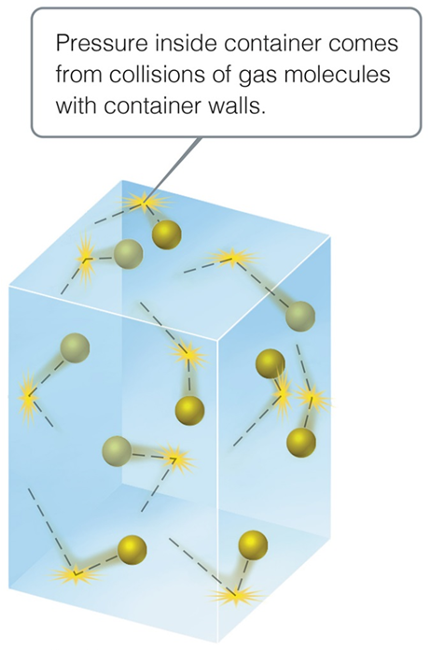
Molecular speed
-temperature is related to the average kinetic energy -individual molecules can have different speeds
µrms
at any given temp, average kinetic energy is the same

R is what
gas constant 0.08206 L atm/mol K
Kelvin
Temperature C+ 273.15 = K
Pressure conversions
given in atmosphere (atm) 1 atm = 760 mmHg; 1 atm = 760 torr; 1 atm = 1.01325 bar; 1 atm = 101,325 Pa; 1 atm = 101.325 kPa
Pressure
amount of force applied to an area

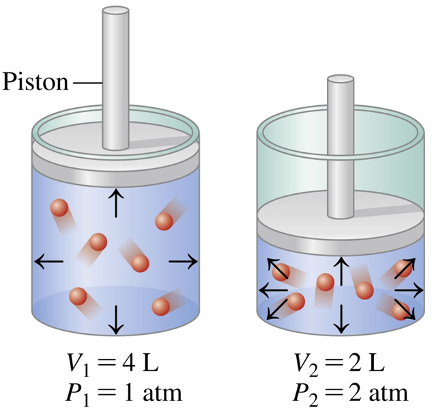
Boyle’s Law
pressure of a gas is inversely related to its volume when temp is constant P1V1 = P2V2
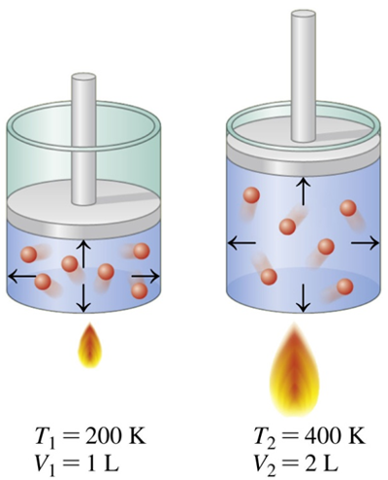
Charles’s Law
temp of a gas is directly related to volume when pressure and amount are constant V1/T1=V2/T2
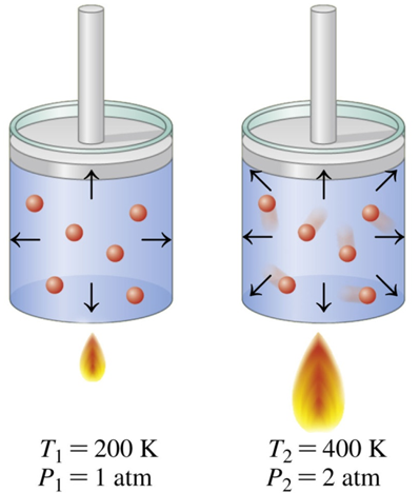
Gay-Lussac’s Law
pressure exerted by a gas is directly related to the temperature of the gas when volume and amount of gas are constant P1/T1=P2/T2
Combined Gas Law
combine Boyles, Charles, gay-lussac

Avogadro’s Law
volume of gas is directly related to amount of gas when temp and pressure are constant V1/n1=V2/n2
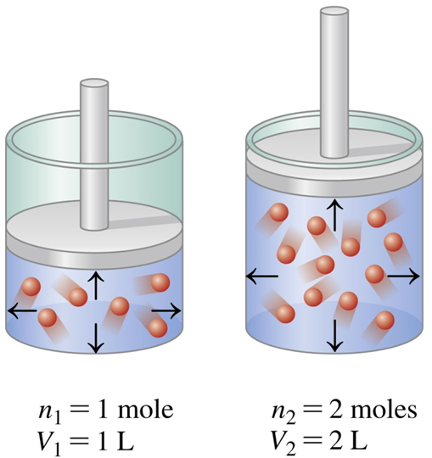
STP
standard temp and pressure 1atm, 273K (one mole of gas occupies 22.4L)
Ideal Gas Law
PV=nRT
Dalton’s law
total pressure of a mixture of gases equal the sum of pressures from each gas

Mole fraction
moles of compound/ total moles

Graham’s Law
relates molar mass of two gases to their rate of speed of travel

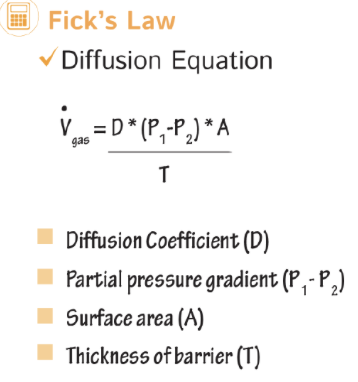
Fick’s Law (don’t need to calculate)
diffusion across a membrane
Henry’s law
solubility of a gas in a given volume of liquid is directly proportional to the partial pressure of that gas in equilibrium
van der Waals equation
the ideal gas law can be adjusted to take deviations from ideal behavior into account