Organic 16: Chromatography
No description yet. This curated deck is ready for daily study.
Card preview (20)
What is chromatography?
A family of separation techniques used to separate mixtures of substances by dissolving them in a solvent and moving it over a solid
What is a mobile phase?
The phase that carries the soluble components of the mixture up the stationary phase The solvent, or eluent, is the mobile phase
What is a stationary phase?
The phase that holds back the components attracted to it in the mixture The more affinity a component in the mixture has for the stationary phase, the slower it moves
What is the stationary phase in thin layer chromatography?
A glass, metal, or plastic plate Coated in a thin layer of silica gel (SiO2) or alumina (Al2O3)
What is the mobile phase in thin layer chromatography?
Whatever solvent is used
What are the advantages of TLC over paper chromatography?
TLC moves faster Smaller amounts can be separated Spots are more compact/specific Plates are more robust than paper
How do you calculate the Rf value?
Distance moved by spot / Distance moved by solvent
How can you locate positions of spots in TLC?
Using UV light Or chemical sprays (e.g. ninhydrin) which react with the spots to produce colours
What is the stationary phase in column chromatography?
Powder such as silica, aluminium oxide, or resin Packed into a narrow column
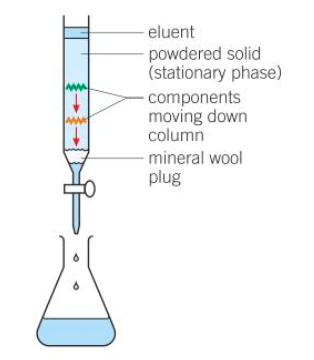
What is the mobile phase in column chromatography?
The eluent is added at the top of the column It runs down the column, bringing the components in the sample mixture with it Different substances move at different speeds And can be separated into flasks at the bottom
Why is mineral wool used in column chromatography?
Acts as support for the stationary phase Ensures uniform solvent flow, preventing mixing between the stationary phase and solvent
What is the main advantage of column chromatography?
Fairly large amounts can be separated and collected E.g. amino acids
What is the stationary phase in gas-liquid chromatography?
Powder coated with oil, either packed into or coated onto the inside of a long capillary tube up to 100m long
What is the mobile phase in gas-liquid chromatography?
Usually an unreactive gas such as nitrogen or helium After injection, the sample is carried along by the gas The mixture separates as some of the components move along with the gas and some are retained by the oil So the components leave the column at different times after injection (have different retention times)
What is the retention time in gas-liquid chromatography?
Time taken for the substance to be detected
How are the results of gas-liquid chromatography represented?
On a graph The area under each peak is proportional to the amount of each component
How are components in gas-liquid chromatography identified?
By comparing retention times with that of known substances under the same conditions Can confirm using mass spectrometer
What are the advantages of gas-liquid chromatography?
Highly sensitive Can separate minute traces of substances Used to test blood or urine for presence of drugs
How is a mass spectrometer used in gas-liquid chromatography?
GCMS A mass spectrometer is used as the detector for a gas chromatography system As each component of a mixture comes out of the gas chromatography column, the time taken to pass through is noted Each component is fed automatically into the mass spectrometer
What are the four main types of chromatography?
Paper chromatography Thin layer chromatography Column chromatography Gas-liquid chromatography